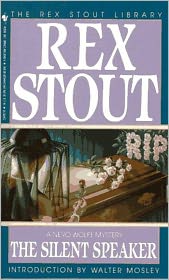
The Silent Speaker. Rex Stout. 1946/1994. Random House. 288 pages.
Seated in his giant's chair behind his desk in his office, leaning back with his eyes half closed, Nero Wolfe muttered at me:
"It is an interesting fact that the members of the National Industrial Association who were at that dinner last evening represent, in the aggregate, assets of something like thirty billion dollars."
I slid the checkbook into place on top of the stack, closed the door of the safe, twirled the knob, and yawned on the way back to my desk.
"Yes, sir," I agreed with him. "It is also an interesting fact that the prehistoric Mound Builders left more traces of their work in Ohio than in any other state. In my boyhood days--"
"Shut up," Wolfe muttered.
I let it pass without any feeling of resentment, first because it was going on midnight and I was sleepy, and second because it was conceivable that there might be some connection between his interesting fact and our previous conversation, and that was not true of mine. We had been discussing the bank balance, the reserve against taxes, expectations as to bills and burdens, one of which was my salary, and related matters. The exchequer had not swung for the third strike, but neither had it knocked the ball out of the park. After I yawned three more times Wolfe spoke suddenly and decisively.
"Archie. Your notebook. Here are directions for tomorrow."
In two minutes he had me wide awake. When he had finished and I went upstairs to bed, the program for the morning was so active in my head that I tossed and turned for a full thirty seconds before sleep came. (1-2)
I enjoyed The Black Orchid, but I really enjoyed The Silent Speaker. I just love, love, love Nero Wolfe and Archie Goodwin. Archie makes for a GREAT narrator! There's just something so delicious, so satisfying, so fun about these Nero Wolfe books. (I can't wait to read all the ones my library has!)
So in The Silent Speaker, Archie and Nero Wolfe are trying to find a way to make some money. I guess you could say they are in between detecting jobs at the moment. There's just been a high profile murder. And though they've not been hired--by any one--Archie is going around town acting like he's on the case. He's interviewing people, writing down clues, making people nervous etc. Soon he's got a handful of people thinking that Nero Wolfe is just days away from solving the crime. So Archie's acting pays off. The NIA hires Nero Wolfe to solve this murder for them. Even though several NIA employees are on the suspect list. But the truth is, Nero Wolfe isn't exactly sure WHO committed this crime. (Or is he?!) You see, there's been a reward offered--a BIG, BIG, BIG reward. And Nero Wolfe may just be out to collect it! If he can outwit the police and everyone else.
© 2011 Becky Laney of Becky's Book Reviews
Monday, May 16, 2011
Sunday, May 15, 2011
Sunday Salon: Week in Review #20
What I Reviewed at Becky's Book Reviews
Black Orchids. A Nero Wolfe Mystery. Rex Stout. 1941/1942. Random House. 208 pages.
The Good Earth. Pearl S. Buck. 1931/2004. Simon & Schuster. 368 pages.
Sons. Pearl S. Buck. 1932/2005. Moyer Bell. 320 pages.
Kinfolk. Pearl S. Buck. 1945/2004. Moyer Bell. 408 pages.
The Story of Britain From the Norman Conquest to the European Union by Patrick Dillon. 2011. Candlewick Press. 352 pages.
What I Reviewed at Young Readers
A Ball for Daisy. Chris Raschka. 2011. Random House. 32 pages.
The Watcher: Jane Goodall's Life with the Chimps. Jeannette Winter. 2011. Random House. 48 pages.
What I Reviewed at Operation Actually Read Bible
Why One Way?: Defending an Exclusive Claim in an Inclusive World. John MacArthur. 2002. Thomas Nelson. 96 pages.
© 2011 Becky Laney of Becky's Book Reviews
Black Orchids. A Nero Wolfe Mystery. Rex Stout. 1941/1942. Random House. 208 pages.
The Good Earth. Pearl S. Buck. 1931/2004. Simon & Schuster. 368 pages.
Sons. Pearl S. Buck. 1932/2005. Moyer Bell. 320 pages.
Kinfolk. Pearl S. Buck. 1945/2004. Moyer Bell. 408 pages.
The Story of Britain From the Norman Conquest to the European Union by Patrick Dillon. 2011. Candlewick Press. 352 pages.
What I Reviewed at Young Readers
A Ball for Daisy. Chris Raschka. 2011. Random House. 32 pages.
The Watcher: Jane Goodall's Life with the Chimps. Jeannette Winter. 2011. Random House. 48 pages.
What I Reviewed at Operation Actually Read Bible
Why One Way?: Defending an Exclusive Claim in an Inclusive World. John MacArthur. 2002. Thomas Nelson. 96 pages.
© 2011 Becky Laney of Becky's Book Reviews
Saturday, May 14, 2011
Library Loot: Second Trip in May
New Loot:
Bumped by Megan McCafferty
What Happened to Goodbye by Sarah Dessen
A House Divided by Pearl S. Buck
Pearl S. Buck: A Cultural Biography by Peter Conn
Pearl Buck in China: A Journey to The Good Earth by Hilary Spurling
Riding the Trail of Tears by Blake M. Hausman
The Last Brother by Nathacha Appanah; translated from the French by Geoffrey Strachan
Leftover Loot:
Peony by Pearl S. Buck
All Men are Brothers = Shui hu chuan by Shi Nai'an & Luo Guanzhong, translated from the Chinese by Pearl S. Buck
Three at Wolfe's Door: A Nero Wolfe Threesome by Rex Stout
Some Buried Caesar; The Golden Spiders by Rex Stout
The Joy Luck Club by Amy Tan
Death of a Doxy by Rex Stout
The Mother by Pearl S. Buck
Three Daughters of Madame Liang by Pearl S. Buck
Pavilion of Women by Pearl S. Buck
The New Year by Pearl S. Buck
The Promise by Pearl S. Buck
Imperial Woman by Pearl S. Buck
Dragon Seed by Pearl S. Buck
The Living Reed by Pearl S. Buck
Mandala by Pearl S. Buck
Library Loot is a weekly event co-hosted by Claire and Marg that encourages bloggers to share the books they’ve checked out from the library. If you’d like to participate, just write up your post-feel free to steal the button-and link it using the Mr. Linky any time during the week. And of course check out what other participants are getting from their libraries.
© 2011 Becky Laney of Becky's Book Reviews
Bumped by Megan McCafferty
What Happened to Goodbye by Sarah Dessen
A House Divided by Pearl S. Buck
Pearl S. Buck: A Cultural Biography by Peter Conn
Pearl Buck in China: A Journey to The Good Earth by Hilary Spurling
Riding the Trail of Tears by Blake M. Hausman
The Last Brother by Nathacha Appanah; translated from the French by Geoffrey Strachan
Leftover Loot:
Peony by Pearl S. Buck
All Men are Brothers = Shui hu chuan by Shi Nai'an & Luo Guanzhong, translated from the Chinese by Pearl S. Buck
Three at Wolfe's Door: A Nero Wolfe Threesome by Rex Stout
Some Buried Caesar; The Golden Spiders by Rex Stout
The Joy Luck Club by Amy Tan
Death of a Doxy by Rex Stout
The Mother by Pearl S. Buck
Three Daughters of Madame Liang by Pearl S. Buck
Pavilion of Women by Pearl S. Buck
The New Year by Pearl S. Buck
The Promise by Pearl S. Buck
Imperial Woman by Pearl S. Buck
Dragon Seed by Pearl S. Buck
The Living Reed by Pearl S. Buck
Mandala by Pearl S. Buck
Library Loot is a weekly event co-hosted by Claire and Marg that encourages bloggers to share the books they’ve checked out from the library. If you’d like to participate, just write up your post-feel free to steal the button-and link it using the Mr. Linky any time during the week. And of course check out what other participants are getting from their libraries.
© 2011 Becky Laney of Becky's Book Reviews
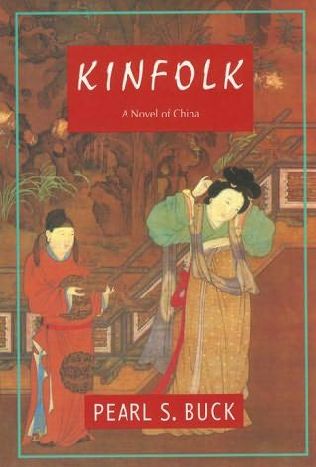
Kinfolk
Kinfolk. Pearl S. Buck. 1945/2004. Moyer Bell. 408 pages.
The theater in Chinatown was crowded to the doors. Every night actors brought from Canton played and sang the old Chinese operas. If Billy Pan, the manager, announced a deficit at the end of the lunar year, businessmen contributed money to cover it. The theater was a bulwark of home for them. Their children went to American schools, spoke the American language, acted like American children. The fathers and mothers were not highly educated people and they could not express to the children what China was, except that it was their own country, which must not be forgotten. But in the theater the children could see for themselves what China was. Here history was played again and ancient heroes came to life before their eyes. It was the only place in Chinatown which could compete with the movies. Parents brought their children early and stayed late. They talked with friends and neighbors, exchanged sweetmeats and gossip, and sat spellbound and dreaming when the curtain went up to show the figures who were contemporary with their ancestors.
As much as I just loved and adored East Wind: West Wind--my very first Pearl S. Buck novel--I just LOVED, LOVED, LOVED Kinfolk. It is so very different from The Good Earth and Sons. While I struggled to find anyone sympathetic in The Good Earth and Sons, I could name half a dozen characters (if not more) that I liked, loved, respected, or admired in Kinfolk. And here's the thing, even the characters that I didn't necessarily "like", I found them to be well-developed, complex. Unlike the often nameless one-dimensional characters in The Good Earth and Sons. And the language, the style. It wowed me. It really did! So much to love and appreciate.
Kinfolk is about the Liang family. Dr. Liang, the father, is a scholar who fled China because it was getting to be too harsh, too ugly, too dangerous, too uncertain. He's a scholar, a teacher, a thinker, a philosopher. He needs peace and quiet and rest. He needs to be surrounded by people who appreciate his intellect, his superiority. (And does he ever think he's superior to just about anyone who's ever lived.) His wife, well, she "appreciates" him as best she can. Knowing that he can be oh-so-difficult to live with. But knowing that it is her place to bring out the best in him. To calm him when he gets furious or frustrated. But this isn't always easy since he doesn't respect her or see her as someone worthy of love and respect. She's the mother of his children. But. That's about it. He doesn't feel like she's intellectually or emotionally his soul mate. And he doesn't see any need to treat her as if she was the love of his life. It's her job to appreciate him, not the other way round.
So the Liangs have four children--two of the children were born in China, two of the children were born in America--James and Mary are the oldest, Peter and Louise are the youngest. James and Mary have a deep longing to return to China, to make their home, their future in China. They know it won't be easy. They know it will require sacrifice and hard work. But neither James or Mary would want to live anywhere else. They wouldn't trade the hardships, the uncertainties for anything because they feel like China is where they belong. James is already having to sacrifice his first love, Lili, because she doesn't share his dream, his vision. She wants to be American, a rich American. James, a doctor, is the first to make the trip. He'll be working in Peking in a hospital. While James knew that Mary was planning on coming to China herself--at some point. He never expected to be joined by Mary and Peter and Louise. But Louise, unfortunately, has a love affair with an American. A love affair which her father found out about. (Louise and Peter are--at least in their parents' opinion--too American.) So Mary, Louise, and Peter are sent away--Louise in disgrace, Mary because that is where she most wants to be, and Peter because his father is afraid of any of his children becoming too American that they begin to lose who they are or who they are supposed to be. Their morals, their values. (It's fine for Americans to act that way, they're American, what do you expect? But you--you shouldn't be acting like that.)
Each responds differently to their new lives in China. Mary loves it but wants even more--she wants to return to their family's ancestral village, she wants to be among the people--the commoners, the peasants, the people that live on the land, work the land, depend on the land for life itself. She wants to bring change, she wants to bring education, she wants to teach them to read and write. Louise is absolutely miserable. Doesn't see any reason why she should have to be in China when she could be living the good life in America if her parents weren't so unreasonable and old-fashioned. But she becomes hopeful when she meets an American man! Could this be her big chance? Peter. Well. Peter sees China and is shocked. The real China is so very far-removed from anything his father has ever told him, taught him, he can only see his father as a big liar, a man out of touch with reality, a man living in his own little dream world. So the real China makes him angry at his father, angry at himself, angry with the whole world. Nothing is as it should be. And he's going to be angry about it for a long, long, long time.
And James, our hero, the man who may just be the most important in Kinfolk, well, he loves China. He shares his sister's dream of returning to their ancestral village, and living with their Uncle Tao and his family. He knows it won't be easy to convince these villagers, these peasants, these farmers that Western medicine is good. That he can heal them, cure them, give them a chance to live life well and healthy. And Uncle Tao may be the one that needs the most convincing. Since James knows that his uncle needs surgery to remove a tumor. But. He knows that China is where he belongs. That China is his destiny, his future. For better or worse. For richer or poorer. James is going to be with the people of China.
We also meet Chen, a fellow doctor, a man who becomes very close with the Liang family. (He's a character that I found so easy to love!) And then there's Young Wang, another man James meets when he's new-to-China. A man that becomes a servant but so much more than a servant. A true friend and guardian to the family.
Much of Kinfolk is set in China. But. We never quite lose touch with the parents in New York. Even separated by all those miles, there's tension between the parents and children.
I absolutely loved James and Mary and Chen and Young Wang. I just LOVED them. And even the characters that I didn't love, I found them to be well-developed and human. I think they could even be studied perhaps. (Kinfolk was one of the novels that I read it and found myself thinking, I could write a dozen papers about this one. It's just that good, that rich, that well-written, that interesting.) It was compelling. It was thought-provoking. It was a marvelous book.
So if the only Pearl S. Buck you've ever read was The Good Earth, I'd urge you to please pick up one of her other books. A book like Kinfolk or East Wind: West Wind. Because you need to give her another try.
Favorite quotes:
James on why he needs to return to China now:
James trying to convince Lili to join him in China:
James trying to decide if he's ready to make the leap:
James speaking to Louise about her disappointing love affair:
Dr. Liang (the father) on the necessity of having peasants:
And this is just one of the reasons why he can't understand his children, and why his children can't understand him.
One of the reasons why I loved Chen:
Dr. Liang reflecting on the past:
James and Mary and Chen reflecting together:
© 2011 Becky Laney of Becky's Book Reviews
The theater in Chinatown was crowded to the doors. Every night actors brought from Canton played and sang the old Chinese operas. If Billy Pan, the manager, announced a deficit at the end of the lunar year, businessmen contributed money to cover it. The theater was a bulwark of home for them. Their children went to American schools, spoke the American language, acted like American children. The fathers and mothers were not highly educated people and they could not express to the children what China was, except that it was their own country, which must not be forgotten. But in the theater the children could see for themselves what China was. Here history was played again and ancient heroes came to life before their eyes. It was the only place in Chinatown which could compete with the movies. Parents brought their children early and stayed late. They talked with friends and neighbors, exchanged sweetmeats and gossip, and sat spellbound and dreaming when the curtain went up to show the figures who were contemporary with their ancestors.
As much as I just loved and adored East Wind: West Wind--my very first Pearl S. Buck novel--I just LOVED, LOVED, LOVED Kinfolk. It is so very different from The Good Earth and Sons. While I struggled to find anyone sympathetic in The Good Earth and Sons, I could name half a dozen characters (if not more) that I liked, loved, respected, or admired in Kinfolk. And here's the thing, even the characters that I didn't necessarily "like", I found them to be well-developed, complex. Unlike the often nameless one-dimensional characters in The Good Earth and Sons. And the language, the style. It wowed me. It really did! So much to love and appreciate.
So the Liangs have four children--two of the children were born in China, two of the children were born in America--James and Mary are the oldest, Peter and Louise are the youngest. James and Mary have a deep longing to return to China, to make their home, their future in China. They know it won't be easy. They know it will require sacrifice and hard work. But neither James or Mary would want to live anywhere else. They wouldn't trade the hardships, the uncertainties for anything because they feel like China is where they belong. James is already having to sacrifice his first love, Lili, because she doesn't share his dream, his vision. She wants to be American, a rich American. James, a doctor, is the first to make the trip. He'll be working in Peking in a hospital. While James knew that Mary was planning on coming to China herself--at some point. He never expected to be joined by Mary and Peter and Louise. But Louise, unfortunately, has a love affair with an American. A love affair which her father found out about. (Louise and Peter are--at least in their parents' opinion--too American.) So Mary, Louise, and Peter are sent away--Louise in disgrace, Mary because that is where she most wants to be, and Peter because his father is afraid of any of his children becoming too American that they begin to lose who they are or who they are supposed to be. Their morals, their values. (It's fine for Americans to act that way, they're American, what do you expect? But you--you shouldn't be acting like that.)
Each responds differently to their new lives in China. Mary loves it but wants even more--she wants to return to their family's ancestral village, she wants to be among the people--the commoners, the peasants, the people that live on the land, work the land, depend on the land for life itself. She wants to bring change, she wants to bring education, she wants to teach them to read and write. Louise is absolutely miserable. Doesn't see any reason why she should have to be in China when she could be living the good life in America if her parents weren't so unreasonable and old-fashioned. But she becomes hopeful when she meets an American man! Could this be her big chance? Peter. Well. Peter sees China and is shocked. The real China is so very far-removed from anything his father has ever told him, taught him, he can only see his father as a big liar, a man out of touch with reality, a man living in his own little dream world. So the real China makes him angry at his father, angry at himself, angry with the whole world. Nothing is as it should be. And he's going to be angry about it for a long, long, long time.
And James, our hero, the man who may just be the most important in Kinfolk, well, he loves China. He shares his sister's dream of returning to their ancestral village, and living with their Uncle Tao and his family. He knows it won't be easy to convince these villagers, these peasants, these farmers that Western medicine is good. That he can heal them, cure them, give them a chance to live life well and healthy. And Uncle Tao may be the one that needs the most convincing. Since James knows that his uncle needs surgery to remove a tumor. But. He knows that China is where he belongs. That China is his destiny, his future. For better or worse. For richer or poorer. James is going to be with the people of China.
We also meet Chen, a fellow doctor, a man who becomes very close with the Liang family. (He's a character that I found so easy to love!) And then there's Young Wang, another man James meets when he's new-to-China. A man that becomes a servant but so much more than a servant. A true friend and guardian to the family.
Much of Kinfolk is set in China. But. We never quite lose touch with the parents in New York. Even separated by all those miles, there's tension between the parents and children.
I absolutely loved James and Mary and Chen and Young Wang. I just LOVED them. And even the characters that I didn't love, I found them to be well-developed and human. I think they could even be studied perhaps. (Kinfolk was one of the novels that I read it and found myself thinking, I could write a dozen papers about this one. It's just that good, that rich, that well-written, that interesting.) It was compelling. It was thought-provoking. It was a marvelous book.
So if the only Pearl S. Buck you've ever read was The Good Earth, I'd urge you to please pick up one of her other books. A book like Kinfolk or East Wind: West Wind. Because you need to give her another try.
Favorite quotes:
James on why he needs to return to China now:
He had never said even to Mary that in some deeply repressed corner of his being he grieved that his own father had chosen to live in exile during the years of the their country's hardship. He knew all the arguments, that a scholar could not work in the midst of turmoil and war. He believed these arguments were true. He knew that his father's delicately balanced mind needed safety and quiet and security in order to do its work. But he had long ago determined that he would work where he was most needed, in the midst of turmoil, even in war. He would not allow his mind to be delicate nor his heart remote. (40)
James trying to convince Lili to join him in China:
"Try to understand how I feel. Our people are good--our people are wonderful. China is great. She is not really weak. She is only in distress. All the great strength is simply waiting until we come to her help. She has lived in an old, old world and she needs to be born into the new one. I am a doctor and I think naturally in terms of birth--of bringing forth life--" (44)
James trying to decide if he's ready to make the leap:
The city was full of such brawls. There were too many starving people, and policemen treated them as criminals. Perhaps they were. There was no line between starvation and crime. He felt himself torn in the division of reality. The world, the whole world, was divided into two parts, the island of the rich and the ocean of the poor. Where would he live? He still had his feet on the island, but he was facing the rough dark waters. He must go back--or else he must leap. (65)
James speaking to Louise about her disappointing love affair:
"All this," he said after a moment, "is because you have let yourself fall in love with an American. At your age love shapes the universe."On differences between the generations, the 'war' between old and new:
She continued to sob, and he went on gently. "I know, too, what it is to love someone. I think I loved Lili with all my heart. Even now when I know we shall never marry, when I think of her, or someone speaks her name, the world trembles. But it does not crash about me. I know there is a life that must be lived happily without Lili. (166)
There was a world of difference between themselves and these kinfolk, centuries of difference, space and time crowded into a single generation. (209)
Dr. Liang (the father) on the necessity of having peasants:
People, he reflected, must live at these different levels. Some must work with the hands, some with the mind. The peasants should not be lifted from their places as workers with the hands, or the higher ones would starve. He himself would, if he lived in China, be quite helpless without the peasants. Even here, he supposed, there were the workers with hands, men on American farms who had to do the crude work of producing food. Such persons must not be taught falsely that they could or should do other work. (228)
And this is just one of the reasons why he can't understand his children, and why his children can't understand him.
One of the reasons why I loved Chen:
"It takes a certain kind of person to live in China now," Chen mused.
"What kind of person?" Mary asked.
"Someone who can see true meanings, someone who does not only want the world better but believes it can be made better, and gets angry because it is not done, someone who is not willing to hide himself in one of the few good places left in the world--someone who is tough!" (251)
Dr. Liang reflecting on the past:
But he had wanted the children to understand the glory of China, the honor, the dignity of an ancient race and country. He himself purposefully dwelled upon these things. It was necessary to do this in order to have a perspective upon the disagreeable present. The present was always transient. It faded away. Only the past and future were eternal. Therefore he had done well to teach his children of their people's greatness. It was what Confucius himself had taught. Confucius too had lived in troubled and divided times, and he had not allowed himself to be troubled or divided. Instead he had gathered together all the greatness of the ancients and he had put this greatness into a book which had lived through the ages. (303)
James and Mary and Chen reflecting together:
The weight of their country, vast and old, lay heavy upon them all, and they were of such conscience that they could not escape.
"What Peter could not see," James said at last, "was that destruction does not heal. For what can be destroyed except people? Yet the people are the treasure store of the nation."
"And our people are good," Chen said.
"I tell you ours are the best people in the world..." (315)
© 2011 Becky Laney of Becky's Book Reviews
Labels:
1945,
adult fiction,
classics,
library book,
literary fiction,
Pearl Buck
Friday, May 13, 2011
Sons
Sons. Pearl S. Buck. 1932/2005. Moyer Bell. 320 pages.
Wang Lung lay dying. He lay dying in his small, dark, old earthen house in the midst of his fields, in the room where he had slept as a young man, upon the very bed where he had lain on his marriage night.
Sons is the second novel in Pearl S. Buck's Good Earth Trilogy. While the first novel chronicled the life of the farmer, Wang Lung, the second book chronicles the lives of Wang Lung's three sons: Wang the Eldest (also known as, Wang the Landlord), Wang the Second, (also known as, Wang the Merchant), and Wang the Third (also known as, Wang the Tiger). These are the same three sons that were nameless in The Good Earth.
If Sons has a main character, it is the youngest of Wang Lung's sons, Wang the Tiger. This is the 'rebellious' son that left home when his father took his third woman, Pear Blossom, in old age. The son that left home to become a soldier. If his father's ambition was to buy good land, to create a lasting legacy for his sons, Wang the Tiger's ambition is to be a great war lord, to collect an army--a well-trained, trustworthy army--and to make a name for himself. The book follows his life over several decades. We follow him on his ambitious journey. We witness his crimes in the name of justice--murdering robbers and bandits, murdering traitors in his own army, murdering the opposition. Wang the Tiger being just one of many war lords who choose to go to battle in the spring of each year. (And it really did seem that random. Who are we going to go fight this year? Okay! Let's go!) If there was logic involved in the warring, I missed it. I mean it was "I want more power, more land, more glory, more people paying taxes TO ME" which turned into who do I kill to get what I want. (Or at the very least who would I be willing to kill if he doesn't feel like surrendering to me.)
For the first two-thirds of the novel, Wang the Tiger believes that he will never get married, that he'll never have sons of his own. But. As he gets a little older, he begins to see things differently. He begins to want a son of his own. A son to be a great soldier, a great leader, a great war lord. His ambitions turn from himself to his son. So he asks his two brothers for help. Each brother selects a wife for him. And Wang the Tiger does not have a favorite wife--he barely recognizes that they have faces and are capable of speech. (Yes, it really is that bad.) One wife gives birth to a daughter, another gives birth to a son. (I don't believe the wives or the sons have names. Though I could be wrong about the son. Chances are he'll have a name in the next novel, A House Divided.)
So do you think that this son will grow up to please his father in every way? Or will this rebellious son have a rebellious son of his own?
This novel doesn't exclusively focus on Wang the Tiger. We also learn about Wang the Landlord, his two wives (still nameless), his sons and daughters (also nameless) and Wang the Merchant, his wife (still nameless), and their children (also nameless). We see their strengths and weaknesses. We see how these brothers relate to one another--on the rare occasions they come together. It's interesting to see how the brothers treat Wang the Tiger. When his future is still uncertain, when his army is unproved, the two are very reluctant to ally themselves with him. But when things change, then they definitely change the way they treat him!
I'm not sure that I "liked" any of the characters in this one. Wang the Tiger can be fierce and cruel when angry. And sometimes his anger is justifiable. But not always. And Wang the Tiger sees himself as being too soft--not hard enough, not cruel enough. He feels that he should be able to kill on a whim without having to be good and angry first. He wishes that he didn't feel what (little) he feels. He's definitely VERY different from Wang Lung. As for Wang the Merchant and Wang the Landlord, I feel what we get are mostly one-dimensional portraits. Wang the Landlord is given to pleasure--selfish pleasure. He doesn't know how to say no--when it comes to himself, when it comes to his eldest son, when it comes to pleasing his two wives and keeping peace in the house. He spends money freely, recklessly. And he has no great ambition in life other than to feel pleasure at every opportunity. Wang the Merchant, on the other hand, is greedy--but in a different way. He's a shrewd business man. He wants to make as much money as possible. He's not above using guile if it helps him make a bit more money with each transaction. He does not want money so he can spend it. He does not believe in needlessly spending money--just because you have it, just because you can, just to show other people how much you've got. He's practical. He's got a plan. Wang the Tiger definitely has thoughts about each of his brothers!
I'm not sure I'd recommend The Good Earth and Sons. But if you've read The Good Earth, I would recommend--unless you ABSOLUTELY hated it--continuing on with the series. It is interesting to see how these two books contrast one another, and to see the family drama continue through a second generation.
© 2011 Becky Laney of Becky's Book Reviews
Wang Lung lay dying. He lay dying in his small, dark, old earthen house in the midst of his fields, in the room where he had slept as a young man, upon the very bed where he had lain on his marriage night.
Sons is the second novel in Pearl S. Buck's Good Earth Trilogy. While the first novel chronicled the life of the farmer, Wang Lung, the second book chronicles the lives of Wang Lung's three sons: Wang the Eldest (also known as, Wang the Landlord), Wang the Second, (also known as, Wang the Merchant), and Wang the Third (also known as, Wang the Tiger). These are the same three sons that were nameless in The Good Earth.
If Sons has a main character, it is the youngest of Wang Lung's sons, Wang the Tiger. This is the 'rebellious' son that left home when his father took his third woman, Pear Blossom, in old age. The son that left home to become a soldier. If his father's ambition was to buy good land, to create a lasting legacy for his sons, Wang the Tiger's ambition is to be a great war lord, to collect an army--a well-trained, trustworthy army--and to make a name for himself. The book follows his life over several decades. We follow him on his ambitious journey. We witness his crimes in the name of justice--murdering robbers and bandits, murdering traitors in his own army, murdering the opposition. Wang the Tiger being just one of many war lords who choose to go to battle in the spring of each year. (And it really did seem that random. Who are we going to go fight this year? Okay! Let's go!) If there was logic involved in the warring, I missed it. I mean it was "I want more power, more land, more glory, more people paying taxes TO ME" which turned into who do I kill to get what I want. (Or at the very least who would I be willing to kill if he doesn't feel like surrendering to me.)
For the first two-thirds of the novel, Wang the Tiger believes that he will never get married, that he'll never have sons of his own. But. As he gets a little older, he begins to see things differently. He begins to want a son of his own. A son to be a great soldier, a great leader, a great war lord. His ambitions turn from himself to his son. So he asks his two brothers for help. Each brother selects a wife for him. And Wang the Tiger does not have a favorite wife--he barely recognizes that they have faces and are capable of speech. (Yes, it really is that bad.) One wife gives birth to a daughter, another gives birth to a son. (I don't believe the wives or the sons have names. Though I could be wrong about the son. Chances are he'll have a name in the next novel, A House Divided.)
So do you think that this son will grow up to please his father in every way? Or will this rebellious son have a rebellious son of his own?
This novel doesn't exclusively focus on Wang the Tiger. We also learn about Wang the Landlord, his two wives (still nameless), his sons and daughters (also nameless) and Wang the Merchant, his wife (still nameless), and their children (also nameless). We see their strengths and weaknesses. We see how these brothers relate to one another--on the rare occasions they come together. It's interesting to see how the brothers treat Wang the Tiger. When his future is still uncertain, when his army is unproved, the two are very reluctant to ally themselves with him. But when things change, then they definitely change the way they treat him!
I'm not sure that I "liked" any of the characters in this one. Wang the Tiger can be fierce and cruel when angry. And sometimes his anger is justifiable. But not always. And Wang the Tiger sees himself as being too soft--not hard enough, not cruel enough. He feels that he should be able to kill on a whim without having to be good and angry first. He wishes that he didn't feel what (little) he feels. He's definitely VERY different from Wang Lung. As for Wang the Merchant and Wang the Landlord, I feel what we get are mostly one-dimensional portraits. Wang the Landlord is given to pleasure--selfish pleasure. He doesn't know how to say no--when it comes to himself, when it comes to his eldest son, when it comes to pleasing his two wives and keeping peace in the house. He spends money freely, recklessly. And he has no great ambition in life other than to feel pleasure at every opportunity. Wang the Merchant, on the other hand, is greedy--but in a different way. He's a shrewd business man. He wants to make as much money as possible. He's not above using guile if it helps him make a bit more money with each transaction. He does not want money so he can spend it. He does not believe in needlessly spending money--just because you have it, just because you can, just to show other people how much you've got. He's practical. He's got a plan. Wang the Tiger definitely has thoughts about each of his brothers!
I'm not sure I'd recommend The Good Earth and Sons. But if you've read The Good Earth, I would recommend--unless you ABSOLUTELY hated it--continuing on with the series. It is interesting to see how these two books contrast one another, and to see the family drama continue through a second generation.
© 2011 Becky Laney of Becky's Book Reviews
Labels:
1932,
adult fiction,
classics,
Historical Fiction,
library book,
Pearl Buck
Subscribe to:
Posts (Atom)