Showing posts with label 1946. Show all posts

Wednesday, June 28, 2017

The Pianist

The Pianist. Wladyslaw Szpilman. Translated by Anthea Bell. 1946/1999. 222 pages. [Source: Library]

First sentence: I began my wartime career as a pianist in the Cafe Nowoczesna, which was in Nowolipki Street in the very heart of the Warsaw ghetto.

Premise/plot: In 1946, I believe, Wladyslaw Szpilman published a memoir sharing his story of how he survived the war. The book was later translated into English and began to include extracts from the diary of Captain Wilm Hosenfeld. The book did inspire a film, and, the film won lots of awards. As for the contents of the book, the life he led during the war, the near-death encounters he experienced, the physical and emotional trials--shocks--he endured, I'm near speechless. His style is matter-of-fact. It is rich in detail that would have been fresh on his mind, but, his intention was not to shock or manipulate to gain sympathy. It is very unemotional. It isn't a book of feelings or emotions. It isn't a diary he recorded day-by-day that captures the in-the-moment horrors of the war.

My thoughts: I read this one before I watched the movie. I am glad I read it first. If it had packed the emotional punch of the movie though, I'm not sure I could have endured it. It isn't that the movie portrays things differently. In fact, one of the things I noticed almost immediately was how true-to-the-book it was. It was that by visualizing it--seeing it, hearing it--changes things. For example, the violence, the destruction, the horror of it all. If you've seen the movie, chances are you know what I'm talking about. There are dramatic, traumatic scenes that words just can't do justice to. At times I watched the movie almost in shock that humans could treat each other like this, that so much hatred could exist, that the world could be unjust. But then I'd switch from the movie to the news, and, it was all reaffirmed.

The movie is not devoid of hope, nor should it be. If its about humanity--it shows us at our best and at our worst. There is good to be found as well as evil. There are kind, generous, loving people as well as monsters.


© 2017 Becky Laney of Becky's Book Reviews

Wednesday, February 22, 2017

Hiroshima

Hiroshima. John Hersey. 1946/1989. 152 pages. [Source: Bought]

First sentence: At exactly fifteen minutes past eight in the morning on August 6, 1945, Japanese time, at the moment when the atomic bomb flashed above Hiroshima, Miss Toshiko Sasaki, a clerk in the personnel department of the East Asia Tin Works, had just sad down at her place in the plant office and was turning her head to speak to the girl at the next desk. At that same moment, Dr. Masakazu Fujii was settling down cross-legged to read the Osaka Asabi on the porch of his private hospital, overhanging one of the seven deltaic rivers which divide Hiroshima; Mrs. Hatsuyo Nakamura, a tailor's widow, stood by the window of her kitchen, watching a neighbor tearing down his house because it lay in the path of an air-raid defense fire lane; Father Wilhelm Kleinsorge, a German priest of the Society of Jesus, reclined in his underwear on a cot on the top floor of his order's three story mission house, reading a Jesuit magazine, Stimmen der Zeit; Dr. Terufumi Sasaki, a young member of the surgical staff of the city's large, modern Red Cross Hospital, walked along one of the hospital corridors with a blood specimin for a Wassermann test in his hand; and the Reverend Mr. Kiyoshi Tanimoto, pastor of the Hiroshima Methodist Church, paused at the door of a rich man's house in Koi, the city's western suburb, and prepared to unload a handcart full of things he had evacuated from town in fear of the massive B-29 raid which everyone expected Hiroshima to suffer. A hundred thousand people were killed by the atomic bomb and these six were among the survivors.

Premise/plot: Hiroshima by John Hersey chronicles the dropping of the first atomic bomb. It was first published in 1946. Later editions of the book provided more up-to-date information on all six survivors.

The first three chapters closely follows events in August 1945. Through the eyes of six survivors, the reader bears witness to the unthinkable: the initial bomb, the wreckage left behind, the injuries, the fires, the floods, etc. The fourth chapter follows the first few months--or perhaps even the first year after the bomb. Again, through the survivors' accounts readers learn of the effects of the bomb. The day in and day out effects of the bomb on men, women, children, babies. If you're ill--very ill, perhaps even dying--how do you find work, keep a job, earn enough money to pay for food to feed your family? How do you recover your life--and have things return to normal? It's a learning process not just for victims but for the medical community as well. The fifth and final chapter was added to the book in the 1980s, this chapter serves as an epilogue. Readers see how the six managed to live for the next few decades after the bomb.

My thoughts: This one left me speechless. How can I do it justice? It is a difficult read--an intense one. Hiroshima would pair well with Alas, Babylon or Your Sins and Mine.
© 2017 Becky Laney of Becky's Book Reviews

Sunday, April 27, 2014

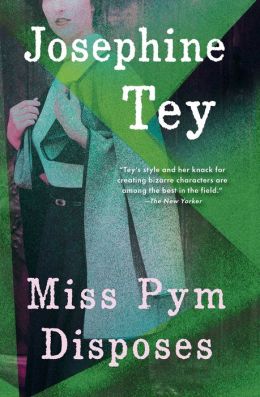
Miss Pym Disposes

Miss Pym Disposes. Josephine Tey. 1946. 238 pages. [Source: Book I Bought]

Miss Lucy Pym is visiting an 'old friend' who is now a principal at a physical training college. The occasion for her visit is her successful bestselling status as an author of a popular psychology book. Her book is the new "it" book of the moment, Miss Pym gives guest lectures. The students of this college, particularly the juniors and seniors, take a real liking to her. They beg and plead and urge her to stay. So she postpones leaving. (I'm not sure her old college friend is as enthusiastic about keeping her around for the last few weeks of the semester until graduation or not. I'm sure by the end she's thinking: why oh why did I think it would be a good idea to ask her to visit!) It's a super busy time for all. One class is preparing to graduate; there is stress and distress as they prepare for finals and critiques. Some students will be placed in a new job before graduation, others will have to make their own applications after graduation. A really ideal job opportunity arises, and, for some reason this causes great rumbles on the staff and among students. One student is chosen over another. Almost everyone disagrees with the decision. Even Miss Pym is argumentative and opinionated. As graduation approaches the inevitable happens. Inevitable ONLY because it's a mystery book and there is the expectation that at some point a crime, probably murder, but at the very least attempted murder, will occur. This happens extraordinarily late in the novel. One of the graduating seniors has an "accident" that ultimately leads to her death. Miss Pym knows the accident was no accident, and she has proof. But will her proof ever be turned over to the authorities?! Will Miss Pym play god and decided that she has no ethical obligation to turn in the murderer--the girl she's convinced is guilty?!

Miss Pym Disposes is a strange little mystery. I found the academic setting interesting, at least in the beginning. But overall, I was not impressed with this one.

© 2014 Becky Laney of Becky's Book Reviews
Monday, June 03, 2013

Reluctant Widow (1946)

The Reluctant Widow. Georgette Heyer. 1946/2008. Sourcebooks. 316 pages.

I am so glad I'm rereading the Georgette Heyer books this year, and trying to do it in chronological order too! I remembered this one as being really good. But I didn't remember how delightful and different it was! It is not really like any of Heyer's other romance novels! It definitely has a strong mystery element to it.

The heroine, Elinor Rochdale, was quite enjoyable! When we first meet her, she's intending to be a governess. But a case of mistaken identity changes all that! She is waiting to meet someone to take her to her new place of employment. The man who meets her thinks she is the answer to his advertisement! His advertisement is NOT for a governess. She learns this much too late. But she decides to HEAR the offer. This man, this stranger, wants her to marry his cousin. It's delightfully complicated in the retelling. But he is very persuasive...

I shared more details in my first review...

Essentially I loved it just as much as I did the first time I read it. It was one I loved, loved, loved. I would definitely recommend this one!

© 2013 Becky Laney of Becky's Book Reviews
Tuesday, January 29, 2013

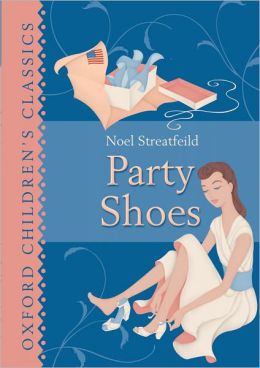
Party Shoes (1946)

Party Shoes. Noel Streatfeild. 1946. Oxford Children's Classics. 320 pages.

Party Shoes isn't quite what I expected it to be. It started out with great promise, I thought. We meet Selina, a girl living with her British cousins through the war (World War II). One day she receives a present from her American godmother. The parcel contains a beautiful (though inappropriate for the times) dress or 'frock' and some lovely shoes. Selina knows, as do her cousins and aunt and uncle that there will never be a suitable occasion for her to wear the dress and shoes. Not with the war on, not with the economy being what it is, not with shortages and restrictions, etc. So the cousins have a meeting. Every person has to suggest at least one idea of how Selina can wear her dress and shoes before she outgrows them. After many ideas are presented, everyone concludes that they will have a pageant on the neighbor's lawn. They set the date for September 20, 1945. And then they each begin writing their piece.

Selina does learn through the process that she is more capable than she ever thought, that she can do things, that she is good at many things, that she is great with working with people, solving problems, etc.

Over half the book is focused on the tiny details of the pageant, each scene of the pageant. We're there for what feels like three hundred rehearsals. Of course, that's not really the case. Probably more like forty. But still. As their scenes are changed, arranged, rearranged, scripted, directed, etc. I found most of the book tedious. I didn't want it to be tedious. I wanted it to be a delight. But most of the delight happened in the first hundred pages.

Read Party Shoes
  • If you like Noel Streatfeild
  • If you like reading about creativity, drama, etc. (writing poetry, dancing ballet, acting/directing drama, etc.)
  • If you like historical fiction set during this time period (1944-1945)
© 2013 Becky Laney of Becky's Book Reviews
Friday, January 04, 2013

Thomas the Tank Engine Collection (1945-1960)

Thomas The Tank Engine Story Collection. The Reverend W. Awdry. (The Railway Series Since 1945). Based On the Railway Series by the Reverend W. Awdry. 2005. Random House. 512 pages.

This story book collection contains fourteen previously published books starring Thomas and his friends. The titles included in the collection: The Three Railway Engines (1945), Thomas the Tank Engine (1946), James the Red Engine (1948), Tank Engine Thomas Again (1949), Troublesome Engines (1950), Henry the Green Engine (1951), Toby the Tram Engine (1952), Gordon the Big Engine (1953), Edward the Blue Engine (1954), Four Little Engines (1955), Percy the Small Engine (1956), The Eight Famous Engines (1957), Duck and the Diesel Engine (1958), The Twin Engines (1960). These were all originally published in the UK.

Each book contains a handful of stories. For example, Gordon the Big Engine contains four stories: "Off the Rails," "Leaves," "Down the Mine," and "Paint Pots and Queens." Henry The Green Engine contains five stories: "Coal," "The Flying Kipper," "Gordon's Whistle," "Percy and the Trousers," and "Henry's Sneeze." Tank Engine Thomas Again contains four stories: "Thomas and the Guard," "Thomas Goes Fishing," "Thomas, Terence, and the Snow," and "Thomas and Bertie."

There were certainly plenty of stories to choose from in this collection. It would have been nice to have an index to each and every story instead of just an index of the picture books. I began the book enthusiastically, appreciating the stories and the little details. By the end of the book, however, I was a bit tired of trains. I liked the writing, for the most part. There were very rhythmic places in the text that felt just right.

A conversation between Thomas, Annie, and Clarabel:
"Why don't you go fast? Why don't you go fast?" called Annie and Clarabel anxiously.
"Wait and see, wait and see," hissed Thomas.
"He's a long way ahead, a long way ahead," they wailed, but Thomas didn't mind. He remembered the crossing. (139)
These stories may have been updated since their initial publication. I've heard that in the original stories, Sir Topham Hatt is just called "The Fat Controller." There is a "complete collection" of Thomas stories now out of print that may be be closer to the original. (It has all twenty-six picture books.)

From "Off the Rails"
 A family of toads croaked crossly at Gordon as he lay in the mud. On the other side of the ditch, some little boys were chattering.
"Gee! Doesn't he look silly!" "They'll never get him out." They began to sing: Silly old Gordon fell in a ditch,
fell in a ditch,
fell in a ditch.
Silly old Gordon fell in a ditch,
all on a Monday morning. (266)
From "Gordon's Whistle"
Gordon was cross.
"Why should Henry have a new shape?" he grumbled. "A shape good enough for me is good enough for him. He goes gallivanting off to Crewe, leaving us to do his work. It's disgraceful!"
"And there's another thing. Henry whistles too much. No respectable engine ever whistles loudly at stations. It isn't wrong," said Gordon, "but we just don't do it." (202-3)
Read Thomas the Tank Engine Story Collection
  • If you have a little one who LOVES Thomas and friends
  • If you have a little train-lover
  • If you are interested in reading classic or vintage picture books
© 2013 Becky Laney of Becky's Book Reviews

Monday, May 16, 2011

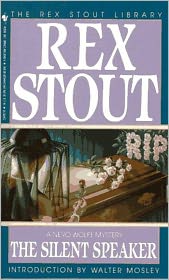
The Silent Speaker

The Silent Speaker. Rex Stout. 1946/1994. Random House. 288 pages.  

Seated in his giant's chair behind his desk in his office, leaning back with his eyes half closed, Nero Wolfe muttered at me:
"It is an interesting fact that the members of the National Industrial Association who were at that dinner last evening represent, in the aggregate, assets of something like thirty billion dollars."
I slid the checkbook into place on top of the stack, closed the door of the safe, twirled the knob, and yawned on the way back to my desk.
"Yes, sir," I agreed with him. "It is also an interesting fact that the prehistoric Mound Builders left more traces of their work in Ohio than in any other state. In my boyhood days--"
"Shut up," Wolfe muttered.
I let it pass without any feeling of resentment, first because it was going on  midnight and I was sleepy, and second because it was conceivable that there might be some connection between his interesting fact and our previous conversation, and that was not true of mine. We had been discussing the bank balance, the reserve against taxes, expectations as to bills and burdens, one of which was my salary, and related matters. The exchequer had not swung for the third strike, but neither had it knocked the ball out of the park. After I yawned three more times Wolfe spoke suddenly and decisively. 
"Archie. Your notebook. Here are directions for tomorrow."
In two minutes he had me wide awake. When he had finished and I went upstairs to bed, the program for the morning was so active in my head that I tossed and turned for a full thirty seconds before sleep came. (1-2)

I enjoyed The Black Orchid, but I really enjoyed The Silent Speaker. I just love, love, love Nero Wolfe and Archie Goodwin. Archie makes for a GREAT narrator! There's just something so delicious, so satisfying, so fun about these Nero Wolfe books. (I can't wait to read all the ones my library has!)

So in The Silent Speaker, Archie and Nero Wolfe are trying to find a way to make some money. I guess you could say they are in between detecting jobs at the moment. There's just been a high profile murder. And though they've not been hired--by any one--Archie is going around town acting like he's on the case. He's interviewing people, writing down clues, making people nervous etc. Soon he's got a handful of people thinking that Nero Wolfe is just days away from solving the crime. So Archie's acting pays off. The NIA hires Nero Wolfe to solve this murder for them. Even though several NIA employees are on the suspect list. But the truth is, Nero Wolfe isn't exactly sure WHO committed this crime. (Or is he?!) You see, there's been a reward offered--a BIG, BIG, BIG reward. And Nero Wolfe may just be out to collect it! If he can outwit the police and everyone else.


© 2011 Becky Laney of Becky's Book Reviews