Debby. Siddie Joe Johnson. Illustrated by Ninon MacKnight. 1940. Longmans, Green and Co. 214 pages. [Source: Bought]
Debby hesitated at the edge of the clearing. It was their own half-acre, that clearing, and held the new trailer house, shining so brightly in the June morning sunlight.
I loved, loved, LOVED Siddie Joe Johnson's Debby. This children's book is set in South Texas. Though it has a 'historical' feel about it now, at the time it was published in 1940, it would have been considered contemporary.
Debby is the heroine. The move is recent. Her father needed to get away from the city for health reasons. The family will be living in a trailer home for a year. He'll be recuperating and writing a book. Will Debby like it in the country? Will she like Texas? Yes, and YES! She'll have many adventures. She'll make plenty of good, good friends.
The book spans the months of June through December. During those months, Debby grows up a bit, makes new friends, and discovers plenty. There is just something pleasant and satisfying and lovely and SIMPLE (in a good way, I promise) about this one. Readers get the summer adventures, the starting-school adventures, and the holiday adventures. (I love that there are chapters about Thanksgiving and Christmas.)
Debby LOVES Mr. and Mrs. Sanders their closest neighbors. And Mrs. Sanders loves, loves, loves having Debby around. This couple never had children, and, they take great delight in Debby. Mrs. Sanders inherited a doll named Deborah. It is this doll which is depicted on the cover. You might suppose since the doll is on the cover, that, the doll would play a prominent role in the book. That the book might even read like Hitty or Miss Hickory. But. It doesn't. Sure, the doll is mentioned in two or three chapters. But the book is about so much more. I was wanting a doll-story. But what I got was even more satisfying in the end.
I would definitely recommend this one! I loved everything about it: the end papers, the illustrations throughout the book, the writing itself.
© 2014 Becky Laney of Becky's Book Reviews
Wednesday, February 11, 2015
Tuesday, February 10, 2015
The Boundless (2014)
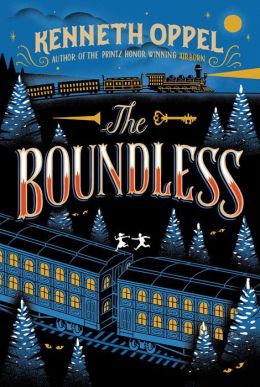
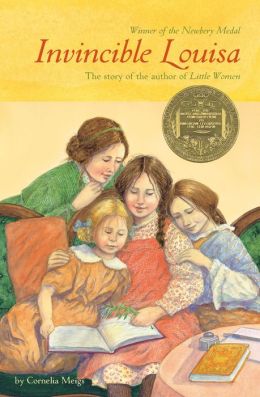
Boundless. Kenneth Oppel. 2014. Simon & Schuster. 320 pages. [Source: Library]
Three hours before the avalanche hits, William Everett is sitting on an upturned crate, waiting for his father. The town doesn't even have a name yet.
If you love historical action-adventures with danger and mysteries and secrets and murders, then The Boundless might be a very good fit for you, especially if you love children's books, or circuses, or trains.
The first chapter serves as a prologue. It introduces the hero, of course, Will Everett, and many of the other characters as well. Readers learn that Will loves to draw. Will meets a mystery-girl that mesmerizes him, that will continue to mesmerize him for over three years. Will meets Cornelius Van Horne, the manager of the Canadian Pacific Railroad. Will gets invited to go along on a train ride. His father, James Everett, works for the railroad, they'll meet him at the end of the line. He'll meet several people on his journey. He'll hear things, see things. For example, he'll see the plans for the Boundless, and hear of this man's visionary idea for train travel. Things happen that will change his life forever.
The rest of the novel is set three years later and covers a short span--perhaps a week. In that week, much will happen. Will, the hero, will face DANGER and have to prove himself again and again and again. Will is many things, talented, for example, but courageous not so much. He is forced to risk much, to face many different kinds of threats and dangers. He also spends much of his time thinking and pondering.
Will has one idea of his future: what he wants, what he needs. His father has another idea. The two are opposites essentially. Part of him wants to completely reject his father's plans for him. Another part is scared. So when he's not actually at risk of dying, Will ponders the future.
I liked this one. I didn't love it. But I think for those that like action-adventure, this one could prove appealing.
© 2015 Becky Laney of Becky's Book Reviews
Three hours before the avalanche hits, William Everett is sitting on an upturned crate, waiting for his father. The town doesn't even have a name yet.
If you love historical action-adventures with danger and mysteries and secrets and murders, then The Boundless might be a very good fit for you, especially if you love children's books, or circuses, or trains.
The first chapter serves as a prologue. It introduces the hero, of course, Will Everett, and many of the other characters as well. Readers learn that Will loves to draw. Will meets a mystery-girl that mesmerizes him, that will continue to mesmerize him for over three years. Will meets Cornelius Van Horne, the manager of the Canadian Pacific Railroad. Will gets invited to go along on a train ride. His father, James Everett, works for the railroad, they'll meet him at the end of the line. He'll meet several people on his journey. He'll hear things, see things. For example, he'll see the plans for the Boundless, and hear of this man's visionary idea for train travel. Things happen that will change his life forever.
The rest of the novel is set three years later and covers a short span--perhaps a week. In that week, much will happen. Will, the hero, will face DANGER and have to prove himself again and again and again. Will is many things, talented, for example, but courageous not so much. He is forced to risk much, to face many different kinds of threats and dangers. He also spends much of his time thinking and pondering.
Will has one idea of his future: what he wants, what he needs. His father has another idea. The two are opposites essentially. Part of him wants to completely reject his father's plans for him. Another part is scared. So when he's not actually at risk of dying, Will ponders the future.
I liked this one. I didn't love it. But I think for those that like action-adventure, this one could prove appealing.
© 2015 Becky Laney of Becky's Book Reviews
Monday, February 09, 2015
Invincible Louisa (1933)
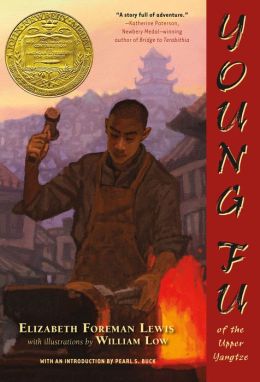
Invincible Louisa: The Story of the Author of Little Women. Cornelia Meigs. 1933/1995. Little, Brown. 256 pages. [Source: Library]
My mom has wanted me to read Invincible Louisa for years. I finally did, and I enjoyed it. Did I love it? Probably not LOVE. But I certainly appreciated it and found it pleasant enough.
Invincible Louisa is a biography of Louisa May Alcott written for children. It reads much like a novel. There is plenty of dialogue; there is plenty of emotion and description. It covers her whole life--from birth to death. Though not equal attention is given to every year, of course!!! Much of the focus is on the whole Alcott family.
Probably half the book focuses on Louisa Alcott "becoming" a writer: how she came to write stories, sketches, poems, novels, etc., how she came to be published, how her works were received by critics and the public. But the book focuses much on her character. (It's not a word you hear a lot about now perhaps. But her values, beliefs, and principles.) So, yes, the book is about her being a writer, but, it is just as much about her being a daughter and sister.
Would I have appreciated Little Women more if I'd read Invincible Louisa as a child? Perhaps. The two books would definitely complement one another.
© 2015 Becky Laney of Becky's Book Reviews
My mom has wanted me to read Invincible Louisa for years. I finally did, and I enjoyed it. Did I love it? Probably not LOVE. But I certainly appreciated it and found it pleasant enough.
Invincible Louisa is a biography of Louisa May Alcott written for children. It reads much like a novel. There is plenty of dialogue; there is plenty of emotion and description. It covers her whole life--from birth to death. Though not equal attention is given to every year, of course!!! Much of the focus is on the whole Alcott family.
Probably half the book focuses on Louisa Alcott "becoming" a writer: how she came to write stories, sketches, poems, novels, etc., how she came to be published, how her works were received by critics and the public. But the book focuses much on her character. (It's not a word you hear a lot about now perhaps. But her values, beliefs, and principles.) So, yes, the book is about her being a writer, but, it is just as much about her being a daughter and sister.
Would I have appreciated Little Women more if I'd read Invincible Louisa as a child? Perhaps. The two books would definitely complement one another.
© 2015 Becky Laney of Becky's Book Reviews
Labels:
1933,
biography,
books reviewed in 2015,
j nonfiction,
mg nonfiction,
Newbery
Sunday, February 08, 2015
Young Fu of the Upper Yangtze (1932)
Young Fu of the Upper Yangtze. Elizabeth Foreman Lewis. illustrated by William Low. 1932/2008. Square Fish. 302 pages. [Source: Review copy]
Young Fu stood on the narrow curbing before Dai's two-storied tenement in Chair-Maker's Way, Chungking, and stared about him. In the doorway, Fu Be Be, his mother, directed load-coolies in placing the household goods which she had brought from home, and anxiously examined each article as it passed before her.
After his father dies, Young Fu and his mother move to the city of Chungking. Young Fu is eager to begin his work as an apprentice to a coppersmith, Tang. He's grateful for the opportunity. And more fortunate still that it isn't his only opportunity for learning, for their new upstairs neighbor is willing to teach him to read and write.
Young Fu of the Upper Yangtze is a coming-of-age novel. The book follows him from the age of thirteen to eighteen, I believe. I would say the book is about his adventures and misadventures growing up, but, I'm not sure adventures is the right word. It captures his experiences growing up in China in the 1920s. Sometimes the experiences are memorable for all the right reasons. Sometimes not. He makes mistakes, he does. But he acknowledges his mistakes, seeks to make restoration, and grows wiser--or at least a little wiser.
I definitely enjoyed this one. I found it interesting. The chapters were long, in my opinion, but ultimately worth it.
© 2015 Becky Laney of Becky's Book Reviews
Young Fu stood on the narrow curbing before Dai's two-storied tenement in Chair-Maker's Way, Chungking, and stared about him. In the doorway, Fu Be Be, his mother, directed load-coolies in placing the household goods which she had brought from home, and anxiously examined each article as it passed before her.
After his father dies, Young Fu and his mother move to the city of Chungking. Young Fu is eager to begin his work as an apprentice to a coppersmith, Tang. He's grateful for the opportunity. And more fortunate still that it isn't his only opportunity for learning, for their new upstairs neighbor is willing to teach him to read and write.
Young Fu of the Upper Yangtze is a coming-of-age novel. The book follows him from the age of thirteen to eighteen, I believe. I would say the book is about his adventures and misadventures growing up, but, I'm not sure adventures is the right word. It captures his experiences growing up in China in the 1920s. Sometimes the experiences are memorable for all the right reasons. Sometimes not. He makes mistakes, he does. But he acknowledges his mistakes, seeks to make restoration, and grows wiser--or at least a little wiser.
I definitely enjoyed this one. I found it interesting. The chapters were long, in my opinion, but ultimately worth it.
© 2015 Becky Laney of Becky's Book Reviews
Thimble Summer (1938)
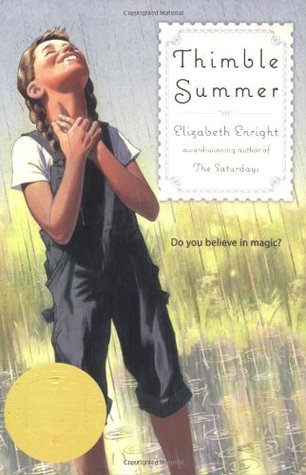
Thimble Summer. Elizabeth Enright. 1938/2008. SquareFish. 144 pages. [Source: Review copy]
Garnet thought this must be the hottest day that had ever been in the world. Every day for weeks she had thought the same thing, but this was really the worst of all.
Thimble Summer won the Newbery in 1939. Thimble Summer is about the 'magical' summer Garnet Linden (the heroine) experiences after finding a silver thimble in a dried up riverbed. (The book opens with a drought. It is hot, hot, hot, and rain is much needed.)
Thimble Summer celebrates life and family. I loved it.
In the first chapter, readers meet Garnet, her family, and her best friend. This is the chapter where she finds the thimble that "changes" everything. (She certainly believes it changes her luck).
In the second chapter, Garnet and her best friend, Citronella, visit Citronella's great-grandmother and hear a story about when she was very naughty. (I loved this bit!) The third and fourth chapters go together. The family is building a new barn, and a lime kiln is needed. During their time watching the kiln, a stranger is introduced to the family, a young boy named Eric. After listening to his story, well, the family just has to 'keep' him. In the fifth chapter, Citronella and Garnet accidentally get locked-in at the library. Chapters six and seven are about when Garnet runs away from home to the 'big' city for a day. Chapters eight and nine are about the fair--and all the fun to be had. Her pig also won a blue ribbon. Chapter ten is Garnet reflecting at how WONDERFUL the summer has been, and how much she loves life just as it is.
I loved this one. I loved Garnet. I loved her family. I loved getting to know Jay, her older brother, and Eric, her new 'adopted' brother. (She has more brothers. But they are all younger, and, Garnet hardly has much to do with them.) I loved her adventures with or without Citronella! It's just a satisfying read from cover to cover.
© 2015 Becky Laney of Becky's Book Reviews
Garnet thought this must be the hottest day that had ever been in the world. Every day for weeks she had thought the same thing, but this was really the worst of all.
Thimble Summer won the Newbery in 1939. Thimble Summer is about the 'magical' summer Garnet Linden (the heroine) experiences after finding a silver thimble in a dried up riverbed. (The book opens with a drought. It is hot, hot, hot, and rain is much needed.)
Thimble Summer celebrates life and family. I loved it.
In the first chapter, readers meet Garnet, her family, and her best friend. This is the chapter where she finds the thimble that "changes" everything. (She certainly believes it changes her luck).
In the second chapter, Garnet and her best friend, Citronella, visit Citronella's great-grandmother and hear a story about when she was very naughty. (I loved this bit!) The third and fourth chapters go together. The family is building a new barn, and a lime kiln is needed. During their time watching the kiln, a stranger is introduced to the family, a young boy named Eric. After listening to his story, well, the family just has to 'keep' him. In the fifth chapter, Citronella and Garnet accidentally get locked-in at the library. Chapters six and seven are about when Garnet runs away from home to the 'big' city for a day. Chapters eight and nine are about the fair--and all the fun to be had. Her pig also won a blue ribbon. Chapter ten is Garnet reflecting at how WONDERFUL the summer has been, and how much she loves life just as it is.
I loved this one. I loved Garnet. I loved her family. I loved getting to know Jay, her older brother, and Eric, her new 'adopted' brother. (She has more brothers. But they are all younger, and, Garnet hardly has much to do with them.) I loved her adventures with or without Citronella! It's just a satisfying read from cover to cover.
© 2015 Becky Laney of Becky's Book Reviews
Subscribe to:
Posts (Atom)