Showing posts with label 1886. Show all posts

Thursday, November 10, 2022

147. The Strange Case of Dr. Jekyll and Mr. Hyde


The Strange Case of Dr. Jekyll and Mr. Hyde. Robert Louis Stevenson. 1886. 54 pages. [Source: Bought]

First sentence: Mr. Utterson the lawyer was a man of a rugged countenance that was never lighted by a smile; cold, scanty and embarrassed in discourse; backward in sentiment; lean, long, dusty, dreary and yet somehow lovable. At friendly meetings, and when the wine was to his taste, something eminently human beaconed from his eye; something indeed which never found its way into his talk, but which spoke not only in these silent symbols of the after-dinner face, but more often and loudly in the acts of his life. He was austere with himself; drank gin when he was alone, to mortify a taste for vintages; and though he enjoyed the theatre, had not crossed the doors of one for twenty years. But he had an approved tolerance for others; sometimes wondering, almost with envy, at the high pressure of spirits involved in their misdeeds; and in any extremity inclined to help rather than to reprove. “I incline to Cain’s heresy,” he used to say quaintly: “I let my brother go to the devil in his own way.” In this character, it was frequently his fortune to be the last reputable acquaintance and the last good influence in the lives of downgoing men.

Premise/plot: Mr. Utterson is our primary narrator. He is the lawyer who has dealings first with Dr. Henry Jekyll and to a certain extent Mr. Edward Hyde. [He is the lawyer who has helped Jekyll prepare his will.] The novella is a suspenseful mystery--of sorts. Readers learn of a "wicked" Mr. Hyde that is unpleasant--at best--and a murderer--at worst. Whether he is a true "terror" or just a ghastly unpleasant fellow that just gives off super-creepy-vibes Mr. Utterson is at first not prepared to say. [At first being the key word.] He is a lawyer who seems so proud of his I-don't-judge-others persona; his live-and-let-live or you-do-you vibes. But Mr. Hyde does creep him out more than most of the other fellows in his acquaintance. (We get to know several with whom he has to do.) 

Mr. Utterson is a curious fellow. He is determined to figure out the relationship between the "good" Dr. Jekyll, his client, and the "creepy" Mr. Hyde. WHY is Dr. Jekyll prepared to leave his whole estate to Mr. Hyde? HOW do they know one another? WHAT is Jekyll thinking in risking his own reputation? Mr. Hyde is mentioned in his will. Mr. Hyde has a key to his place. He obviously either a) genuinely likes him and accepts him or b) he is being coerced or blackmailed by Hyde. Mr. Utterson, for the longest time, is inclined to think just that. Surely the good Dr. Jekyll is being blackmailed. And though Mr. Utterson usually is NOT his brother's keeper, he tries to "help" in this instance. He starts investigating or snooping. He'll follow clues about Dr. Jekyll's life...he'll follow clues about Mr. Hyde's life....he'll just keep searching any and every clue until he has the answers he's looking for.

And that leads him to a better acquaintance with Dr. Lanyon. Dr. Lanyon is/was a friend of Dr. Jekyll. And, yes, that is awkward but factual. They were friends--once upon a time. At one point they are mere civil acquaintances--close friends no more. Dr. Jekyll does, at one point, reach out to him--a plea calling upon their past [close] friendship. Dr. Lanyon, for better or worse, does respond to that cry for help--that plea. And because he does so, well, he acts as the catalyst of the story. He supplies almost all the missing puzzle pieces that Mr. Utterson, the lawyer, needs to see the big picture. Utterson would have not connected all the dots without knowing Dr. Lanyon. 

I said for better or worse for a reason. It is to the readers' gain that Dr. Lanyon does answer his friend's cry for help. For the sake of the story, Dr. Lanyon doing what he does, going where he goes, seeing what he sees...and living long enough to set it down on paper and make arrangements that his narrative is given to Mr. Utterson...well, it benefits the mystery/suspense angle of the novella. There is no big reveal without Dr. Lanyon. 

Yes, this is fiction. I never really suspended my disbelief for a second in this horror/thriller/mystery. But let's say, for a second, this was "real," by saying yes to his friend, Dr. Lanyon is making a big mistake--in terms of what is best for his own self interests. Being there for his friend in this moment of great need directly leads to Dr. Lanyon's death.

Now, don't ask me WHY Dr. Lanyon HAD to die. Just don't. Because I think the answer is more related to *using* the character as a plot device. The character's death means that a) Mr. Utterson can read this narrative and have his curiosity satisfied. There were two documents--Dr. Lanyon's narrative and Henry Jekyll's narrative--that were dependent on their deaths. Mr. Utterson can only get all the answers if both are dead. Both documents are conditional. If Mr. Utterson isn't allowed the answers, the readers aren't allowed the answers either. The whole book would be pointless. 

Sometimes authors just kill off characters because they think it makes poetic sense, almost. [Like I'll never understand WHY Victor Hugo killed off Jean Valjean. In a million years I'll never have the answer. There was no "need" coming from within the story itself. But that is neither here nor there.] Here readers are asked to suspend their disbelief. So you witness something super traumatic. You don't die of "shock" then and there in the moment. But you go home and suddenly know that you've only got a few more weeks to live??? Like the shock of living with the aftermath of the trauma is literally going to kill you? Like goodbye world, I'll just sit here getting weaker and weaker. I mean it's just silly. Still, I suppose it's all about getting the information into the hands of Mr. Utterson--and subsequently the readers. Therefore Dr. Lanyon had to die or the book would be too short. [I am jesting a little.] 

My thoughts: Dr. Jekyll and Mr. Hyde contains a plot twist that almost ALL readers will know in advance. Almost all. Many if not most. It does make me curious HOW the original audience--those reading the novella in the first year or two--would have read the story. Would it have been shocking? Would it have been thrilling? Would it have kept them guessing? What would they have thought going into the last few chapters? Would they have suspected the two men were one in the same? Or would they have thought like Mr. Utterson that it was a case of blackmail? Would they have felt disgusted by both Dr. Jekyll and Mr. Hyde? Would they have felt any pity? Does knowing the *big* plot twist in advance change the way the novella is read and understood? What have we lost? What have we gained? 

I do think that the moral implications would probably have been greater felt or appreciated by the original audience of this one. I think modern/contemporary audiences would see it merely as spooky/supernatural/horror.

Sin always takes you further than you intended to go, keeps you longer than you intended to stay, and costs you more than you intended to pay. (Erwin Lutzer, How You Can Be Sure You Will Spend Eternity with God, 38)
Our sins are often as dear to us as our children! We love them, hug them, cleave to them and delight in them! To part with them, is as hard as cutting off a right hand or plucking out a right eye! But it must be done. The parting must come. J.C. Ryle, Holiness

We would often be sorry if our wishes were gratified. John Milton. 

© 2022 Becky Laney of Becky's Book Reviews

Saturday, December 19, 2020

152. The Birds' Christmas Carol


The Birds' Christmas Carol. Kate Douglas Wiggin. 1886. 93 pages. [Source: Bought]

First sentence: It was very early Christmas morning, and in the stillness of the dawn, with the soft snow falling on the housetops, a little child was born in the Bird household.

Premise/plot: Our heroine, Carol Bird (so named because she was born on Christmas Day), is dying and has never been perfectly well. This Christmas--as her family very well knows--could be her very last birthday/Christmas. How will the family celebrate? How they live life every day--with kindness, joy, and love in their hearts. Carol lives--though bedridden--by loving others and sharing with others what she has. For example, she shares her books with the local hospital--ten at a time--and she corresponds with others. Though life has "given her lemons" if you will she has made enough lemonade for one and all. 

Quotes: 

  • Love could do nothing; and when we have said that we have said all, for it is stronger than anything else in the whole wide world.
  • On one side of the room was a bookcase filled with hundreds—yes, I mean it—with hundreds and hundreds of books; books with gay-colored pictures, books without; books with black and white outline-sketches, books with none at all; books with verses, books with stories, books that made children laugh, and some that made them cry; books with words of one syllable for tiny boys and girls, and books with words of fearful length to puzzle wise ones. This was Carol's "Circulating Library." Every Saturday she chose ten books, jotting their names down in a little diary; into these she slipped cards that said: "Please keep this book two weeks and read it. With love, Carol Bird." Then Mrs. Bird stepped into her carriage, and took the ten books to the Childrens' Hospital, and brought home ten others that she had left there the fortnight before. This was a source of great happiness; for some of the Hospital children that were old enough to print or write, and were strong enough to do it, wrote Carol cunning little letters about the books, and she answered them, and they grew to be friends.
  • (It is very funny, but you do not always have to see people to love them. Just think about it, and see if it isn't so.)

My thoughts: I didn't appreciate this one at all--not even a little bit--as a kid. I don't know WHY my mom tried so hard to get me to read it every year. I still think it's not really a "children's book." Unless you just happen to know KIDS  who love books where the MAIN CHARACTER DIES. I don't know if that's better or worse than a story where the family dog dies, but, it's not necessarily uplifting unless you're an extraordinary reader--wise beyond one's years perhaps. 

I do appreciate it more now as an adult. I can at the very least appreciate the writing and some of the universal truths. For example, I love, love, love the YOU DO NOT ALWAYS HAVE TO SEE PEOPLE TO LOVE THEM. I have found this to be very true with folks I've only "met" online and have taken up a friendship with!  

This one isn't as cheery as Pollyanna--I still much prefer Pollyanna--but Carol does live out faith in an admirable way. One could argue that the book itself represents everything that's wrong with early children's literature--be good so you can die young and be assured of where you will spend salvation--but I won't be making that argument. Yes, Carol is a GOOD heroine who dies blessed in the Lord--with a smile upon her face--and yes, the fact that she is now happily with her Lord is stressed. But if that alone was the "point" of the book--it wasn't nearly preachy enough. That is to clarify it could have been more preachy and more didactic and more forced. The text was sweet--without question--but not hiding a dose of  bitter medicine that you had to swallow. 

© 2020 Becky Laney of Becky's Book Reviews

Friday, April 12, 2019

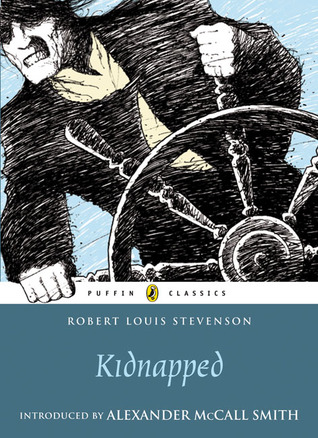
Kidnapped

Kidnapped. Robert Louis Stevenson. 1886. 276 pages. [Source: Bought]

First sentence: I will begin the story of my adventures with a certain morning early in the month of June, the year of grace 1751, when I took the key for the last time out of the door of my father's house.

Premise/plot: When David Balfour's father dies, he sets out on a journey to meet the uncle he never even knew he had. There had been--he reasons, and rightly so--a falling out between the two brothers. But with his father's letter to his brother intact, he sets out with few expectations. Will his uncle welcome him with open arms? Will his uncle invite him to live with him? Will his uncle assist him in getting established in a profession? Will his uncle send him on his way?

Soon after he arrives in the village/town where his father lives, he begins to ask for directions. Every person that he meets gives him a) either a strange look b) strange warning or c) both of the above. It seems this uncle is little respected, much feared. Though he's been warned NOT to make his uncle's acquaintance, he reasons, well, I've come this far already it would be just silly not to go through with my plans.

Can you guess how the meeting goes?

My thoughts: If Kidnapped was a Choose Your Own Adventure book, the version I'd read would be very short! If given the option of choosing to meet the uncle or not meet the uncle, then I'd have him go back to his own neighborhood and trust in the friends he knows versus the family he doesn't.

Though David Balfour's choices would not be my own, I have to say this one is PACKED, absolutely packed, with action and adventure and twists and turns and DRAMA. And I suppose I should have mentioned before now that this one is set in Scotland where feudal disputes and violence abound...

I found this a compelling read. It was INTENSE and enjoyable. Alan Breck and David Balfours certainly know how to keep you turning pages....

Quotes:
"Captain," says Alan, "I doubt your word is a breakable. Last night ye haggled and arglebargled like an apple wife; and then passed me your word, and gave me your hand to back it; and ye ken very well what was the upshot. Be damned to your word!" says he. (86)
Charles the Second declared a man could stay outdoors more days in the year in the climate of England than in any other. This was very like a king, with a palace at his back and changes of dry clothes. (113)
I have seen wicked men and fools, a great many of both; and I believe they both get paid in the end, but the fools first. (118)
At first I proposed I should give him for a signal the "Bonnie House of Airlie," which was a favorite of mine; but he objected that as the piece was very commonly known, any ploughman might whistle it by accident; and taught me instead a little fragment of a Highland air, which has run in my head from that day to this, and will likely run in my head when I lie dying. (239)

© 2019 Becky Laney of Becky's Book Reviews

Friday, October 28, 2016

Strange Case of Dr. Jekyl and Mr. Hyde

The Strange Case of Dr. Jekyl and Mr. Hyde. Robert Louis Stevenson. 1886. 144 pages. [Source: Library]

First sentence: Mr. Utterson, the lawyer, was a man of a rugged countenance, that was never lighted by a smile;

Premise/plot: What if the 'dark' inside you was fully released and realized?!

My thoughts: What an interesting book to read after reading John Owen's Overcoming Sin and Tempation! Dr. Jekyll has a secret 'dark' side that he struggles to keep concealed. Only a few come to learn his BIG, BIG secret: he has found a way of satisfying his dark side in the personality of MR. HYDE. But the more he gives into temptation and becomes Mr. Hyde, letting Mr. Hyde loose in the city and country, the harder the struggle is to return to being Dr. Jekyll. There is a battle going on over his body--if you will--but it isn't a battle of good versus evil, just slightly evil with totally evil.

This is a very short read that is easy to recommend.

© 2016 Becky Laney of Becky's Book Reviews
Saturday, October 19, 2013

Strange Case of Dr. Jekyl and Mr. Hyde (1886)

Dr. Jekyl and Mr. Hyde. Robert Louis Stevenson. 1886. 144 pages. [Source: Bought]

I first read this classic in 2007. (I read it for my first R.I.P. challenge.) I enjoyed revisiting it. I remember being surprised that I liked it. I mentioned how it was impossible to read without this Arthur song popping up in my mind!


The story is simple. Dr. Jekyll's lawyer, Mr. Utterson, begins to worry about his client because he names Mr. Hyde in his will. Mr. Hyde, he has just learned, is a strange man that almost everyone has a bad vibe about. He is described as "pure evil" by some. Utterson worries that Hyde must be blackmailing Jekyll into making those provisions in his will. The more worried and anxious he becomes, the more involved he gets in trying to solve the mystery between the two men. He especially becomes worried when Mr. Hyde commits a murder. Will Dr. Jekyll be next? Is there a way to save his friend and put Mr. Hyde away for good?

Quotes:
You start a question, and it's like starting a stone. You sit quietly on the top of a hill; and away the stone goes, starting others; and presently some bland old bird (the last you would have thought of) is knocked on the head in his own back garden and the family have to change their name.
"Hm," said Mr. Utterson. "What sort of a man is he to see?" "He is not easy to describe. There is something wrong with his appearance; something displeasing, something down-right detestable. I never saw a man I so disliked, and yet I scarce know why. He must be deformed somewhere; he gives a strong feeling of deformity, although I couldn't specify the point. He's an extraordinary looking man, and yet I really can name nothing out of the way. No, sir; I can make no hand of it; I can't describe him. And it's not want of memory; for I declare I can see him this moment." Mr. Utterson again walked some way in silence and obviously under a weight of consideration. "You are sure he used a key?" he inquired at last. "My dear sir..." began Enfield, surprised out of himself. "Yes, I know," said Utterson; "I know it must seem strange. The fact is, if I do not ask you the name of the other party, it is because I know it already. You see, Richard, your tale has gone home. 
It is one thing to mortify curiosity, another to conquer it;
© 2013 Becky Laney of Becky's Book Reviews

Friday, October 01, 2010

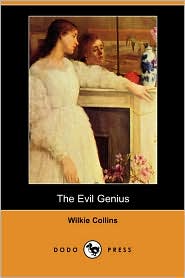
Evil Genius

Evil Genius. Wilkie Collins. 1886. 348 pages.

The gentlemen of the jury retired to consider their verdict.
Their foreman was a person doubly distinguished among his colleagues. He had the clearest head, and the readiest tongue. For once the right man was in the right place.
Of the eleven jurymen, four showed their characters on the surface. They were:
The hungry juryman, who wanted his dinner.
The inattentive juryman, who drew pictures on his blotting paper.
The nervous juryman, who suffered from fidgets.
The silent juryman, who decided the verdict.
Of the seven remaining members, one was a little drowsy man who gave no trouble; one was an irritable invalid who served under protest; and five represented that vast majority of the population -- easily governed, tranquilly happy -- which has no opinion of its own.

While I didn't love The Evil Genius as much as The Moonstone, I did enjoy it. What should you know? Well, it is NOT a mystery. It is a "domestic story." You should also know that it has a forty-page prologue (of sorts) that establishes the background of one of its main characters.

Readers first meet Sydney Westerfield as a child. Her father has died; her mother--at best--is disinterested. Her mom is all about her son. When her mother remarries and moves to America, she leaves her daughter in the care of her sister. Of course, she takes her beloved son. The aunt? Well, she's super-excited because she can use Sydney as a servant and a teacher-in-training. So poor Sydney has not known love in many, many years. Perhaps since her father died.

The novel opens when Herbert Linley seeks a governess for his daughter, Kitty. He brings home the young, the beautiful, the pathetic Sydney. After hearing her story, after seeing her kicked out of her aunt's home, he had to hire her. Mrs. Presty, his mother-in-law, is skeptical. She's been married twice, and she's convinced she knows a thing or two about men. And the fact that Sydney is so young, so beautiful, so innocent, so in need of love and acceptance, so sweet, well, she thinks that it is unwise to have her in their home. (Yes, Mrs. Presty lives with her daughter and son-in-law.) But Mrs. Linley meets Sydney and is enchanted. Her heart is big enough to accept Sydney without doubt, without reservation. And Kitty? Her daugher? Well, Kitty loves, loves, loves her governess! So it looks like Sydney may have found a happy home at last....

But. One late night stroll in the moonlight finds Mr. Linley and Sydney unexpectedly thrown together--they're locked out of the house--and Mr. Linley fancies himself in love with this ever-grateful young woman. He confesses as such. As soon as those words are spoken, both know that they cannot remain in this situation...

The Evil Genius, like Anna Karenina, focuses on marriage, adultery, divorce, and scandal. But it is so VERY different from Anna Karenina! Both Mrs. Linley and Miss Westerfield are sympathetic. And Mrs. Presty is great for comical relief! (Is she "The Evil Genius" of the family that contributes to its downfall?) The Evil Genius is never boring. It's extremely readable. 

I enjoyed it. There were places I loved it.
"Is there any human character, even the noblest, that is always consistently good?"
"One reads of them sometimes," she suggested, "in books."
"Yes," he said. "In the worst books you could possibly read--the only really immoral books written in our time."
"Why are they immoral?"
"For this plain reason, that they deliberately pervert the truth. Clap-trap, you innocent creature, to catch foolish readers! When do these consistently good people appear in the life around us, the life that we all see? Never! Are the best mortals that ever lived above the reach of temptation to do ill, and are they always too good to yield to it? How does the Lord's Prayer instruct humanity? It commands us all, without exception, to pray that we may not be led into temptation. You have been led into temptation. In other words, you are a human being. All that a human being could do you have done--you have repented and confessed." (324)

© Becky Laney of Becky's Book Reviews