Showing posts with label 1912. Show all posts

Wednesday, January 27, 2021

8. Pygmalion


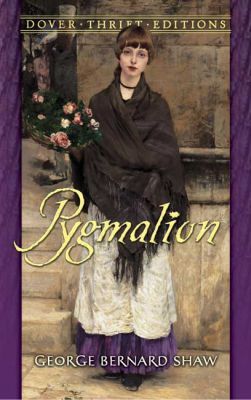
Pygmalion. George Bernard Shaw. 1912. 96 pages. [Source: Bought]

First sentence: ACT I Covent Garden at 11.15 p.m. Torrents of heavy summer rain. Cab whistles blowing frantically in all directions. Pedestrians running for shelter into the market and under the portico of St. Paul's Church, where there are already several people, among them a lady and her daughter in evening dress. They are all peering out gloomily at the rain, except one man with his back turned to the rest, who seems wholly preoccupied with a notebook in which he is writing busily.

If you've ever seen the musical MY FAIR LADY, then you know the basic skeletal  plot of Pygmalion. That's my short and concise summary. 

It has been ages since I've seen the film Pygmalion starring Leslie Howard and Wendy Hiller. I can't say if the play differs a little or a LOT from that film adaptation. 

I can tell you that the play differs GREATLY from the musical MY FAIR LADY. And I don't just mean the obvious: lack of singing. I mean My Fair Lady fleshes out the play by adding dozens of scenes. In the play, for example, we have NO SCENES depicting the months Eliza Doolittle was being trained by Professor Higgins. We go from her offering to pay for lessons to her first debut months later with NOTHING in between. Her first appearance is at his mother's house. It is at his mother's house she first meets Freddy Hill. (There is no racing scene). The big finale is a garden party--nothing so grand and phenomenal as in the musical. And the ending, of course, the ending is what has changed the most.

The play does offer some of the great lines that are retained in My Fair Lady. 

It is recognizable as My Fair Lady.

But in my opinion, My Fair Lady is a thousand times better than the play Pygmalion. Because we actually get more time with the characters--to see their strengths, their weaknesses, their interactions with one another. The lines have more resonance if you've seen HIGGINS behavior throughout. 

Quotes: 

Happy is the man who can make a living by his hobby! You can spot an Irishman or a Yorkshireman by his brogue. I can place any man within six miles. I can place him within two miles in London. Sometimes within two streets.

You see this creature with her kerbstone English: the English that will keep her in the gutter to the end of her days. Well, sir, in three months I could pass that girl off as a duchess at an ambassador's garden party. I could even get her a place as lady's maid or shop assistant, which requires better English.

THE FLOWER GIRL. Oh, we are proud! He ain't above giving lessons, not him: I heard him say so. Well, I ain't come here to ask for any compliment; and if my money's not good enough I can go elsewhere. HIGGINS. Good enough for what? THE FLOWER GIRL. Good enough for ye—oo. Now you know, don't you? I'm come to have lessons, I am. And to pay for em too: make no mistake. HIGGINS [stupent] WELL!!! [Recovering his breath with a gasp] What do you expect me to say to you? THE FLOWER GIRL. Well, if you was a gentleman, you might ask me to sit down, I think. Don't I tell you I'm bringing you business?

THE FLOWER GIRL. Oh, we are proud! He ain't above giving lessons, not him: I heard him say so. Well, I ain't come here to ask for any compliment; and if my money's not good enough I can go elsewhere.

HIGGINS. If I decide to teach you, I'll be worse than two fathers to you. Here [he offers her his silk handkerchief]! LIZA. What's this for? HIGGINS. To wipe your eyes. To wipe any part of your face that feels moist. Remember: that's your handkerchief; and that's your sleeve. Don't mistake the one for the other if you wish to become a lady in a shop.

HIGGINS. To wipe your eyes. To wipe any part of your face that feels moist. Remember: that's your handkerchief; and that's your sleeve. Don't mistake the one for the other if you wish to become a lady in a shop.

HIGGINS [tempted, looking at her] It's almost irresistible. She's so deliciously low—so horribly dirty— LIZA [protesting extremely] Ah—ah—ah—ah—ow—ow—oooo!!! I ain't dirty: I washed my face and hands afore I come, I did.

What is life but a series of inspired follies?

Time enough to think of the future when you haven't any future to think of.

Besides, do any of us understand what we are doing? If we did, would we ever do it?

HIGGINS. Nonsense! I know I have no small talk; but people don't mind. [He sits on the settee]. MRS. HIGGINS. Oh! don't they? Small talk indeed! What about your large talk? Really, dear, you mustn't stay.

The difference between a lady and a flower girl is not how she behaves, but how she's treated. I shall always be a flower girl to Professor Higgins, because he always treats me as a flower girl, and always will; but I know I can be a lady to you, because you always treat me as a lady, and always will.       

I have forgotten my own language, and can speak nothing but yours.

LIZA. You want me back only to pick up your slippers and put up with your tempers and fetch and carry for you. HIGGINS. I haven't said I wanted you back at all. LIZA. Oh, indeed. Then what are we talking about? HIGGINS. About you, not about me. If you come back I shall treat you just as I have always treated you. I can't change my nature; and I don't intend to change my manners. My manners are exactly the same as Colonel Pickering's. LIZA. That's not true. He treats a flower girl as if she was a duchess. HIGGINS. And I treat a duchess as if she was a flower girl.

HIGGINS. About you, not about me. If you come back I shall treat you just as I have always treated you. I can't change my nature; and I don't intend to change my manners. My manners are exactly the same as Colonel Pickering's. The great secret, Eliza, is not having bad manners or good manners or any other particular sort of manners, but having the same manner for all human souls: in short, behaving as if you were in Heaven, where there are no third-class carriages, and one soul is as good as another.

HIGGINS [irritated] The question is not whether I treat you rudely, but whether you ever heard me treat anyone else better.

LIZA. So you are a motor bus: all bounce and go, and no consideration for anyone. But I can do without you: don't think I can't.

Sneering doesn't become either the human face or the human soul.

HIGGINS: I don't and won't trade in affection. You call me a brute because you couldn't buy a claim on me by fetching my slippers and finding my spectacles. You were a fool: I think a woman fetching a man's slippers is a disgusting sight: did I ever fetch YOUR slippers? I think a good deal more of you for throwing them in my face. No use slaving for me and then saying you want to be cared for: who cares for a slave? If you come back, come back for the sake of good fellowship; for you'll get nothing else.       

© 2021 Becky Laney of Becky's Book Reviews

Sunday, December 21, 2014

Eight More Christmas Books

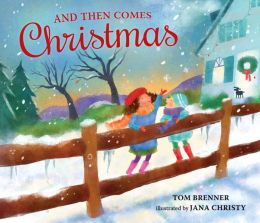
And Then Comes Christmas. Tom Brenner. Illustrated by Jana Christy. 2014. Candlewick Press. 32 pages. [Source: Review copy]

With some picture books, you almost have to read them a few times before you decide if you like them or not. Such is the case with Tom Brenner's And Then Comes Christmas.

And Then Comes Christmas is all about establishing atmosphere and celebrating traditions. Atmosphere is established by description and detail. Phrases like "bare branches rake across the sky" and "romp in snow as smooth as bedcovers." Traditions are celebrated: choosing a tree, decorating a tree, making cookies, wrapping presents, reading stories, attending programs, making crafts, seeing Santa at the mall, etc. Some traditions will likely be familiar. Some may not be. Not every child gets to play in the snow before Christmas--or after Christmas, for that matter! But all children could choose to make paper snowflakes to decorate their windows.

It is a book that slowly and gently counts down to Christmas. (Though not with actual numbers.) There is a certain pattern to it...multiple when/then passages.

I think my favorite when/then passage is:
When elves and reindeer appear in stores, and small trains race through toy villages, and piles of presents nestle in cotton drifts...Then hop from foot to foot, waiting to sit on Santa's knee."
I like this one well enough. But I would hate to have to diagram any of these sentences!

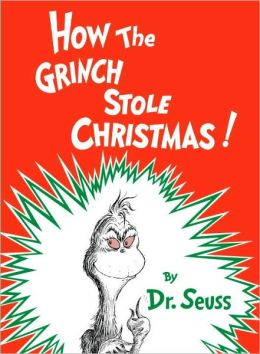
How the Grinch Stole Christmas. Dr. Seuss. 1957. Random House. 64 pages. [Source: Review copy]

I love it. Of course I love it. How could I not? Now, I will admit that I didn't read the actual book until I was an adult. It wasn't one of the Seuss books that I owned growing up. But the christmas special--the cartoon--is one I've seen dozens and dozens of times. The book itself is lovely. If you love one, you'll love the other.

So in case you're unfamiliar with the book or special, The Grinch hates Christmas. His neighbors, the Whos in Who-ville, love Christmas. He is super-cranky this year, and, he decides to steal it. He thinks Christmas is all about the stuff. Take the stuff, do away with it altogether, right? Wrong. The Whos in Who-ville teach the Grinch a lesson about joy.

One of my favorite things about it is it's just SO quotable. Here are a few of my favorite lines:
Every who down in Who-ville liked Christmas a lot...But the Grinch, who lived just north of Who-ville, did NOT!
And THEN they'd do something he liked least of all! Every who down in Who-ville, the tall and the small, would stand close together, with Christmas bells ringing. They'd stand hand-in-hand. And the Whos would start singing. They'd sing! And they'd sing! AND they'd SING! SING! SING!
Then he slid down the chimney. A rather tight pinch. But, if Santa could do it, then so could the Grinch.
Then the last thing he took was the log for their fire! Then he went up the chimney, himself, the old liar.
It came without ribbons! It came without tags! It came without packages, boxes, or bags!"

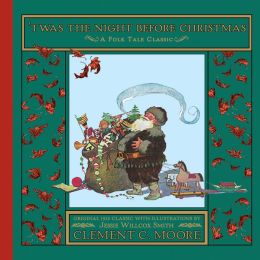
'Twas the Night Before Christmas. Clement C. Moore. Illustrated by Jessie Willcox Smith. 1823/1912. HMH. 32 pages. [Source: Review copy]

I've read 'Twas the Night Before Christmas plenty of times before. But this is the first time I've read the edition of the poem published as a picture book in 1912 with illustrations by Jessie Willcox Smith.

The poem itself is as delightful as it ever is. I think this is a poem that feels familiar no matter what. You don't have to seek it out year after year. It just finds you and sticks. It's just part of the Christmas culture. (I love the Sesame Street play starring Bert and Ernie as featured in Muppet Family Christmas.)

It was interesting to see the illustrations from this time period. (You may see the illustrations at project gutenberg.) Did I love the illustrations? Not particularly.

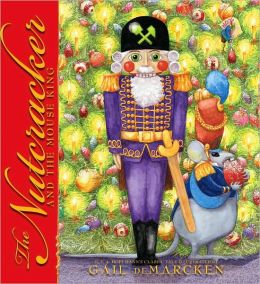
The Nutcracker and the Mouse King. E.T.A. Hoffmann. Adapted by Wren Maysen. Illustrated by Gail de Marcken. 2009. 56 pages. [Source: Review copy]

I am not as familiar with the original story (1816) as I am the story of the ballet. (The two are different.) It's an odd book. I'll be honest. It is just as strange as Alice in Wonderland. (Though, of course, The Nutcracker and the Mouse King came decades before Alice.)

Marie Stahlbaum is the heroine of The Nutcracker and the Mouse King. The book opens with Marie and her brother, Fritz, playing together and waiting, waiting, waiting for all the delights of Christmas. They are waiting to enter the large drawing room where the tree is, and where the presents are. Their mother and father are there as well. As is Godfather Drosselmeier. There is a new doll, Clara, for Marie. There are new toy soldiers for Fritz. And there is a lovely toy castle, Marzipan Castle, for them both. The Nutcracker is a gift for the whole family. Marie does take special interest in it, this interest remains despite the fact that Fritz breaks the Nutcracker when he's showing off.

Marie stays up past her bedtime in the drawing room. This is when things get strange: seeing Godfather Drosselmeier on top of the clock, seeing all the mice attack, seeing the Mouse King, etc. She witnesses a battle. Towards the close of that battle, she throws a slipper at the wicked Mouse King.

Marie awakens in bed the next day. Her mother had found her bleeding on the floor near the tree and toy cupboard. She spends the next few days at least in bed. Spending so much time in bed might seem horrible, and, perhaps Marie found it to be so part of the time at least. But her Godfather tells her strange stories which she believes of course.

Plenty of The Nutcracker and the Mouse King is the Godfather's strange, strange story. This story is about "a king, a queen, some mice, and a young princess named Pirlipat." The story is rich in detail:
Princess Pirlipat was very lovely. She had flawless white skin, with bright blue eyes and flowing locks of golden hair. The generals, noblemen, and ministers of the state all told the king and queen that they had never seen a baby like the princess. Not only was the princess beautiful, but she was also born with two perfect rows of teeth!
The queen insisted that Princess Pirlipat's cradle always be guarded. The royal guards were placed at Pirlipat's door, and directly beside her cradle sat six nurses...and with these six nurses sat six big cats. The nurses had strict orders from the queen to keep one cat in each of their laps and pet them all day and all night so that they would never stop purring. This was indeed strange. No one knew why the queen went to such lengths to protect her princess, but still, every night, the sound of purring cats echoed throughout the castle. But the queen had a very good reason to be on guard, for a curse had been placed on her family.
Readers learn of the family curse, of course. And it's something. The story becomes more and more bizarre as it unfolds. But to Marie, it is completely captivating.

Meanwhile, we have not seen the last of the mice or their dreadful King. Marie knows that sooner or later the final battle will come....

There does come a time when the Nutcracker takes Marie to his magical, fantastic home in Toyland.

So readers see Marie awaken again from yet another dream. Will Marie's ultimate dream come true?

This story is so strange and bizarre and rich in detail--pure fantasy.

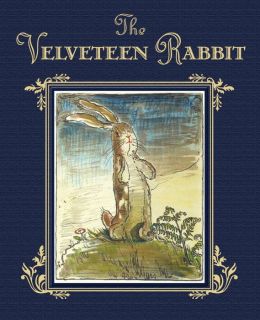
The Velveteen Rabbit. Margery Williams. Illustrated by William Nicholson. 1922/2014. Random House. 48 pages. [Source: Review copy]

Do you know what it is to be real? One little Christmas bunny will learn this and plenty of other life lessons in Margery Williams' classic tale The Velveteen Rabbit.

The Velveteen Rabbit opens with a young boy receiving a rabbit for a Christmas present. All is lovely for the rabbit that first day. But the toy is quickly forgotten. He becomes one toy of many, many, many toys. He's not exactly special to the boy or the other toys. In fact, I'd say the other toys bully him a bit. All except for the Skin Horse, the oldest toy in the nursery. It is this horse that tells the Rabbit all about being real, what it takes to be real, what it feels like, how it changes you, etc.
"Real isn't how you are made," said the Skin Horse. "It's a thing that happens to you. When a child loves you for a long, long time, not just to play with, but REALLY loves you, then you become Real." "Does it hurt?" asked the Rabbit. "Sometimes," said the Skin Horse, for he was always truthful. "When you are Real you don't mind being hurt." "Does it happen all at once, like being wound up," he asked, "or bit by bit?" "It doesn't happen all at once," said the Skin Horse. "You become. It takes a long time. That's why it doesn't often happen to people who break easily, or have sharp edges, or who have to be carefully kept. Generally, by the time you are Real, most of your hair has been loved off, and your eyes drop out and you get loose in the joints and very shabby. But these things don't matter at all, because once you are Real you can't be ugly, except to people who don't understand." "I suppose you are real?" said the Rabbit. And then he wished he had not said it, for he thought the Skin Horse might be sensitive. But the Skin Horse only smiled. "The Boy's Uncle made me Real," he said. "That was a great many years ago; but once you are Real you can't become unreal again. It lasts for always." (5-8)
The Velveteen Rabbit is one of my favorite Christmas books. I love the nursery magic. I love the ending. It was originally published in 1922. The story and illustrations in this edition are original. This is a beautiful edition of the book. One of the best I've seen.

The Velveteen Rabbit was published several years before A.A. Milne's Winnie the Pooh and House at Pooh Corner. Chances are if you enjoy one, you'll enjoy the other.

Do you have a favorite toy-come-to-life fantasy?

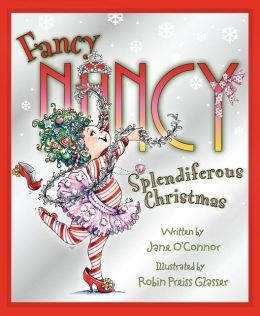
Fancy Nancy: Splendiferous Christmas. Jane O'Connor. Illustrated by Robin Preiss Glasser. 2009. HarperCollins. 32 pages. [Source: Library]

I enjoyed reading Fancy Nancy Splendiferous Christmas. This is actually the first Fancy Nancy book I've read, so it served as a good introduction to the series as well. I liked it very much. I love the illustrations. They were a bit busy, perhaps, but that is part of their charm, I think. I love the amount of detail. Every time I read it, I notice something I hadn't noticed before. There is something almost precious about this book--perhaps because of the illustrations, or even the text. But I don't mind that in a picture book now and then.

In this one, Fancy Nancy and her family are decorating the house for Christmas. They are doing plenty of christmas-y things all together as a family. One of things they are doing is waiting. Waiting is a big part of the holiday, in my opinion. They are waiting for the Grandpa to arrive. When he arrives, they can begin to decorate the tree. They always wait for him. And I imagine every year, she gets a bit impatient because she is oh-so-excited. This year, however, her parents allow her to put on the brand-new tree-topper, something that she picked out and bought with her own money--in the summer...I won't spoil this one. But I ended up liking it very much!
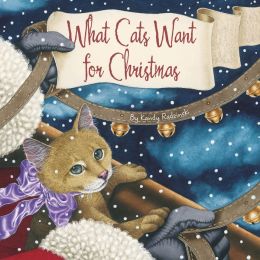
What Cats Want for Christmas. Kandy Radzinski. 2007. Sleeping Bear Press. 32 pages. [Source: Library]

For cat-lovers, this is a charming-enough book to read at Christmas time. The premise is simple: if cats could write letters to Santa, what would they ask for. Each spread shows a cat and his/her letter to Santa. The letters are all written in rhyme. The letters are predictable enough, but, the idea I think is original. I do wish there was more variety in what the letters requested, however. And some letters seem a bit dark and twisted.

I really liked the illustrations. I think I liked looking at the various cats better than reading the letters.

 It's Not About You Mr. Santa Claus. Soraya Diase Coffelt. 2014. Morgan James Publishing. 34 pages. [Source: Review copy]

There are plenty of children who write letters to Santa each year. But how many letters to Santa include the gospel message? In this picture book a young boy does just that.
Dear Mr. Santa Claus,
It's me again--a kid. I know I've written lots of letters to you before with long lists of gifts I wanted for Christmas. Well, not this year. This letter is different. I discovered the real meaning of Christmas has nothing to do with you at all. It is about a very special gift. I want to tell you about this gift. By the way, how are you and Mrs. Santa Claus doing? Have you lost any weight? Did your helpers, the elves, grow any taller? Do you still like cookies and milk? Are you still wearing that red, furry outfit? I've always wondered, what do you wear in the summer time?
It's a simple book with a timeless message. Which timeless message? Well, I suppose I could pick one or two that stand out. First, that Christmas is not about Santa and presents and shopping. It is actually about celebrating Jesus. Second, that the gospel is too good to keep to yourself. The gospel is for sharing.
The real Christmas story began a long time ago, when a Roman emperor named Caesar Augustus ordered that a census be taken. A census is when all the people had to be counted. At that time, A man named Joseph and his wife, Mary had to take a long journey to the city of David, known as Bethlehem, for the census. It wasn't an easy journey as Mary was going to have a baby soon.
The focus of this book is on retelling the Christmas story and communicating the gospel message. Probably leanings toward more retelling.

I was pleasantly surprised by the illustrations. I thought they were very nicely done.

Will this book please every single reader? Probably not. It may not be a perfect fit for every family this holiday season. But I think for some it will be a great find.


© 2014 Becky Laney of Becky's Book Reviews

Monday, September 16, 2013

The Life of Cesare Borgia (1912)

The Life of Cesare Borgia: A History and Some Criticisms. Rafael Sabatini. 1912. 326 pages. [Source: Bought]

Rafael Sabatini would NOT have approved of Horrible Histories' Borgia Family. The truth is, however, that I would never have sought out Sabatini's biography of Cesare Borgia if I'd not fallen in love with the video. It was Mat's "I am the mostest, powerfulest, evilest of all" that made me curious and seeking. I wasn't that impressed by my first attempt to learn more. The fictional Borgia Bride was awful. Fortunately, I discovered Sabatini's biography. It was LOVE.  It wasn't love because it fit into any preconceived notions about how I wanted the Borgia family to be. It was love because it respected human nature and historical fact. It embraced common sense and used dry wit, in part, to argue and persuade.

I journaled my reading in four parts. The first post tackled the preface and introduced Sabatini's goal in writing. It was WONDERFUL. The second post examined Cesare's father, Alexander VI (Rodrigo). The third post focused almost exclusively on Cesare. The fourth post focused on Sabatini as an author, his narrative style, his technique of criticizing other authors and sources. 
Life is an ephemeral business, and we waste too much of it in judging where it would beseem us better to accept, that we ourselves may come to be accepted by such future ages as may pursue the study of us.
But if it be wrong to judge a past epoch collectively by the standards of our own time, how much more is it not wrong to single out individuals for judgement by those same standards, after detaching them for the purpose from the environment in which they had their being? How false must be the conception of them thus obtained! We view the individuals so selected through a microscope of modern focus. They appear monstrous and abnormal, and we straight-way assume them to be monsters and abnormalities, never considering that the fault is in the adjustment of the instrument through which we inspect them, and that until that is corrected others of that same past age, if similarly viewed, must appear similarly distorted.
Hence it follows that some study of an age must ever prelude and accompany the study of its individuals, if comprehension is to wait upon our labours.
Sabatini just came across to me as practical, witty, sometimes wise, and sometimes poetic.
Mind being the seat of the soul, and literature being the expression of the mind, literature, it follows, is the soul of an age, the surviving and immortal part of it; (6)
Anyway, here is Sabatini's thesis--his goal for writing this biography. If you can embrace this premise, then chances are you'll find this one well worth the read!!!
Before we admit facts, not only should we call for evidence and analyse it when it is forthcoming, but the very sources of such evidence should be examined, that, as far as possible, we may ascertain what degree of credit they deserve. In the study of the history of the Borgias, we repeat, there has been too much acceptance without question, too much taking for granted of matters whose incredibility frequently touches and occasionally oversteps the confines of the impossible. (12)
If the author has a mercy to crave of his critics, it is that they will not impute it to him that he has set out with the express aim of "whitewashing"—as the term goes—the family of Borgia. To whitewash is to overlay, to mask the original fabric under a superadded surface. Too much superadding has there been here already. By your leave, all shall be stripped away. The grime shall be removed and the foulness of inference, of surmise, of deliberate and cold-blooded malice, with which centuries of scribblers, idle, fantastic, sensational, or venal, have coated the substance of known facts.
But the grime shall be preserved and analysed side by side with the actual substance, that you may judge if out of zeal to remove the former any of the latter shall have been included in the scraping.
(13)
If Sabatini was alive to refute current fictional portrayals of Cesare in romance novels...
Women play no part whatever in his history. Not once shall you find a woman's influence swaying him; not once shall you see him permitting dalliance to retard his advancement or jeopardize his chances. With him, as with egotists of his type, governed by cold will and cold intellect, the sentimental side of the relation of the sexes has no place. With him one woman was as another woman; as he craved women, so he took women, but with an almost contemptuous undiscrimination. 
The biography is rich in detail. It doesn't just focus on Cesare. It tries to cover more than that--to look at an age, to capture a time and place. It is ALL ABOUT context for Rafael Sabatini. And I really enjoyed his technique overall. 

© 2013 Becky Laney of Becky's Book Reviews

Friday, April 26, 2013

Pygmalion (1912)

Pygmalion. George Bernard Shaw. 1912. 96 pages.

Pygmalion is another book I read for the book to movie reading challenge. There is a lovely 1938 movie starring Leslie Howard and Wendy Hiller. If you've only seen Leslie Howard in Gone With The Wind, you should really make a point to see either Pygmalion OR The Scarlet Pimpernel (1934). Pygmalion was also the inspiration, of course, for the musical My Fair Lady starring Rex Harrison and Audrey Hepburn. Don't ask me to choose between Pygmalion and My Fair Lady. I happen to LOVE musicals, but Leslie Howard is oh-so-good in this one!!!

Pygmalion is certainly the inspiration for My Fair Lady. And I feel the musical stays, perhaps until the very end, true to the spirit of the original play. The songs fill in the gaps between the acts and scenes. The songs are quite expressive and provide insight on the individual characters. Through song, we learn more about what is going on in the house and about the months of training involved. On the other hand, in the book, there's a big gap between when Henry Higgins agrees to the experiment with Eliza Doolittle and her first outing. The first outing in the book is to Professor Higgins' mother's house. (The racing scene isn't in the original play.) Another big difference is that readers don't witness the big scene, the triumphant scene firsthand. Readers simply see the three returning home all dressed up. Readers hear the boasting and learn of the success after the fact. I really enjoyed the way My Fair Lady added to the original while keeping up the spirit.

Pygmalion is a short read, and it's also quite enjoyable!  

© 2013 Becky Laney of Becky's Book Reviews
Sunday, March 03, 2013

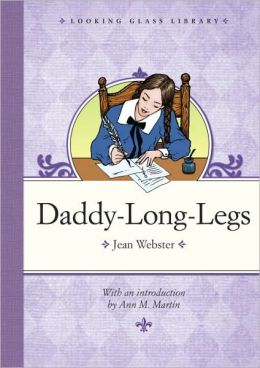
Sunday Salon: Reading Daddy Long Legs (1912)

Daddy Long Legs. Jean Webster. 1912. 208 pages.

Judy Abbot has a wonderful opportunity before her. If she'll agree to write her anonymous sponsor (or benefactor) a letter each and every month, then he will pay for her to attend four years of college. It is more than she ever hoped for, and so, of course, she agrees. The book chronicles all four years of her college experiences--including her summer vacations. Her benefactor manages to still manage her even during her school breaks. Not that she hears from him very often...

The book focuses on many aspects of college life: making friends, learning to get along with disagreeable people, learning how to be responsible, studying, attending classes, taking tests, spending time with friends, becoming interested in boys and dating, balancing everything just so.

I enjoyed this one. I like the letter-format, for the most part. But I can't exactly say that I'm kindred spirits with the heroine.
It isn't the big troubles in life that require character. Anybody can rise to a crisis and face a crushing tragedy with courage, but to meet the petty hazards of the day with a laugh--I really think that requires spirit. (51)
Thank heaven I don't inherit my God from anybody! I am free to make mine up as I wish Him. (67)
I have a beautiful play that I invented a long time ago when I first learned to read. I put myself to sleep every night by pretending I'm the person (the most important person) in the book I'm reading at the moment. (88)
It isn't the great big pleasures that count the most; it's making a great deal out of the little ones--I've discovered the true secret of happiness, Daddy, and that is to live in the now. (141)

© 2013 Becky Laney of Becky's Book Reviews
Monday, February 11, 2013

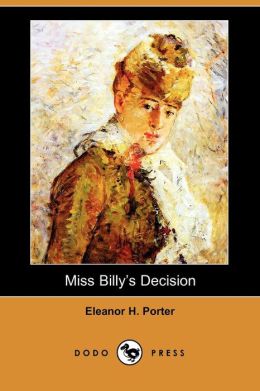
Miss Billy's Decision (1912)

Miss Billy's Decision. Eleanor H. Porter. 1912. Dodo Press. 248 pages. 

Miss Billy is engaged to Bertram Henshaw. Their engagement has just been announced. But life gets busy and the couple struggles in their relationship. Bertram is painting the portrait of a young, wealthy, beautiful woman--very temperamental, always changing her mind on what pose suits her best. Billy is occupied with a handful of things: first, planning the wedding of Cyril and Maria (the music teacher); second, writing or composing her own songs for publication: this time with a partner, "Mary Jane" Arkwright; third participating or organizing an operetta for charity: if she can play matchmaker for two of her new friends, it would be great. Through the months, Billy feels that Bertram is too focused on ART and not focused enough on her, and, Bertram feels that Billy is too focused on MUSIC and not focused enough on him. Each feels let down by the other. Perhaps each feeling that love should be easy now that they're together and planning to get married. The couple begins to grow apart from one another--very gradually. 

At one point in the novel, Miss Billy struggles to make the decision that is "right" for everyone. She's been told by a certain someone that she is ruining Bertram's life, that the two would never--could never--be happy together. That it would be best for Bertram's career if he were to remain single. It's not like Billy has never had doubts about their future together. So Billy starts looking for signs to help her decide...

One might think that Bertram would be more developed as a hero, as a character since he is the love of Miss Billy's life. But. He still wasn't as developed as he might have been. I still feel that readers never really get a chance to know him. Readers spend MOST of the novel seeing Miss Billy and "Mary Jane" (M.J. Arkwright) together. He LOVES Billy and honestly doesn't know that she's already engaged. And they have so much in common, at first glance. She's great at writing music; he's great at writing lyrics. Readers know that he loves her, but, does she love him in return?

I did enjoy this one more than Miss Billy.


Read Miss Billy's Decision
  • If you enjoy Eleanor Porter's writing style; she's VERY readable
  • If you enjoy light/clean romance
  • If you enjoy reading classics
  • If you're looking for vintage 'new adult' titles
© 2013 Becky Laney of Becky's Book Reviews
Tuesday, September 22, 2009

Riders of the Purple Sage


Grey, Zane. 1912. Riders of the Purple Sage.

For those of you who don't know, I'm allergic to westerns. I first noticed this allergy to the bang, bang, shoot'em up formula as a young child. So what would possess me to read Zane Grey? Well, it's the book my mom chose for round two of Me? Read That?! (You can find out all about our get back at one another fun challenge in that original post. And that's the post that will feature links to all of my posts that deal with the challenge.)

So what is Riders of the Purple Sage about? Short answer: shooting Mormons. The long answer is slightly more complicated. It has two heroines and two heroes. The setting is Utah in the 1870s.

The content. This was published in 1912. I try to remember that when reading it. But it's not the easiest thing to do. But I wasn't comfortable reading this one. The casual shooting of others--in this case Mormons--didn't sit easy with me. And there were several things the "heroes" did that I just didn't agree with at all.

So who are the characters? Well, there's Jane Withersteen. She's one we meet on page one. She's a wealthy land owner. Single. A Mormon. She's at the center of the trouble in the novel because she has the unpleasant (to the villains that is) habit of befriending gentiles (non-mormons). She's also a bit too independent for their tastes. Why doesn't she get married? Why doesn't she start a family? What kind of believer is she if she doesn't want to raise the next generation of Mormons? The Mormon men--led by someone named Tull, I believe--will stop at nothing to run friends out of Utah. One of her friends is a man named Venters. This 'action' scene serves as an introduction into the story really. A showdown between Elder Tull and Venters. But it's one that is interrupted by the arrival of a strange man, Lassiter. He's a gunman, one known for his hatred of Mormons. One who has been known to shoot a few. He's on a mission, that's for sure, he's looking for vengeance. (His sister was "kidnapped" by Mormons. It's been almost twenty years since, and while she's long dead...he's still bitter.) He stops the men from beating Venters. There are a few other characters, of course, another woman, one named Bess. But I won't tell you exactly how she enters into this drama.

The writing. It started out very painful. Zane Grey, in my humble opinion, needed an editor badly. The descriptions. Oh, they hurt! Chapter five is the most painful chapter of the book. The descriptions were boring and repetitive. And I had to laugh when Venters "soliloquized" to the sage. (Okay, technically, he was probably talking to himself or possibly the unconscious person he'd just shot. But still.) His phrasing at times struck me as awkward and ill-formed.

Broad daylight and a hint of sunshine high on the cliff-rim to the west brought him to consideration of what he had better do. (49)

"A good tracker could trail me," he muttered. "And I'd be cornered here. Let's see. Rustlers are a lazy set when they're not on the ride. I'll risk it. Then I'll change my hiding-place." (49)

Venters was conscious of an indefinite conflict of change within him. It seemed to be a vague passing of old moods, a dim coalescing of new forces, a moment of inexplicable transition. He was both cast down and uplifted. He wanted to think and think and think of the meaning, but he resolutely dispelled emotion. His imperative need at present was to find a safe retreat, and this called for action. (80)

This sad-eyed girl was so utterly different from what it would have been reason to believe such a remarkable life would have made her. (110)

So the story. Aside from talking about shooting Mormons, what happens in this book? (And there is more talk than action.) Well, there are horses and horse races. And cattle. And cattle rustlers. And romance. Two couples falling in love, and the obstacles they face along the way.

I'm almost embarrassed to admit this, but for the last hundred pages, I was hooked. Not hooked in a wow-this-is-a-great-book way, but still I didn't want to put the book down until I found out how it all worked out. The pacing and tension in these last pages worked really, really well. Not well enough to make up for the painfulness of the earlier chapters--particularly that awful fifth chapter--but enough for me to think that maybe just maybe Grey was good at what he set out to do.

So am I still allergic to westerns? Yes. Give me a scenario where there are no guns and no horses, and I'll maybe reconsider.

© Becky Laney of Becky's Book Reviews
Saturday, June 20, 2009

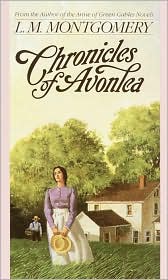
Chronicles of Avonlea


Montgomery, L.M. 1912. Chronicles of Avonlea. Bantam Classics. 183 pages.

Chronicles of Avonlea is a short story collection by L.M. Montgomery, the author of Anne of Green Gables. These stories are all set on Prince Edward Island. Several of them are set in Avonlea and feature references to the unforgettable red-headed orphan, Anne Shirley. At the time this book was originally published, the Anne series consisted of two books: Anne of Green Gables (1908) and Anne of Avonlea (1909).

There are twelve stories included in this collection:
The Hurrying of Ludovic
Old Lady Lloyd
Each In His Own Tongue
Little Joscelyn
The Winning of Lucinda
Old Man Shaw's Girl
Aunt Olivia's Beau
The Quarantine at Alexander Abraham's
Pa Sloane's Purchase
The Courting of Prissy Strong
The Miracle at Carmody
The End of a Quarrel

Several of these stories are quite memorable. Especially "The Hurrying of Ludovic," "Old Lady Lloyd," "The Winning of Lucinda," and "The Quarantine at Alexander Abraham's."

What makes these stories memorable? Well, it could be that they're full of eccentric characters. Montgomery had a way of writing eccentric that made eccentric a good thing.

The Hurrying of Ludovic, for example, is about the slow courtship of Theodora Dix. Ludovic Speed has been courting Theodora for fifteen years. An indecisive man to say the least, he needs to be "speeded" up according to Anne. And that is just what Anne sets out to accomplish. Will she do it? Can Theodora get her happily ever after with a little help from Anne?

Old Lady Lloyd is a more sentimental short story. Perhaps it's the most melodramatic of the bunch. It features an old woman, "Old Lady Lloyd" who is quite poor but proud. Her neighbors think she is rich but stingy. But her pride is about to be tested when she learns that the daughter of an old beau of hers, Sylvia Gray, is in town. She's the new music teacher. She loves her. She represents the daughter she could have had--would have had--if not for her foolish pride. So she becomes a "fairy" god-mother of sorts to the girl. She gives her presents--anonymously--and watches her from afar. As the summer progresses, Old Lady Lloyd's heart begins to thaw and she becomes more and more in touch with her humanity, with her feelings. (I warned you it was sentimental.)

"The Winning of Lucinda" is a great story because it is funny. It's about two very stubborn people: Lucinda and Romney. These two cousins courted and quarreled. In fact, they were engaged--still are engaged. It's been years--fifteen years to be exact. But Lucinda said she would never say another word to Romney, and Romney said he wouldn't speak to her until she spoke to him first. Is there hope for this couple yet?

"The Quarantine at Alexander Abraham's" is about two very cranky people finding love. One is a man-hater, cat lover, Angelina Peter MacPherson. And the other is a woman-hater, dog-lover named Alexander Abraham Bennett. Through chance, these two along with William Adolphus (cat) and Mr. Riley (dog) get quarantined together when there is an outbreak of small pox. It's a great story--a fun story.

I enjoy L.M. Montgomery. Whether she is writing novels or short stories, her work is always amazing. Even if you're not a short story lover, even if you think you hate short stories, I would suggest giving L.M. Montgomery a try.

© Becky Laney of Becky's Book Reviews