Showing posts with label 2018 Paris in July. Show all posts

Saturday, July 14, 2018

Me? Listen to Audio?! #27

Celebrated Crimes, Volume III: Mary Stuart. Alexandre Dumas. Translated by George Burnham Ives. Before 1870. Read by John Van Stan for Librivox. 6 hours and 25 minutes.

This week I listened to volume three of Alexandre Dumas' Celebrated Crimes. (For the record, I have not read or listened to volumes one or two). The subject of the volume is Mary Stuart, Queen of Scots.

First sentence: Some royal names are predestined to misfortune: in France, there is the name "Henry". Henry I was poisoned, Henry II was killed in a tournament, Henry III and Henry IV were assassinated. As to Henry V, for whom the past is so fatal already, God alone knows what the future has in store for him.

In Scotland, the unlucky name is "Stuart". Robert I, founder of the race, died at twenty-eight of a lingering illness. Robert II, the most fortunate of the family, was obliged to pass a part of his life, not merely in retirement, but also in the dark, on account of inflammation of the eyes, which made them blood-red. Robert III succumbed to grief, the death of one son and the captivity of other. James I was stabbed by Graham in the abbey of the Black Monks of Perth. James II was killed at the siege of Roxburgh, by a splinter from a burst cannon. James III was assassinated by an unknown hand in a mill, where he had taken refuge during the battle of Sauchie. James IV, wounded by two arrows and a blow from a halberd, fell amidst his nobles on the battlefield of Flodden. James V died of grief at the loss of his two sons, and of remorse for the execution of Hamilton. James VI, destined to unite on his head the two crowns of Scotland and England, son of a father who had been assassinated, led a melancholy and timorous existence, between the scaffold of his mother, Mary Stuart, and that of his son, Charles I. Charles II spent a portion of his life in exile. James II died in it. The Chevalier Saint-George, after having been proclaimed King of Scotland as James VIII, and of England and Ireland as James III, was forced to flee, without having been able to give his arms even the lustre of a defeat. His son, Charles Edward, after the skirmish at Derby and the battle of Culloden, hunted from mountain to mountain, pursued from rock to rock, swimming from shore to shore, picked up half naked by a French vessel, betook himself to Florence to die there, without the European courts having ever consented to recognise him as a sovereign. Finally, his brother, Henry Benedict, the last heir of the Stuarts, having lived on a pension of three thousand pounds sterling, granted him by George III, died completely forgotten, bequeathing to the House of Hanover all the crown jewels which James II had carried off when he passed over to the Continent in 1688—a tardy but complete recognition of the legitimacy of the family which had succeeded his. In the midst of this unlucky race, Mary Stuart was the favourite of misfortune.
The introduction reminded me of the lovely Horrible Histories songs about the Stuarts, "The Blue Blooded Blues."

I found this a difficult one to listen to. I like history. I like biography. I like to think of myself of having a good attention span when it comes to both. It may not be Dumas' fault. It may be the reader of the audio book, John Van Stan, or this reader.

I may still be willing to read the book at some point.

© 2018 Becky Laney of Becky's Book Reviews

Saturday, July 07, 2018

My Victorian Year #26

What am I currently reading that was published during the Victorian period? Well, it should come as no surprise that I'm still reading Anthony Trollope's Rachel Ray. I read several chapters in the past two weeks. (Yes, I missed last week's post but it was intentional. Really.)

I am also reading Alexandre Dumas' The Three Musketeers.

Rachel Ray

Rachel is missing Luke. He's gone away on business. Luke's mother and the Tappitts have made it their business to smear not only Luke's reputation but hers as well. They are telling everybody--and I do mean anybody with ears whether like gossip or not--that Luke is a scoundrel and that he's never, ever, ever, ever coming back to marry Rachel. They are hoping, of course, that the marriage doesn't happen. They want to speak that truth into the universe I suppose. The Tappitts have their motives. His mother has hers. The Tappitts want Luke to fail in his professional and personal life. His mother just wants to choose whom he marries and when he marries. She wants to be the only woman in his life--for now at least.

Luke wrote Rachel a letter. But Rachel hasn't been allowed to write back because her mother--Mrs. Ray--wants to show the letter around to her friends and get their advice on whether or not Rachel should write back. Rachel is like REALLY?!?!?! She doesn't voice it quite like that. But she is aggravated through and through with her mother's silliness. Though she would never call her mother a goose. (That's one of the accusations against Luke, don't you know, that he had the audacity to call his mother a silly goose.)

The Three Musketeers

First paragraph: On the first Monday of the month of April 1625, the village of Meung, where the author of the Romance of the Rose was born, seemed to be in as total an upheaval as if the Huguenots had come to make a second La Rochelle. Many of the townsmen, seeing women fleeing along the main street, hearing children crying on the doorsills, hastened to put on their breastplates and, backing up their somewhat uncertain countenances with a musket or a partisan, headed for the Jolly Miller Inn, before which jostled a compact group, noisy, full of curiosity, and growing every minute.

Father's advice to his son, d'Artagnan:
You are young, you must be brave for two reasons: first, because you are a Gascon, and second, because you are my son. Do not shrink from opportunities and seek out adventures. I have taught you to handle a sword; you have legs of iron, a fist of steel; fight whenever you can; fight all the more because duels are forbidden, and therefore it takes twice the courage to fight. (7)
Character description of d'Artagnan:
Don Quixote took windmills for giants and sheep for armies; d'Artagnan took every smile for an insult and every glance for a provocation. (8)
The scene that's in all the movies:
"Aha!" he said, "what's this?"
"This is the gentleman I am to fight with," said Athos, indicating d'Artagnan with his hand and greeting him with the same gesture.
"I am to fight with him, too," said Porthos.
"But not until one o'clock," said d'Artagnan.
"And I, too, am to fight with the gentleman," said Aramis, arriving on the scene in his turn.
"But not until two o'clock," d'Artagnan said with the same calm.
"But what are you fighting about, Athos?"
"By heaven, I don't quite know, he hurt my shoulder. And you, Porthos?"
"By heaven, I'm fighting because I'm fighting," Porthos replied, blushing.
Athos, who missed nothing, saw a slight smile pass over the Gascon's lips.
"We had a discussion about clothes," said the young man.
"And you, Aramis?" asked Athos.
"Me? I'm fighting for reasons of theology," replied Aramis, making a sign to d'Artagnan that he begged him to keep the cause of his duel secret.
Athos saw a second smile pass over d'Artagnan's lips.
"Indeed," said Athos.
"Yes a point in St. Augustine on which we disagree," said the Gascon. (54-5)


© 2018 Becky Laney of Becky's Book Reviews

Me? Listen to Audio?! #26

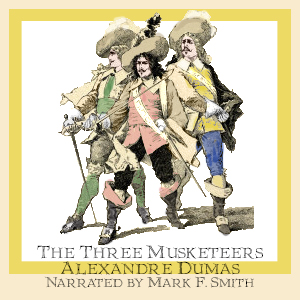
The Three Musketeers (Version 2) Alexandre Dumas. Translated by William Robson. Read by Mark F Smith for Librovox. 1844. 26 hours and 40 minutes.

Is The Three Musketeers the longest audio book I've tackled to date? I think it might just be. I didn't find the length intimidating. Quite the contrary actually. It was comforting to know what I would be listening to as I work each day. It was comforting to know that I wouldn't have to make a decision--at least not about that.

Athos, Portos, Aramis, and D'Artagnan star in this action-packed adventure story set in France in the 1620s. Every other chapter or so there seems to be a crisis for them to face--a challenge to face together, of course.

I do not think any of the movie adaptations I've seen cover the whole book, the whole story, all the characters.

I was only planning on listening to this one for the Paris in July experience. But listening made me want to read the book. I think I'll enjoy reading it even more than listening to it.

© 2018 Becky Laney of Becky's Book Reviews

Saturday, June 30, 2018

Me? Listen to Audio #25

Cyrano de Bergerac. Edmond Rostand. 1897. Translated by Anthony Burgess. Adapted for BBC 3 Radio Drama. Directed by David Timson. Starring Kenneth Branaugh as Cyrano, Jodhi May as Roxane, Tom Hiddleston as Christian. Two hours and fifteen minutes.

I love, love, love, LOVE this play. I do. The radio dramatization was GREAT. I would even dare to say it's one of the BEST dramas I've listened to. That doesn't surprise me, and it shouldn't surprise you either. How could it fail to be great when it stars Kenneth Branaugh and Tom Hiddleston?!?!?!

The story is simple. Cyrano de Bergerac is in love with his cousin, Roxane. The problem? He lacks the courage to tell her so because he feels his nose--his hideous, ugliness--will prevent her from ever loving him in return. Also standing in his way is the fact that Roxane declares herself head over heels in love with oh-so-handsome Christian de Neuvillette. How does Christian feel about Roxane? He loves her of course. Why? Because she's beautiful. (At least Cyrano knows Roxane, and, his love isn't based on her beauty alone.) Roxane asks Cyrano to watch over Christian and be his friend. (Christian has just joined the same regiment.) Cyrano tells Christian that Roxane does love him, but, instead of that being the end of it...it is just the start. For Roxane is determined that the man she loves will be brilliant and exceptionally well-spoken. He must win her heart through his words. The problem? Christian's idea of wooing is to say "I love you" and go in for a kiss. NOT WHAT ROXANE WANTS AT ALL. The solution is for Cyrano to give Christian the words to speak to win her heart for once and all. But is that a real solution?! Is a happily ever after possible in this love triangle?!

Favorite quotes:
Cyrano: I have a different idea of elegance. I don't dress like a fop, it's true, but my moral grooming is impeccable. I never appear in public with a soiled conscience, a tarnished honor, threadbare scruples or an insult that I haven't washed away. I'm always immaculately clean, adorned with independence and frankness. I may not cut a stylish figure, but I hold my soul erect. I wear my deeds as ribbons, my wit is sharper than the finest mustache, and when I walk among men I make truths ring like spurs. (40)
Cyrano: Look at me and tell me what hope this protuberance might leave me! I have no illusions. Sometimes, in the blue shadows of evening, I give way to tender feelings. I go into a garden, smelling the fragrance of spring with my poor monstrous nose, and watch a man and a woman strolling together in the moonlight. I think how much I, too, would like to be walking arm in arm with a woman, under the moon. I let myself be carried away, I forget myself--and then I suddenly see the shadow of my profile on the garden wall. (50)
Ragueneau: How can you treat poetry with such disrespect?
Lise: I'll treat poetry however I please!
Ragueneau: I shudder to think of what you might do with prose! (62)
Cyrano: I'll now put down on paper the love letter that I've already written within myself a hundred times. I have only to look into my soul and copy the words inscribed in it. (66)
Cyrano: My poor girl, you're so fond of fine words and gracious wit--what if he should prove to be an uncultured savage?
Roxane: Impossible. He has the hair of one of d'Urfe's heroes!
Cyrano: His speech may be as crude as his hair is elegant.
Roxane: No, there's delicacy in everything he says. I feel it.
Cyrano: Yes, all words are delicate when they come from lips adorned with a shapely mustache...But what if he's a fool?
Roxane: [stamping her foot] Then I'll die! There, are you satisfied? (78)
Cyrano: Shall we complete each other? We'll walk together: you in the light, I in the shadow. I'll make you eloquent, you'll make me handsome. (102)
Roxane: Your words are hesitant tonight. Why?
Cyrano (pretending to be Christian): Because of the darkness, they must grope their way to your ears.
Roxane: My words have no such difficulty.
Cyrano: They go straight to my heart, a goal too large to miss, whereas your ears are small. And your words travel swiftly because they fall, while mine must slowly climb.
Roxane: But they seem to be climbing better now.
Cyrano: They've finally become accustomed to that exercise.
Roxane: It's true that I'm speaking from high above you.
Cyrano: Yes, and it would kill me if you let a harsh word fall on my heart from that height. (126)
Cyrano: After all, what is a kiss? A vow made at closer range, a more precise promise, a confession that contains its own proof, a seal placed on a pact that has already been signed; it's a secret told to the mouth rather than to the ear, a fleeting moment filled with the hush of eternity, a communion that has the fragrance of a flower, a way of living by the beat of another heart, and tasting another soul on one's lips! (133)
Roxane: I've adored you since the evening when under my window, you began to reveal your soul to me in a voice I'd never heard you use before, and when I read your letters it was like hearing that same voice. I could feel its tenderness enveloping me! Finally I had to come to you, no matter what the danger! Penelope wouldn't have calmly stayed home with her weaving if Ulysses had written to her as you've written to me! She would have become as ardent as Helen of Troy, thrown her work aside, and gone off to join him! (184)
Roxane: Ah, how many things have died, and how many have now been born! Why were you silent for fourteen years, knowing that he hadn't written that letter, and that the tears on it were yours?
Cyrano: The blood was his. (218)


© 2018 Becky Laney of Becky's Book Reviews
Friday, June 22, 2018

Paris in July 2018

Paris in July
Hosted by Thyme for Tea; sign up 
When: the month of July
Goal: read, watch, listen to French things

I have participated in this for several years. I absolutely LOVE it. In fact, as soon as it's June I begin to plot and plan ahead. Of course, most of my plotting is set aside once it's July. Actually despite my plans I tend to be spontaneous in what I include for my Paris in July experience.

Still. I hope to finish one of these chunksters for the event. I've read Les Miserables at least three or four times. But this is a new-to-me translation. The Three Musketeers would be a reread as well. But it would be my first reread of the novel. I have never read The Hunchback of Notre-Dame. Never. In fact I find it the most intimidating of the three. It is my scary do-I-dare-to-do-it choice.

What I might do--might--is read one and listen to one. I've newly started listening to audio books.


© 2018 Becky Laney of Becky's Book Reviews