Showing posts with label Jane Eyre Project. Show all posts

Monday, July 09, 2012

All About Jane (Eyre)

This summer I've met ten Jane Eyres and ten Mr. Rochesters. I've had a lot of fun spending time watching so many different adaptations of this classic novel. So which Jane Eyre is the best Jane Eyre? Who is my favorite Mr. Rochester? Which Jane Eyre would I recommend most? Well, I thought I would share my thoughts on all the films I've seen...

Jane Eyre (1934) [My review]

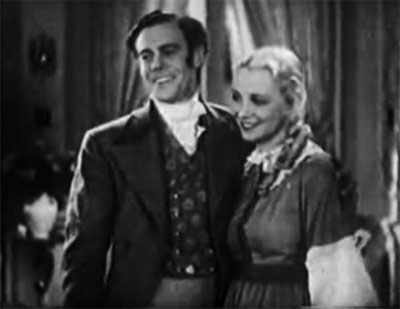
Black and white film starring Colin Clive and Virginia Bruce. This hour-long adaptation is comedic. It features a rather unique interpretation of Adele, for example. An Adele that gets stuck in a tree, an Adele that falls into a giant vase, an Adele that actually charms the guests, an Adele that begs Mr. Rochester to marry Jane. Mr. Rochester's preference for Jane is obvious; in this adaptation he actually ignores Blanche Ingram and dances with Jane Eyre. It may not be faithful to the novel--Mr. Rochester is seen talking with his lawyer about getting an annulment, he's actually just waiting for the paperwork to come through before he's free to marry again--it is good for a few laughs. 

Strengths:
  • Adele has a personality.
  • Viewers get a unique opportunity to see Bertha Mason when she's not acting insane
  • Is available to watch online
Weaknesses:
  • Virginia Bruce doesn't act like Jane or look like Jane.
  • Great liberties are taken with plot and characterization.
Jane Eyre (1943 or 1944) [My review]

Black and white film starring Orson Welles and Joan Fontaine. Orson Welles is WONDERFUL as Mr. Rochester. This film is melodrama at its best; very, very gothic. The proposal scene with the lightning strike, for example. It can be a little over-the-top at times, I admit, but Orson Welles is forceful and charismatic and a joy to watch! It's no surprise that Joan Fontaine is swept away. Joan is one of the older Jane Eyres, which is interesting because she's paired with one of the youngest Mr. Rochesters! (Orson Welles, 29, Joan Fontaine, 27) Still, their romance is completely believable.

Strengths:
  • Jane's childhood is wonderfully portrayed. Agnes Moorehead is a WONDERFUL Mrs. Reed, and Henry Daniell makes a fantastically evil Mr. Brocklehurst. Helen Burns is played by Elizabeth Taylor. Young Jane is played by Peggy Ann Garner. EVERYONE does a great job.
  • The romance is so STRONG; yes, it's melodramatic at times, but this Mr. Rochester is very swoon-worthy!!!
  • The abridgment makes complete sense; it stands alone as a film and works quite well.
Weaknesses:
  • The actors don't match the ages of the characters
  • The adaptation isn't faithful--in terms of plot--with the novel
Jane Eyre (1949) [My review]

Black and white TV episode for Studio One in Hollywood starring Charlton Heston as Edward Rochester and Mary Sinclair as Jane Eyre. While I can say that the Virginia Bruce and Colin Clive adaptation of Jane Eyre was worth watching, I'm not sure I can say the same of this one. Mary Sinclair is closer to looking the part of Jane Eyre--though the costumes are lacking, in my opinion. But she still doesn't act the part of Jane Eyre. There is nothing reserved about her, she's always gushing about something, or someone, like when she confesses all to Mrs. Fairfax during the "party" scene.

Viewers also get an interesting introduction to Mr. Rochester. We don't see his face until several minutes of their conversation go by. We only really get three locations for this adaptation: the main living space (pictured in both pictures), Jane's bedroom, and an outside garden that is just steps away from the living room. (There is no fire in Mr. Rochester's room--his bed curtains--Mr. Rochester falls asleep in a chair and viewers see Bertha sneak down the stairs and catch the floor--or a chair--on fire, depending on your perspective I suppose.)

Strengths:
  • Available to view online complete with two or three commercials for Westinghouse products (electric range stove with TWO ovens; electric sheet)
  • Interesting camera angles (though I don't agree with the theory that zooming in on candles or other objects "makes" a film appear gothic)
Weaknesses:
  • Bad costumes
  • Bad acting
 Jane Eyre (1970) [My review]

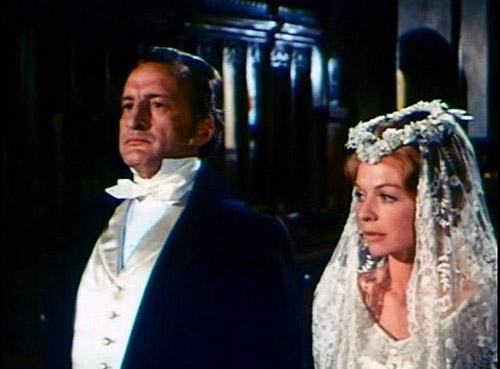
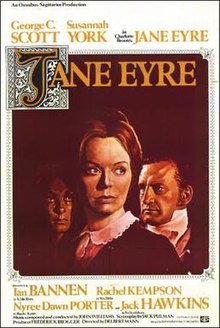
This color film stars George C. Scott and Susannah York. It is an abridged adaptation of the novel, but we do get to see part of Jane's childhood in this film, AND, we do get to meet the Rivers family. True, Jane doesn't learn that they are her cousins, and, true, she doesn't get her inheritance in this adaptation. It is not faithful to the book exactly, but, it's not as free as the 1934 or 1949 adaptations.
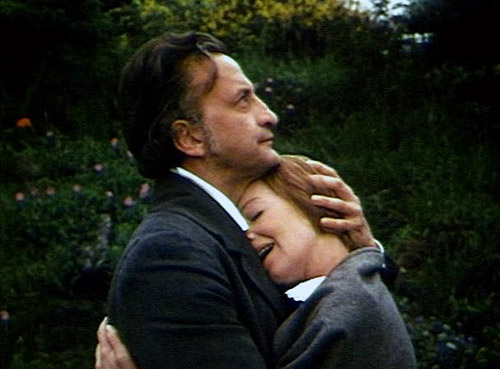
This film does not feel as timeless--TO ME--as the 1944 film starring Orson Welles and Joan Fontaine. I found Susannah York's portrayal of Jane to be lacking. She just didn't look like Jane Eyre; she didn't look the part. I had a hard time believing that she was a young, plain governess. George C. Scott was not my ideal Mr. Rochester either. Some viewers may have a different opinion, of course, but I had a hard time believing in the romance in this film. Their love scenes just didn't quite work for me.

Strengths:
  • Does a better job than some of the earlier adaptations in capturing the whole story of Jane Eyre, but, it's far from perfect, far from complete. We don't meet the Reeds at all in this adaptation. Jane doesn't receive her inheritance, but, she does receive a proposal from St. John Rivers.
Weaknesses:
  • Not the best acting
  • Not the best costumes
  • Feels a bit dated; the soundtrack does not help in this regard
  • Susannah York was too old to play Jane Eyre believably
Jane Eyre (1973) [My review]

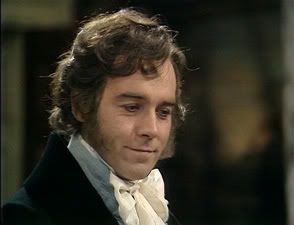
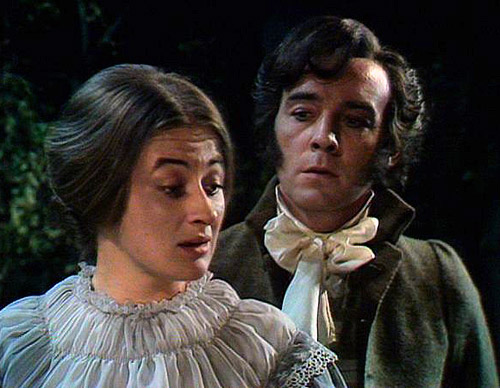
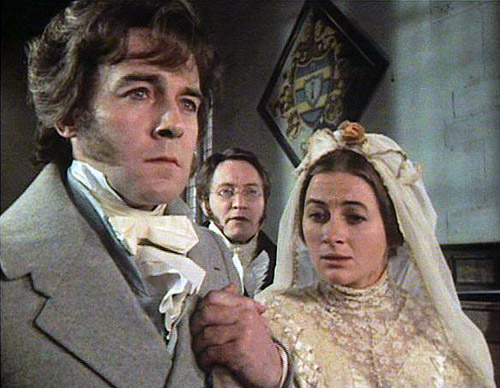
BBC TV miniseries starring Sorcha Cusack and Michael Jayston. It is around four hours long. It is quite faithful to the book. It doesn't just touch on every part of the story, viewers get to watch it all unfold. Between the dialogue and the narration (voiced by Cusack), viewers essentially "have the novel read" to them. Not really. But it sometimes feels that way. Michael Jayston does a GREAT job in bringing Charlotte Bronte's hero to life. Using Bronte's own words, he's ready to make Jane (and viewers) swoon. (He certainly made me LOVE him). He captures the many sides of Mr. Rochester. (I was quite giddy in places!!!) And I just LOVED the ending. If this adaptation has a fault, however, it would be that Sorcha Cusack's Jane is too quick, too clever, too in control. The narration can also be intrusive and distracting at times. But. For the most part, this adaptation is worth viewing especially if you're patient. If you don't love the book, if you're just looking for quick and easy entertainment, this probably won't be for you.
Strengths:
  • Very faithful to the book, for the most part. It's not that the adaptation doesn't take some liberties here and there, it's just that most of the time they are so consistent that small differences don't take away the joy of the whole. 
  • Very faithful in terms of dialogue between Jane and Edward
Weaknesses:
  • May prove too long to some viewers
  • Lacks the quality of a 'real' film (this was a TV miniseries in the 1970s)
  • Jane's narration can be REALLY annoying at times
  • Appears a bit dated in some ways
Jane Eyre (1983) [My review]

BBC TV miniseries starring Zelah Clarke and Timothy Dalton. It is over FIVE hours long. Viewers get to spend over five wonderful, glorious hours with Mr. Rochester and Jane Eyre. This one is very faithful to the novel, and a pure delight to watch!!! Loved Timothy Dalton's portrayal of Mr. Rochester. LOVED, LOVED, LOVED to see him bring to life all the dimensions of Bronte's hero. Here viewers get to see how the *real* Mr. Rochester dressed up as gypsy, and here, viewers get to see Rochester's proper reaction to the big reveal as Jane prepares to leave him. (Though I must admit Jayston did a WONDERFUL job with this as well.) Loved the playful banter between Jane and Edward.

We get to see this relationship develop in a completely delightful way. Zelah Clarke is very, very close to my ideal Jane. Loved just about all the scenes they were in together. I definitely thought the romance worked in this one. Loved to see them tease one another. Yes, Mr. Rochester could tease her, could talk nonsense with her, but she could talk right back to him and hold her own. They were just so believable together.

Where this one may fail a little is in the gothic department. While the romance worked wonderfully, it didn't really capture everything that could be captured from the book. It wasn't mysterious and suspenseful and gothic. It wasn't great at being melodramatic.

Strengths:
  • Incredibly faithful to the book (as is the 1973 adaptation)
  • Very faithful in terms of dialogue between Jane and Edward
  • The romance works really, really well
  • Zelah Clarke is practically perfect in her role as Jane
  • Timothy Dalton is perfect in his role of Edward Rochester
  • Has a very horrid St. John Rivers!
Weaknesses
  • It is OVER FIVE hours long. Not every viewer wants to spend that much time with Jane and Edward.
  • It may seem dated to modern viewers
  • A miniseries from the 1980s, like the 1973 adaptation, this one looks more like a staged play. 
Jane Eyre (1996)

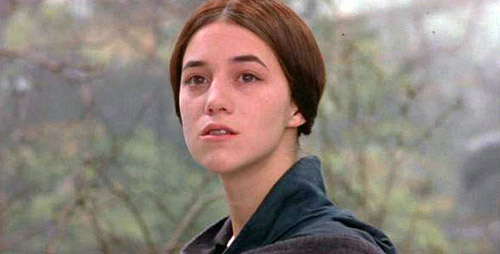
Film starring William Hurt and Charlotte Gainsbourg. I think Charlotte Gainsbourg makes a very lovely Jane Eyre. I really loved her portrayal of Jane. I thought it worked really well. She was just a delight to watch! William Hurt does a nice job as Mr. Rochester. His portrayal is not as forceful, as charismatic as Orson Welles, but, he did move me more than George C. Scott, Colin Clive, and Charlton Heston. While he can appear cranky, moody, or grumpy, viewers don't get the idea that he has a lot of rage and anger inside of him. He does appear broken and frustrated, but, not in an out-of-control way.
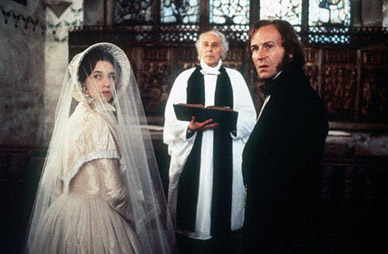
One nice quality to this adaptation is that the ages of the actors are closer to matching the characters...at least in terms of age difference. There is twenty-one years difference between them! So in some ways, they are able to bring Bronte's story to life on screen. While the romance in this one isn't magical, it's not bad either. I liked this movie, for the most part. I thought they did a good job adapting this one to fit for time--it's under two hours. Viewers even get the chance to meet Miss Temple (who is played by Amanda Root!!!).  There were definitely things that I enjoyed in this adaptation. Not that it's perfect, but I liked it. It was a very pleasant way to spend an afternoon.

Strengths
  • One of the better shorter adaptations
  • Charlotte Gainsbourg makes a great Jane Eyre
  • Liked how Mr. Rochester did not respond with violence and threats to Jane when she left him.
  • Enjoyed seeing Jane Eyre paint and draw; loved seeing her sketch Helen and Rochester, for example. It felt natural and right.
  • Really loved the score or soundtrack of this one
Weaknesses
  • The portrayal of Mr. Rochester isn't as forceful or charismatic as it could be. For better or worse. He's not over the top or melodramatic. He's not too angry or too violent. But he doesn't come across as passionate either. 
  • Not as faithful in detail to the original novel; St. John Rivers is NOT her cousin, but, is instead a rector near Gateshead, she first meets him and his sister, Mary, while visiting her dying aunt.
Jane Eyre (1997)

A&E Film starring Samantha Morton and Ciaran Hinds. This adaptation could have worked well for me, if only, if only, if only Ciaran Hinds had done a better job with Mr. Rochester. He tries so very, very, very hard to be mean and angry. It does sound like he's always yelling. And there were scenes when I felt he was just getting it all wrong. He was too angry, too violent, too destructive; Yelling his lines does not make him complex as a character. It doesn't mean that his portrayal was as forceful or as charismatic as Orson Welles. Watching some of his scenes made me want to cringe. There were some scenes that felt more restrained, but, they didn't feel exactly natural to me either. I never really believed that he WAS the character. Everything felt acted. But. I must say that I just LOVED, LOVED, LOVED Samantha Morton as Jane Eyre. I did!!! I thought she was delightful and wonderful. She is everything I imagined Jane to be. She felt just right in the role, a natural in the role. And the abridgment wasn't horrible either. I've seen worse. This film had great potential, but, it didn't quite work for me. I loved elements of it and hated elements of it. For example, Ciaran Hinds took Mr. Rochester to whole other level when he reacted too strongly to Jane's departure. After the big reveal, he took the character where he had no business going. That scene was just WRONG on so many levels. It does a good job at tainting the rest of the film for me.

Strengths:
  • Samantha Morton is a WONDERFUL Jane Eyre. I loved everything about her portrayal.
  • While it may not be quite as enjoyable, overall, as the 1996 adaptation. It is A LOT better than the 1970 adaptation!!!  The film is lovely in places, and well worth watching.
  • This adaptation had just the right amount of narration. 
Weaknesses:
  • Presents some of the characters differently than in the book. 
  • Is definitely an abridgment that makes some changes. She does NOT inherit money in this one, for example.
  • Ciaran Hinds is NOT my ideal Rochester. I did NOT like his portrayal of the character at all.
Jane Eyre (2006)

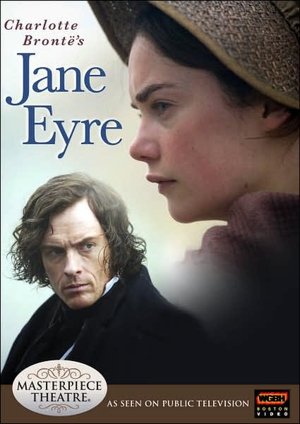
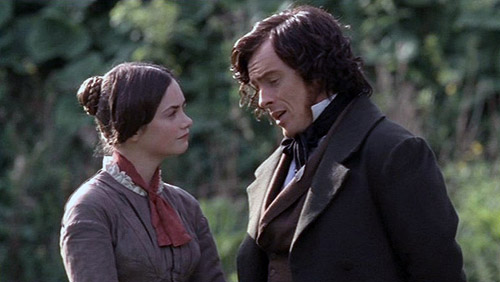
BBC miniseries starring Ruth Wilson and Toby Stephens. This film isn't quite four hours long. It has plenty of time to be faithful to the book, but is it? Every viewer will probably have an opinion on that. I feel it does take liberties with the dialogue--meaning that the words Jane and Rochester speak do not necessarily come from Bronte, and they may not even be true-in-spirit to Bronte's original. Also, there are a few scenes that take a LOT of liberty.
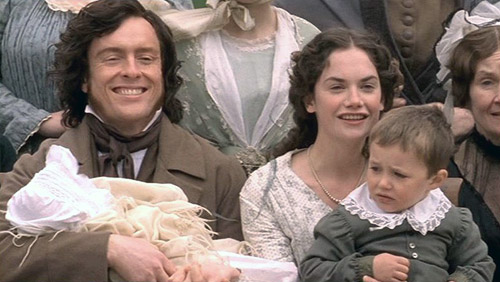
Meaning Rochester does NOT act like Rochester and Jane does NOT act like Jane. Some viewers may love these changes, others not so much. Toby Stephens does have charisma. Some charisma at least! And he plays his role well, for the most part. With drama, power, and passion. And he'll charm plenty of viewers, I'm sure. But. He's not my ideal Rochester. Ruth Wilson is a nice Jane Eyre. I'm not sure she's my ideal Jane Eyre, but, she does a nice job with the character. If the script had been more faithful, or even more faithful, perhaps, then this one might have wowed me. In many ways it is a beautiful film, and it's easy to see why it's a favorite with some viewers.

Strengths:
  • Great film, has plenty of gothic ambiance, very entertaining.
  • Gives the appearance of being faithful to the book, for the most part, covers Jane's childhood, her school years, her leaving Lowood for Thornfield, etc. A good amount of time is even spent with the Rivers. 
  • Nice romance between Jane and Edward; I felt too much liberty was taken here, but, for the most part it worked.
  • The film is a nice length; longer than some adaptations (1944, 1970, 1996, 1997) and shorter than others (1973, 1983). 
Weaknesses:
  • Not as faithful to the book as I'd hoped; some liberties are taken with some characters
 Jane Eyre (2011)

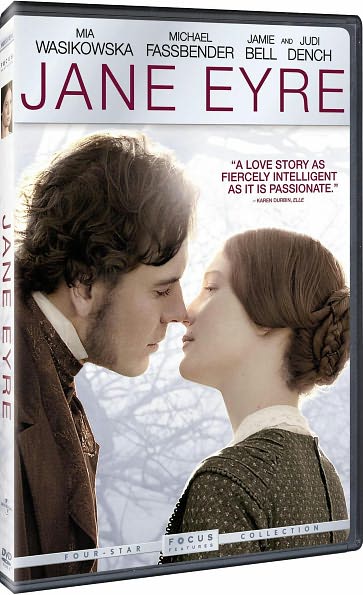
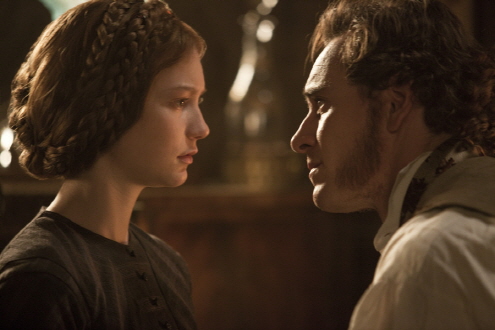
Film starring Mia Wasikowska and Michael Fassbender. This film definitely has a feel and style all its own. It is completely unique in its storytelling--among Jane Eyres, at least. It begins with Jane RUNNING away from Mr. Rochester and his mad wife, Bertha Mason. A desperate Jane Eyre is your first impression. It is only after she finds refuge with the Rivers family (not her cousins, by the way) that her story unfolds in a series of flashbacks. This is not my favorite Jane Eyre adaptation. I don't think Mia Wasikowska is the best Jane ever. But I don't think she's the worst either. I think her portrayal is good. And if given enough time on screen, perhaps, Michael Fassbender could have made a good Rochester. But there's not enough time spent with the characters, with Jane and Edward, to develop a satisfying romance. I think I would be able to enjoy this film more IF it had had a proper ending. I feel this movie has a non-ending. (Another Jane Eyre film with an unsatisfying ending is the 1970 adaptation.) The ending needed to wow, to be as magical as the 1996 ending OR the 2006 ending. It needed something MORE. Instead it has a blink and you'll miss it ending.

Strengths:
  • Unique and original in its storytelling; you may love it, you may hate it, but it knows how to be different from all the other adaptations
  • Good film, very gothic, great at ambiance; looks beautiful
  • Mia Wasikowska is a believable Jane Eyre
  • Judi Dench is a good Mrs. Fairfax
Weaknesses:
  • Michael Fassbender's portrayal of Mr. Rochester didn't quite satisfy me. I think if he'd acted better after the big reveal; if he hadn't been portrayed as out of control and violent and over-the-top, then, I might have liked him better. His reaction  is NOT as bad as Ciaran Hinds, however.
  • Perhaps because of its arrangement, it doesn't necessarily feel true to the book; this could just be perception, however. 
  • Not enough time spent with dialogue between Mr. Rochester and Jane Eyre; not quite enough character development. 
Now, I'll rank my Mr. Rochesters

10) Charlton Heston
9) George C. Scott
8) Colin Clive
7) Ciaran Hinds
6) Michael Fassbender
5) William Hurt
4) Toby Stephens
3) Orson Welles
2) Michael Jayston
1) Timothy Dalton

And now for my Jane Eyres

10) Mary Sinclair
9) Susannah York
8) Virginia Bruce
7) Joan Fontaine
6) Mia Wasikowska
5) Sorcha Cusack
4) Ruth Wilson
3) Charlotte Gainsbourg
2) Samantha Morton
1) Zelah Clarke

The best adaptation around two hours: Jane Eyre (1944);
The best adaptation over two hours: Jane Eyre (1983)
Well worth watching: 1973, 2006, 1996, 2011, 1997
Worth watching just for laughs: 1934, 1949
Least Favorite: 1970
My favorite soundtrack: 1996
My least favorite soundtrack: 1970

© 2012 Becky Laney of Becky's Book Reviews

Sunday, July 08, 2012

The Sunday Salon: Watching Jane Eyre (1996)

This week I'm sharing my thoughts on the 1996 film, Jane Eyre. This adaptation stars Charlotte Gainsbourg as Jane Eyre and William Hurt as Edward Rochester.

I have been having so much FUN watching all these adaptations of Jane Eyre. You might not think it would be fun to watch Jane Eyre and only Jane Eyre for weeks at a time, but, surprisingly enough I am having a delightful time with this project of mine. Why? Even though not every adaptation gets every, little thing right, even though some interpretations of Bronte's original novel don't make me giddy in delight--even though a few scenes in a few adaptations make me cringe--I have found enough to enjoy in each and every adaptation.

For the most part I enjoyed this adaptation of Jane Eyre. I really enjoyed William Hurt as Mr. Rochester. I think he did a good job in capturing Charlotte Bronte's hero. Perhaps he isn't fully-fully realized or brought to life in this adaptation, a few scenes are missing, a few exchanges are missing, but, for the most part he plays the role right. (The gypsy-fortune-teller scene is missing from this adaptation. And some of the couple's conversations are cut short or eliminated from this abridgment.)

The film did a good job in adapting two tricky scenes. I thought this film did a great job in portraying the first meeting between Mr. Rochester and Jane Eyre. This is closer to how I imagined it from the book. Perhaps this stood out to me because I thought it was done so horribly in the 1997 adaptation.
The second scene that has proved oh-so-tricky to get right is after-the-non-wedding, post-big-reveal scene. This movie gets a passing score not so much for what it does, but for what it doesn't do. It isn't a monstrous temper tantrum or a make-out session. Rochester isn't yelling, screaming, grabbing, pushing, pulling, or demanding.

NOW, what happens after she leaves, well, that certainly deviates from the book!!! Perhaps it took inspiration from the 1934 film?

Overall, this one does take liberties with the book. It is not as faithful as it could be. St. John Rivers is not her cousin, he is rector at Gateshead or near Gateshead. She meets St. John Rivers and his sister, Mary Rivers, not in her desperate hour of need when she's running away from Mr. Rochester, but, instead when she goes to visit her dying Aunt Reed. She returns to them after her bitter disappointment, but, they are already acquainted with her. She does inherit her money (unlike the 1997 adaptation) but she's never as desperate and friendless in this one. For St. John Rivers and his sister know they are taking care of a wealthy heiress.

My general thoughts are this was a very nice, very pleasant, very enjoyable, non-offensive adaptation of Jane Eyre. It may not be WOW, WOW, WOW this is the best Jane Eyre EVER, but, it works really well, in my opinion. It's a nice abridgment, nothing *too* essential was lost. And the romance was nicely done. I thought the age difference between the two worked. (In some adaptions, they are too close together in age to be believable as Jane and Edward. For example, in the 1944 adaptation starring Orson Welles and Joan Fontaine.) I enjoyed both William Hurt's portrayal as Mr. Rochester and Charlotte Gainsbourg's portrayal as Jane Eyre. Essentially, I thought they got all the most important elements right in this adaptation. True, it could have been longer, and if it had been longer, they could have been more faithful to the book or even more faithful to the book. But I think they did a good job in capturing the heart of the original. For this reason, I think I prefer it now to the 2006 adaptation. And I definitely prefer it to the 1997 adaptation.

First conversation
Second conversation
Third conversation
Jane Rescues Mr. Rochester (fire scene)
Blanche Ingram and "guests" on governesses
The Proposal 
The Wedding
Jane Leaves Mr. Rochester after the big reveal

Have you seen this adaptation? What did you think? Do you have a favorite adaptation?

Other Jane Eyre (movie) reviews

© 2012 Becky Laney of Becky's Book Reviews

Sunday, July 01, 2012

The Sunday Salon: Watching Jane Eyre (1997)

Today I'm sharing my thoughts on the 1997 adaptation of Charlotte Bronte's Jane Eyre. This film stars Samantha Morton and Ciaran Hinds.

Was it faithful to Charlotte Bronte's novel? No and Yes. OR, if you prefer, yes and no. Did every character from the book make it into the film? NO. Did every scene from the book make it into the film? NO. Did every important character and every important scene make it into the film? Well? I don't know how to answer that.

For example, in this adaptation, Jane does NOT learn that the Rivers are her cousins, and she does NOT inherit the money from her dead uncle. Rosamond Oliver and Mary Rivers have both disappeared from this adaptation. But how important are the Rivers to the story as a whole? Do people love Jane Eyre because she runs away and spends time with cousins she didn't even know she had? Or is the romance itself most important to readers and viewers?

Another example, in this adaptation, Jane does leave Thornfield Hall to visit her dying aunt, but, if you blink you'll miss it. Because within seconds of her leaving she's returned. We're told she spent a month there, but, we don't see a minute of it. You have to ask yourself if you love Jane Eyre because of those scenes, that time spent with her dying aunt, and her Reed cousins, or do you love Jane Eyre because of the main story with Mr. Rochester and his mad wife. 

Was it faithful to the book where it counted the most? Was it faithful in the character of Jane Eyre? Was it faithful in the character of Mr. Rochester? Did it do justice to their romance? Were the scenes between Jane and Edward done properly? Did the actors interpret the characters in a way that was true to the book? Did anything feel off? 

I happened to enjoy Samantha Morton as Jane Eyre. I really, really liked her in this role. I thought she did a great job being Jane. I loved her narration, for example. I thought she did a good job with getting the character right. She is definitely a good reason to watch this adaptation.

As for Ciaran Hinds, well, it's hard for me to say. For one thing, a couple of his scenes made me want to cringe. Truly. I did not like the way he portrayed Mr. Rochester. There were a couple of scenes I thought he was TOO angry, TOO violent, TOO forceful, TOO scary, TOO intimidating, TOO dramatic. Particularly the oh-so-crucial after-the-non-wedding, post-big-reveal scene. His temper tantrum is just so out of character. He's way too physical, too physically abusive--bordering on it anyway. And the whole scene just makes me cringe. That is NOT the way it's supposed to go, that is NOT how it was handled in the book.

And at times I felt Hinds' Mr. Rochester was not dimensional enough, sure, he got a few of the emotions down, but, did he capture the full complexity of Bronte's hero?! I'm not sure he did. Also, on a more personal note, the mustache and sideburns bothered me. From certain angles, I kept seeing Tennessee Ernie Ford. (When I wasn't thinking of this animated villain.)

Was this adaptation faithful when it comes to portraying the relationship between Jane and Edward? I think it was. I think the dialogue between them worked. I think many of their scenes were faithful to the book--for the most part. 

I thought this was a very comfortable Jane Eyre to watch. It was just around two hours. You could sit and watch it comfortably all at once. Yes, it condensed things, yes, certain things were missing from this adaptation. But it made sense, it flowed smoothly. I found many, many things delightful about it. I enjoyed many of the scenes, of course, I had issues with a couple of scenes. I didn't particularly love the first meeting between Jane Eyre and Mr. Rochester, I thought it was way too dramatic, definitely over-the-top. But other scenes made up for it, in my opinion.

I did think the film did a good job creating ambiance--at capturing the gothic elements of this one. There were scenes that captured the mystery, suspense, and horror of the original.

I thought Abigail Cruttenden brought something unique to Blanche Ingram--for better or worse. In this film, she was portrayed sympathetically, or more sympathetically than in other adaptations. While we're still told that she was mainly after Mr. Rochester's money, she's not portrayed one-dimensionally as vain and haughty. While she may not be exactly friendly towards "the governess." She doesn't come across as mean and deserving of what she gets. (That is Mr. Rochester using and manipulating her, leading her to believe one thing, but in all truth just trying to make Jane jealous.) Is that a good thing? Well, I suppose that depends on your perspective. Would a nice Caroline Bingley work in Pride and Prejudice? Are people so determined to not like Blanche Ingram that this slightly modified Blanche would offend? I'm not sure.

 St. John Rivers is likewise portrayed sympathetically. He doesn't come across as offensively as he does in other adaptations. He actually seems quite nice, quite pleasant, as someone who actually has people-skills.

Have you seen this adaptation? What did you think of it?

Watch Jane Eyre
  • If you're a fan of the book
  • If you're a fan of Victorian period dramas 
Other Jane Eyre (movie) reviews


© 2012 Becky Laney of Becky's Book Reviews
Sunday, June 24, 2012

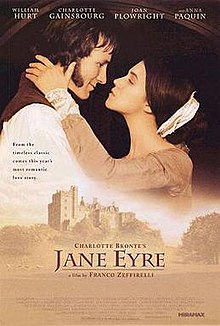
The Sunday Salon: Watching Jane Eyre (2006)

Last Sunday, I reviewed my favorite adaptation of Jane Eyre starring Zelah Clarke and Timothy Dalton. This Sunday, I am ready to discuss the 2006 adaptation of Jane Eyre starring Ruth Wilson and Toby Stephens. This was the first time I've seen this adaptation since discovering the other one. And it had been a good two years since I'd seen this adaptation, so I was more than happy to reacquaint myself with this film!!!

So, you already know that this one isn't my favorite, favorite, favorite Jane Eyre. But I thought I would share specifically what I liked and didn't like about this adaptation.

I loved Georgie Henley as the young Jane Eyre. I just LOVED her! This adaptation hardly spends time on Jane's childhood, but for what we do see in those short minutes it was love. Granted, I will always see her as Lucy (from The Lion, The Witch, and The Wardrobe), and so that does bias me a little in her favor. But I thought they included just enough of her childhood to flavor the movie.

I loved Christina Cole as Blanche Ingram. Out of all the Jane Eyre adaptations I've ever seen--four or five at this point?--she is the BEST Blanche I've ever seen. The scenes with Blanche and the other house guests worked so incredibly well. Viewers know that Mr. Rochester is just using Blanche to make Jane Eyre jealous, that he is manipulating both women. But we also get a sense that Blanche is using him as well, that she sees him purely as status and wealth. And so it's easy to excuse Mr. Rochester perhaps. Still, he's technically in the wrong.

There were a few scenes that I liked (a little) better in this adaptation. For example, when Jane Eyre "saves" Mr. Rochester when his bed curtains are on fire. The aftermath of that fire when they're talking and he holds her hand. It is in the 1983 adaptation too, of course. But in this movie, viewers see Jane Eyre go back to bed. And the emotion she conveys actually reminds me a bit of "I Could Have Danced All Night" from My Fair Lady. Viewers catch a glimpse of Jane Eyre's love for Mr. Rochester, and how she holds him dear, and how she is treasuring up his touch of her hand. It could be viewed as silly, I suppose, but I think it's heartfelt too.

Adele. The scene where we first meet Adele was nicely done. I liked meeting her in this way, with her singing and "performing" in French. The subtitles translating the song were quite effective. They conveyed to the viewers part of Adele's tragic background. And I think we do catch glimpses of her neediness, her desperation for love and acceptance and family. True, she may appear a brat, a horribly spoiled brat, but, I think there is something more that could be there. But this isn't Adele's story, and, it's easy to forget about her completely.

Her cousins. Well, in this adaptation St. John Rivers does not come across as a horrible-horrible-horrible man. For better or worse depending on how you read Bronte's novel! And his sisters do have a young, vibrant feel about them in this adaptation. In the 1983 adaptation, they appear much older, much more settled, content with what little they have and not expecting life to offer them any entertainment or thrills. 

I do think this adaptation does a better job with ambiance, capturing the gothic elements of the novel, and the movie is more sophisticated and polished in terms of sets, scenery, costumes, soundtrack, etc. 

But. This movie does take liberties with the story and the characters. Mr. Rochester's scenes with Jane Eyre aren't necessarily going to be from the book, or true to the book, or true to the spirit of the book. In some scenes, yes, they are similar enough that it works...especially if it's been a few years since you've last read the book. The fuzzier your memory is, the better. And some scenes do feel like they could be authentic enough to the book because they get the characterization right. But. In other scenes, well, liberties were taken.

There were two scenes that bothered me in this adaptation, the two scenes with the most liberties taken. One scene was the "after wedding" scene, but, really it is the after-the-non-wedding scene. It is very sensual, too sensual in my opinion. Jane Eyre and Mr. Rochester on a bed kissing and caressing while he tries to make excuses for his having kept his mad-wife a secret AND trying to convince Jane that he wouldn't try to tempt her if only she would consent to travel with him and go far away, they could live as brother-and-sister. I didn't buy that argument for a second, if, he truly respected her and wanted to be completely honorable he wouldn't have her on a bed right then and there trying to use his kisses to convince her to stay. This scene is completely wrong for a couple of reasons. One, it is NOT true to the book, not true to the characters, not true to Charlotte Bronte. You'd never find the scene written out like that in Charlotte Bronte's novel. The novel uses words, charismatic words spoken by a passionate Mr. Rochester, to try to convince Jane to stay, to try to help her understand. Read the scene from the book and it is SO MUCH BETTER. The second scene that bothers me is the near-ending where Jane and Mr. Rochester agree to marry and live happily ever after. The book is SO MUCH BETTER. And the changes they made just didn't sit well with me.

So what did I think of Toby Stephens as Mr. Rochester? Well, I thought he did a good job in some parts, in some ways, in some scenes. Some of his scenes worked better than others. But. He did a good job. He was likable. He was charismatic. He was passionate. You could tell *why* Jane Eyre would be drawn to him. And the film does a good job in building their relationship. But he isn't Timothy Dalton. And he's not completely true to the book, true to the spirit of the book.

I did like Ruth Wilson as Jane Eyre. I  thought she did a good job in her role as Jane. But I'm not sure I like her better than Zelah Clarke. But she's definitely one of the reasons why this adaptation works so well and has so many fans.

Watch Jane Eyre
  • If you love Jane Eyre
  • If you love period dramas
  • If you love historical romances
  • If you love good drama 
ETA: Other Jane Eyre (movie) reviews
Coming soon:
1996
1997

© 2012 Becky Laney of Becky's Book Reviews

Friday, June 22, 2012

Jane in the Seventies

Today I'll be sharing my thoughts on TWO adaptations of Charlotte Bronte's Jane Eyre, both adaptations are from the 1970s, but they are so DIFFERENT from one another. One I'd definitely recommend, the other, well, not so much.

I'll start with the one I wouldn't really recommend, the 1970 adaptation starring George C. Scott and Susannah York. The only thing that *may* save this one from being the worst Jane Eyre ever it is my recent discovery of the 1949 TV episode adaptation of Jane Eyre starring Charlton Heston and Mary Sinclair. And then there is always the 1934 adaptation with Colin Clive and Virginia Bruce. So it would not be an easy automatic decision.

What can I say about this adaptation of Jane Eyre? Susannah York did NOT make a convincing Jane Eyre. While this couple managed to still have a twelve year age difference, it wasn't because she was so young, quite the reverse. She was over thirty and trying to play a young woman of eighteen, nineteen, or twenty. It did NOT work well. In my opinion. She was not convincing in her role as a young, plain governess. And I had a hard time believing in the romance of this couple. George C. Scott, likewise, did not make a convincing Mr. Rochester. In fact, none of the actors--at least the human ones--were quite believable in their roles in this movie. (The horses and Pilot did okay for the most part.) Now, some did better than others. I won't lie. Not everyone was equally horrible. And part of the trouble could have been the script. (The Rivers family are not her cousins, she doesn't receive an inheritance, etc. Also the Reed family does not appear at all.)

I believe there are some issues with some DVD productions being extremely low quality--in terms of picture quality, sound quality, etc. And I do believe that played a role in why I found this one so painful to watch. But only partly. Because better sound quality wouldn't necessarily have made me appreciate the score to this film any better. I found it very intrusive. It just didn't feel like it was written for this movie. 

The second adaptation I will be discussing is the BBC adaptation of 1973. This adaptation is shorter than the 1983 adaptation starring Timothy Dalton and Zelah Clarke. But. It is faithful--quite faithful--to the book. A few might even say more faithful. Then again a few might say it wasn't as faithful as it might first appear to be. (For example, this one does have Mr. Rochester dressing up as a gypsy and telling fortunes! However, this Jane is not fooled for even half a second. Before she even goes to see the gypsy, before she even hears him speak, she claims to have known it was Mr. Rochester all along. He's not able to really talk with her in disguise at all. The scene is not as vulnerable perhaps. So on the one hand, Jane's "cleverness" is maintained and she never loses control, but, is that a good thing? Is this interpretation the best one? Here's the 1983 one for comparison.)

Is this adaptation for every viewer? Probably not. It is just over four hours in length. For viewers unfamiliar with other BBC adaptations from the 1970s and 1980s, the production quality may seem low. It doesn't necessarily feel like a proper movie. It doesn't have this grand, sophisticated, polished feel to it. The sets, the scenery, the costumes, the landscapes, the filming isn't as grand. Don't be surprised to find reviews calling it boring and unwatchable. It's all a matter of taste and preference. For viewers who are READERS, for viewers who LOVE, LOVE, LOVE the novel, Jane Eyre. For viewers who passionately care for Bronte's novel and hold Bronte's words in high esteem, it doesn't really get any better than this. (Same with the 1983.) I read a review of the 2011 movie that said it [the 2011 movie] was better because it didn't try to read the book to viewers. And it made me smile a little. It's all a matter of taste. Faithfulness--particularly faithfulness in dialogue between Jane and Edward--is SO VERY VERY VERY important to me. And this one has it, for the most part.

I will say that this adaptation was heavy in narration. And that sometimes the narration was intrusive. The narrator stating what was so clearly obvious to one and all. In a few scenes, this bothered me a lot. I kept thinking it would be near-perfect if the narrator would quiet down and let me watch in peace. But. For the most part. I did like this adaptation.

It stars Sorcha Cusack as Jane Eyre and Michael Jayston as Edward Rochester. While I didn't love, love, love Cusack as Jane Eyre (I liked her well enough but didn't quite love her), I absolutely LOVED, LOVED, LOVED Michael Jayston as Mr. Rochester. With each episode, I came to love him more. And by the time he proposed, well, I was extremely giddy to say the least.

This adaptation got many things right. I loved the romance of this one. They make a very good couple. And while this Jane smiled a little too much, I loved the twinkle in Rochesters eyes.

First Conversation, part one, part two
Second Conversation, part one, part two
Third Conversation
Guests at Thornfield
The Proposal
Conversation After The Proposal (Next Day)
Mr. Rochester as Gypsy
Meeting Mr. Rochester
Fire Scene
After the Big Reveal

© 2012 Becky Laney of Becky's Book Reviews

Watching Jane Eyre (2011)

Do I have thoughts and opinions on the newest adaptation of Jane Eyre? Of course, I do!!! But they have calmed down a little since my first viewing of the film last fall.  My first impression was that it was a horrible adaptation. It felt like they shuffled the pages of the script and didn't care to sort them out properly again. I just didn't understand why anyone would want to play around with the timeline and pacing. Why start the movie with Jane Eyre on the run? Why put viewers on the same page with the Rivers family? Why start there?! If you've never read Jane Eyre--never seen a movie version--it could prove VERY confusing to say the least. And I can only guess that it would influence one's impression of Mr. Rochester when we do finally meet him. Knowing from the start that this love story ends badly--with tears, angst, desperation, she's RUNNING away, etc.

Would this movie make any sense at all if you'd never read Jane? Is there enough of a story there for viewers to piece together the proper story? I can never answer that because I've read Jane Eyre and I've seen Jane Eyre countless times. I didn't necessarily find it confusing--in terms of story--more puzzling in terms of WHY did they choose to interpret it this way? The two are not the same, I know!!! The story does feel rushed, in a way, especially if you're more accustomed to a longer adaptation (2006, 1983, 1973). But it doesn't feel AS rushed as it used to feel to me since I've seen other adaptations that were comparable in length (1944, 1996, 1997, 1970). And compared to the hour-long adaptations I've seen (1934, 1949) this one was so much better.

My first impression of Michael Fassbender in the role of Mr. Rochester was not favorable. Seeing it again, I've softened a little. At first, I thought he got so little time on screen that it would be absolutely impossible to like him--or love him--for his character, personality, charisma, whatever you want to call it. But. Now that I've seen some other (shorter) Jane Eyre adaptations, I realize that it's not so horrible after all. Other adaptations--longer adaptations--give you MORE to love, perhaps. They may add different dimensions to the character of Mr. Rochester--for better or worse--and have their own way of interpreting Mr. Rochester, bringing him to life from the pages of a novel. But I think he does try. One reason why I had such a strong dislike for this portrayal was in how he chose to "react" to Jane's resolution to leave. His anger, his violence, his temper was SO out of control, so over the top. But having seen the 1997 film starring Ciaran Hinds, I have a different perspective. His rage doesn't seem as over-the-top to me because Hinds performance was even worse. Granted, I still don't "like" this scene; it still makes me uncomfortable. But I've seen worse now.

My first impression of Mia Wasikowska in the role of Jane Eyre was not the best either. I didn't dislike her by any means. The problem was that she didn't leave much of an impression at all--either good or bad. She just left me indifferent. How do I feel now? Well, I can say with absolute confidence that she is so much better (or better suited) in the role than Susannah York, Mary Sinclair, and Virginia Bruce. She at least feels like she belongs to this story. And while she may not have amazed me with her performance, she does a good job. Nothing in her portrayal of Jane is unbelievable or out of character. Nothing she adds to the role offends in any way.

© 2012 Becky Laney of Becky's Book Reviews
Wednesday, June 20, 2012

Watching Other Janes

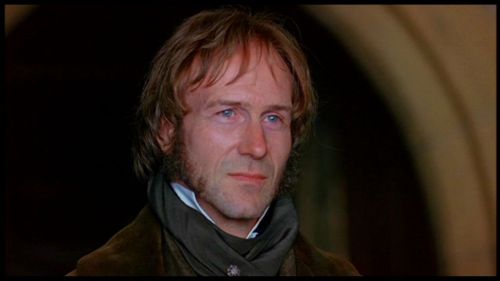
Today I thought I would share with you my thoughts on early adaptations of Jane Eyre. The 1934 adaptation starring Colin Clive and Virginia Bruce, and the 1944 adaptation starring Orson Welles and Joan Fontaine.

The 1934 adaptation is almost comical. I'm not sure comedy was the intent, but this adaptation is only an hour and five minutes!!!! If you found some of the newer adaptations rushed (2011, 1996, 1997, etc.) then you may not believe how condensed it can be. There is also something awkward about this adaptation. Virginia Bruce is just not convincing as Jane Eyre. Not in any way. (And I really wish her clothes had fit her. The costumes just do not hang right on her, they just don't fit. OR else they were trying really hard to make them as unflattering to her as possible.) I could talk about all the hundreds of details that just weren't right about this edition, or you could watch for yourself.  But despite all that, I do consider it worth watching...if you're a big Jane Eyre fan! OR if you just want a GOOD laugh!!!!

Jane Eyre meets Mr. Rochester *before* she even meets Mrs. Fairfax or Adele
Jane (in a frilly dress) has her first conversation with Mr. Rochester and sings 
Naughty Adele in a Tree
Jane Puts Out the Fire All On Her Own
Adele being absolutely ridiculous in front of the guests but charming too
Mr. Rochester tricks Jane leading to the...  Proposal
Now this certainly wasn't in the book....OR...this Bertha doesn't quite look crazy

I recently rewatched the 1944 adaptation of Jane Eyre starring Orson Welles and Joan Fontaine. I watched it at the first of the year and liked it, this time I may even have loved it. I think I appreciated Orson Welles' Mr. Rochester even more than before. One thing I've come to appreciate are the scenes between Jane and Edward. Particularly the oh-so-crucial scene between them after the big reveal. Orson Welles got this just right. He wasn't absurdly violent, he wasn't abusive; his heart ache and pain was transparent. He was full of sorrow and regret. Anyway, I thought this adaptation was great in the romance department. Passion, romance, drama, this movie has it in abundance. And this adaptation even features Jane as a child, even takes time to have her become good friends with Helen. True this one doesn't have her cousins or her inheritance. No St. John Rivers to propose marriage giving Jane Eyre an alternative. But. It does have John Sutton as "Dr. Rivers" the man responsible for saving the young Jane from her misery. Is it melodramatic? Yes. Is it entertaining? Yes!!! Is it worth watching?! Definitely!!!

I also appreciate this adaptation because of the childhood scenes we get with Jane, Helen, Mr. Brocklehurst, Mrs. Reed, and Dr. Rivers. I really enjoyed Agnes Moorehead as Mrs. Reed--she was wonderful! And Henry Daniell as Mr. Brocklehurst, well, he's so brilliant at being evil!!! (Helen is played with Elizabeth Taylor, and she is quite angelic.)

Jane Eyre meets Mr. Rochester
The Oh-so-dramatic proposal 
The Happy Ending

I also watched a television adaption from 1949 starring Mary Sinclair as Jane Eyre and Charlton Heston as Edward Rochester. This may just be the worst Jane Eyre ever. It just doesn't work on any level. It's not entertaining; it's not believable as a drama, horror, or comedy. It takes an incredible amount of liberties with the book. There's not one character that is believable or likable in this production. Was it the acting? Was it the script-writing? I'm not sure. But I do think it's sad that the two commercials for Westinghouse products--the first for an electric range with not one but two ovens, and an electric sheet so you don't have to sleep with twelve pounds of blankets to stay warm--are more interesting than the drama itself.

Part one, part two, part three, part four.

© 2012 Becky Laney of Becky's Book Reviews
Sunday, June 17, 2012

The Sunday Salon: Watching Jane Eyre (1983)

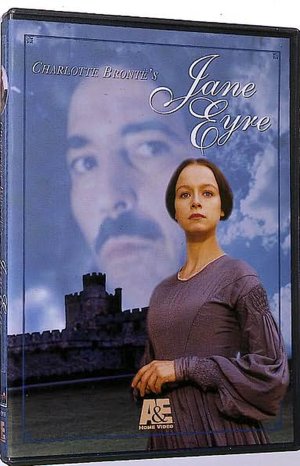
Jane Eyre is one of my favorite, favorite, favorite books. It's a book that I just love and adore. So it's only natural that I have a favorite adaptation, right?! Before viewing this 1983 adaptation starring Timothy Dalton and Zelah Clarke, my favorite Jane Eyre was the 2006 adaptation starring Ruth Wilson and Toby Stephens. (Though it's only fair to point out it was the only adaptation I'd seen...at the time. Now I've seen quite a few!) And I'll be reviewing it too in the next week or so--but this one, well, this one is the BEST one.

What makes this one the BEST version of Jane Eyre? Well, it is so very, very faithful to the book. If you LOVE the book, if you love Bronte's writing, her dialogue, her pacing, her characterization, etc., then this one could hardly disappoint. There isn't as much interpretation going on, there aren't as many liberties taken with the story, the characters, the dialogue, the scenes. For better or worse. (I admit that some (but by no means all) of the added scenes in the 2006 adaptation were lovely, were faithful in spirit to the original novel, but they still weren't exactly in the book.)

It does help that this adaptation is over five hours in length!!! 311 wonderful minutes; 11 episodes of 28 or 29 minutes apiece. Because it is so long--the perfect length in my opinion--nothing felt rushed, nothing was left out for time, nothing left unexplored. Time could be spent on her childhood, her school years, even her time as a teacher at Lowood while she's waiting to hear a reply to her advertisement. Time could be spent at Thornfield Hall; viewers get a real chance to get to know Mrs. Fairfax and Adele, a chance to be spooked by Grace Poole. And then, of course, there is the arrival of Mr. Rochester.

There is just something wonderful in Timothy Dalton's portrayal of Mr. Rochester. There is just something wonderful in his scenes with Jane. For what this adaptation realizes is that the foundation of this romance, the heart and soul of it, are revealed in their conversations together. And these are absolutely faithful to the book. Nothing is rushed or abridged; nothing is forced or assumed. Dalton's Rochester is complex, is multidimensional. And this is a must, in my opinion. He must be capable of being polite and stern and playful and teasing and charismatic and mysterious and angry and tender and soulful. He's very much a character that needs to be in control yet at the same time capable of being vulnerable. And he just feels like the right Mr. Rochester. (Orson Welles, I felt, was great at being a forceful, melodramatic Mr. Rochester. If capturing GOTHIC is your only criteria, well, he did that quite well.)

And I quite enjoyed Zelah Clarke's performance as Jane Eyre. She captured Jane's shyness and awkwardness and hesitation. But as she became more comfortable--both with herself and with Mr. Rochester--she became more outspoken, more playful, more assertive. I still saw her as an introvert, but, in my opinion that is NOT a bad thing at all. It made me love her more. In this adaptation, I felt I knew exactly why Mr. Rochester was so drawn to her: her honesty, her vulnerability. Here was a woman who was incapable of deceit, of manipulation. Here was a woman who was free from conceit and vanity and pride. Here was a woman who didn't know how to play games with men, didn't know how to flirt, how to charm, how to manipulate. And even if she knew how, she'd never dream of it.

Their relationship develops slowly but surely, and I believed every minute of it. It didn't felt rushed. And it didn't feel reliant on appearances. (Whereas in the 2011 adaptation viewers who connect with that Mr. Rochester are forced to either base the swoon factor on his appearance OR on their imagination, what they bring to the film based on their experience with the book. For it is not in his script to cause anyone to fall in love with him.) There was a genuineness in the relationship that was so refreshing.

While this adaptation isn't the absolute best at capturing the gothic ambiance, it did an adequate job at presenting things as they were: the incidences leading up to the big reveal. I personally feel that this adaptation--the 1983 one--is best at capturing what happens after the big reveal. Most make the mistake of going completely, completely over the top and to all extremes. Read the scene(s) in the book after watching some of the other adaptations and you'll see what I mean. But this one gets it just right. You can see the pain, the heartbreak, the sorrow, the regret, the tenderness, the torture.

I thought the film did a good job with Jane's cousins as well. They truly captured the hideousness of St. John Rivers!!! In some versions you merely get that he was not the one, or not the one for her, but that he wasn't a bad sort of guy. That he was capable of making someone happy, not just Jane. In this one, his views on marriage, on women, on love, on duty, on relationships was so horrid, so horrible, so offensive that it was EASY to see why he's not husband material. ("God and nature meant you for a missionary's wife. You are formed for labor, not for love. I claim you. Not for my pleasure but for my sovereign service." And if that wasn't enough...."Jane, you are docile, disinterested, faithful, and courageous. Very gentle and heroic.") Enjoyed her (unspoken) commentary on his proposal! And I loved, LOVED, loved her spoken rejection!

And I loved the ending!!!!

The Proposal
After the "Wedding,"  
Jane With Her Cousins, Receiving Her Inheritance, the other "proposal"
Fan Music Video for Jane Eyre

Have you seen this adaptation? What did you think of it? What is your favorite adaptation? Are you willing to watch other adaptations?

Watch Jane Eyre
  • If you're a fan of Charlotte Bronte's Jane Eyre
  • If you're a fan of romantic, dramatic, mysterious movies
  • If you're a fan of Timothy Dalton
  • If you're a fan of period dramas 
© 2012 Becky Laney of Becky's Book Reviews