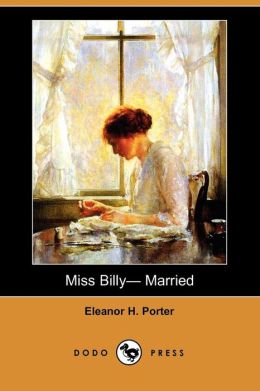
Miss Billy Married. Eleanor H. Porter. 1914. 240 pages.
Miss Billy Married is the conclusion to Eleanor H. Porter's Miss Billy trilogy. The first novel was
Miss Billy and the second was
Miss Billy's Decision. The first two Miss Billy novels were published before the oh-so-successful publication of the children's novel, Pollyanna in 1913. (Other popular authors of the time were Jean Webster, L.M. Montgomery, and Grace Livingston Hill.)
Billy has married Bertram Henshaw, and the two are living with brother William. (The other brother, Cyril, has moved with his wife, into a home of their own.) If Billy, our heroine, has a weakness, that weakness would definitely be thinking too much and making things more complicated than they need to be. (Though one could argue that she doesn't think enough in some places!) For example, Billy will read an article--or to be precise a quiz--in a magazine and become obsessed with it, obsessed with analyzing herself, analyzing her husband, analyzing her marriage, etc. And you can just imagine what Billy does with self-help books, cook books, and parenting books! The truth is that Billy is completely silly and ridiculous as a heroine. The book, for better or worse, is enjoyable--or entertaining--because it is comical. The laughs coming at Billy's expense for the most part. Is this a terrible thing? Has Billy lost some of her intelligence since getting married? After all, in the first two books, Miss Billy was managing just fine! She was composing music and having it published! She was popular, successful, and generous. She was absorbed in her music OR she was absorbed in her friends, making their lives better, making a contribution to society. Readers are presented with a whole new Billy in this one. Billy is facing her toughest trials: learning to manage without hired live-in servants, learning to cook and bake, learning to clean, learning when to make her husband, her "everything, and when to give him some space, learning to mother, learning that reading twenty conflicting parenting books is ridiculous, etc.
Example of the humor:
It was at this juncture that Billy ran across a book entitled "Correct
Eating for Efficiency." She bought it at once, and carried it home in
triumph. It proved to be a marvelous book. Billy had not read two chapters
before she began to wonder how the family had managed to live thus far
with any sort of success, in the face of their dense ignorance and her own
criminal carelessness concerning their daily bill of fare.
At dinner that night Billy told Bertram and William of her discovery, and,
with growing excitement, dilated on the wonderful good that it was to
bring to them.
"Why, you don't know, you can't imagine what a treasure it is!" she
exclaimed. "It gives a complete table for the exact balancing of food."
"For what?" demanded Bertram, glancing up.
"The exact balancing of food; and this book says that's the biggest
problem that modern scientists have to solve."
"Humph!" shrugged Bertram. "Well, you just balance my food to my hunger,
and I'll agree not to complain."
"Oh, but, Bertram, it's serious, really," urged Billy, looking genuinely
distressed. "Why, it says that what you eat goes to make up what you are.
It makes your vital energies. Your brain power and your body power come
from what you eat. Don't you see? If you're going to paint a picture you
need something different from what you would if you were going to—to
saw wood; and what this book tells is—is what I ought to give you to
make you do each one, I should think, from what I've read so far. Now
don't you see how important it is? What if I should give you the saw-wood
kind of a breakfast when you were just going up-stairs to paint all day?
And what if I should give Uncle William a—a soldier's breakfast when
all he is going to do is to go down on State Street and sit still all
day?"
"But—but, my dear," began Uncle William, looking slightly worried,
"there's my eggs that I always have, you know."
"For heaven's sake, Billy, what have you got hold of now?" demanded
Bertram, with just a touch of irritation.
Billy laughed merrily.
"Well, I suppose I didn't sound very logical," she admitted. "But the book—you
just wait. It's in the kitchen. I'm going to get it." And with laughing
eagerness she ran from the room.
In a moment she had returned, book in hand.
"Now listen. This is the real thing—not my garbled
inaccuracies. 'The food which we eat serves three purposes: it builds the
body substance, bone, muscle, etc., it produces heat in the body, and it
generates vital energy. Nitrogen in different chemical combinations
contributes largely to the manufacture of body substances; the fats
produce heat; and the starches and sugars go to make the vital energy. The
nitrogenous food elements we call proteins; the fats and oils, fats; and
the starches and sugars (because of the predominance of carbon), we call
carbohydrates. Now in selecting the diet for the day you should take care
to choose those foods which give the proteins, fats, and carbohydrates in
just the right proportion.'"
"Oh, Billy!" groaned Bertram.
"But it's so, Bertram," maintained Billy, anxiously. "And it's every bit
here. I don't have to guess at it at all. They even give the quantities of
calories of energy required for different sized men. I'm going to measure
you both to-morrow; and you must be weighed, too," she continued, ignoring
the sniffs of remonstrance from her two listeners. "Then I'll know just
how many calories to give each of you. They say a man of average size and
weight, and sedentary occupation, should have at least 2,000 calories—and
some authorities say 3,000—in this proportion: proteins, 300
calories, fats, 350 calories, carbohydrates, 1,350 calories. But you both
are taller than five feet five inches, and I should think you weighed more
than 145 pounds; so I can't tell just yet how many calories you will
need."
"How many we will need, indeed!" ejaculated Bertram.
"But, my dear, you know I have to have my eggs," began Uncle William
again, in a worried voice.
"Of course you do, dear; and you shall have them," soothed Billy,
brightly. "It's only that I'll have to be careful and balance up the other
things for the day accordingly. Don't you see? Now listen. We'll see what
eggs are." She turned the leaves rapidly. "Here's the food table. It's
lovely. It tells everything. I never saw anything so wonderful. A—b—c—d—e—here
we are. 'Eggs, scrambled or boiled, fats and proteins, one egg, 100.' If
it's poached it's only 50; but you like yours boiled, so we'll have to
reckon on the 100. And you always have two, so that means 200 calories in
fats and proteins. Now, don't you see? If you can't have but 300 proteins
and 350 fats all day, and you've already eaten 200 in your two eggs,
that'll leave just—er—450 for all the rest of the day,—of
fats and proteins, you understand. And you've no idea how fast that'll
count up. Why, just one serving of butter is 100 of fats, and eight
almonds is another, while a serving of lentils is 100 of proteins. So you
see how it'll go."
"Yes, I see," murmured Uncle William, casting a mournful glance about the
generously laden table, much as if he were bidding farewell to a departing
friend. "But if I should want more to eat—" He stopped helplessly,
and Bertram's aggrieved voice filled the pause.
"Look here, Billy, if you think I'm going to be measured for an egg and
weighed for an almond, you're much mistaken; because I'm not. I want to
eat what I like, and as much as I like, whether it's six calories or six
thousand!"
Billy chuckled, but she raised her hands in pretended shocked protest.
"Six thousand! Mercy! Bertram, I don't know what would happen if you ate
that quantity; but I'm sure you couldn't paint. You'd just have to saw
wood and dig ditches to use up all that vital energy."
"Humph!" scoffed Bertram.
"Besides, this is for efficiency," went on Billy, with an earnest
air. "This man owns up that some may think a 2,000 calory ration is
altogether too small, and he advises such to begin with 3,000 or even
3,500—graded, of course, according to a man's size, weight, and
occupation. But he says one famous man does splendid work on only 1,800
calories, and another on even 1,600. But that is just a matter of chewing.
Why, Bertram, you have no idea what perfectly wonderful things chewing
does."
"Yes, I've heard of that," grunted Bertram; "ten chews to a cherry, and
sixty to a spoonful of soup. There's an old metronome up-stairs that Cyril
left. You might bring it down and set it going on the table—so many
ticks to a mouthful, I suppose. I reckon, with an incentive like that to
eat, just about two calories would do me. Eh, William?"
"Bertram! Now you're only making fun," chided Billy; "and when it's really
serious, too. Now listen," she admonished, picking up the book again. "'If
a man consumes a large amount of meat, and very few vegetables, his diet
will be too rich in protein, and too lacking in carbohydrates. On the
other hand, if he consumes great quantities of pastry, bread, butter, and
tea, his meals will furnish too much energy, and not enough building
material.' There, Bertram, don't you see?"
"Oh, yes, I see," teased Bertram. "William, better eat what you can
to-night. I foresee it's the last meal of just food we'll get for
some time. Hereafter we'll have proteins, fats, and carbohydrates made
into calory croquettes, and—"
"Bertram!" scolded Billy.
But Bertram would not be silenced.
"Here, just let me take that book," he insisted, dragging the volume from
Billy's reluctant fingers. "Now, William, listen. Here's your breakfast
to-morrow morning: strawberries, 100 calories; whole-wheat bread, 75
calories; butter, 100 calories (no second helping, mind you, or you'd ruin
the balance and something would topple); boiled eggs, 200 calories; cocoa,
100 calories—which all comes to 570 calories. Sounds like an English
bill of fare with a new kind of foreign money, but 'tisn't, really, you
know. Now for luncheon you can have tomato soup, 50 calories; potato salad—that's
cheap, only 30 calories, and—" But Billy pulled the book away then,
and in righteous indignation carried it to the kitchen.
"You don't deserve anything to eat," she declared with dignity, as she
returned to the dining-room.
"No?" queried Bertram, his eyebrows uplifted. "Well, as near as I can make
out we aren't going to get—much."
But Billy did not deign to answer this.
In spite of Bertram's tormenting gibes, Billy did, for some days, arrange
her meals in accordance with the wonderful table of food given in "Correct
Eating for Efficiency." To be sure, Bertram, whatever he found before him
during those days, anxiously asked whether he were eating fats, proteins,
or carbohydrates; and he worried openly as to the possibility of his
meal's producing one calory too much or too little, thus endangering his
"balance."
Billy alternately laughed and scolded, to the unvarying good nature of her
husband. As it happened, however, even this was not for long, for Billy
ran across a magazine article on food adulteration; and this so filled her
with terror lest, in the food served, she were killing her family by slow
poison, that she forgot all about the proteins, fats, and carbohydrates.
Her talk these days was of formaldehyde, benzoate of soda, and salicylic
acid.
Very soon, too, Billy discovered an exclusive Back Bay school for
instruction in household economics and domestic hygiene. Billy
investigated it at once, and was immediately aflame with enthusiasm. She
told Bertram that it taught everything, everything she wanted to
know; and forthwith she enrolled herself as one of its most devoted
pupils, in spite of her husband's protests that she knew enough, more than
enough, already. This school attendance, to her consternation, Billy
discovered took added time; but in some way she contrived to find it to
take.
© 2013 Becky Laney of
Becky's Book Reviews