Showing posts with label Realistic Fiction. Show all posts

Monday, October 27, 2025

113. Standoff (Kidnapped from Ukraine #2)


113. Kidnapped From Ukraine #2 Standoff. Marsha Forchuk Skrypuch. 2025. 288 pages. [Source: Library] [realistic fiction, family, drama, war] [5 stars]

First sentence: The bed moved. I squinched my eyes shut and flipped to my side. Smack. Something hit my head. Was Dariia doing one of her silly tricks again? I reached over to push her away, but her side of the bed was empty.

Premise/plot: Standoff is the companion novel to Under Attack. Under Attack was the story of what happened to Dariia (and her mom). Standoff is the story of what happened to Rada (and her dad). The focus of both books is primarily on these twin sisters--Dariia and Rada. This family is literally torn apart, separated by the sudden onset of war. Since Rada's father is fighting in the resistance or army, she's in the care of neighbors at the shelter  at the Azovstal plant. Many have taken shelter, but, it's a hard, desperate struggle to survive. So many unknowns. Each day a struggle to survive--for food, for water, for warmth, for health. Will these sisters ever find one another again?!

My thoughts: Both books are intense and compelling. I do recommend both books. They are companion books. I think they could be read as stand alone books. I think they could be read out of order.


© 2025 Becky Laney of Becky's Book Reviews

Monday, March 23, 2020

45. Orphan Train

Orphan Train. Christina Baker Kline. 2013. 278 pages. [Source: Library]

First sentence from the prologue: I believe in ghosts. They’re the ones who haunt us, the ones who have left us behind. Many times in my life I have felt them around me, observing, witnessing, when no one in the living world knew or cared what happened.

Premise/plot: Molly and Vivian are the narrators of Orphan Train. Molly is our seventeen year old heroine. She’s about to age out of the foster care system. Her current placement is not working out for anyone. Dina, her foster mother, is openly hostile and threatening. Ralph is trying to appease his angry wife and the defensive Molly. When Molly is caught stealing a library book, it seems like she might be heading to juvie. But her boyfriend seems to convince all concerned parties that she can put in community service hours helping Vivian, our ninety-one year old heroine, clean and organize her attic. The two spend hours together each week; both have stories to tell, to share. But being vulnerable doesn’t necessarily come naturally to either. Molly and Vivian have a lot to learn from each other.

My thoughts: A few days ago I read Orphan Train Girl at the insistence of my mother. I didn’t realize it was a young readers adaptation of a very adult book. I knew I would have to seek out the adult book.

The narrative of the adaptation is jerky, very jumpy and sometimes awkward in transitions. Every chapter has a section from Molly and a section from Vivian. Neither flows particularly well. But. The stories manage to somehow remain compelling and moving. The focus is on being unwanted and unloved, not belonging. I do think the narrator Molly has been aged down to a much younger age.

The adult book is much better crafted. The narrative flows naturally and easily.

The content is quite different. Niamh-Dorothy-Vivian lives through a lot. Her experiences are quite a bit darker, rougher, adult.

The language is definitely not clean.

I can see why both versions exist. The writing is definitely better in the original. Yet I love the adaptation as well. I love the connection between the two which is strong in both.


© 2020 Becky Laney of Becky's Book Reviews

Monday, April 15, 2019

The Curious Incident of the Dog in the Night

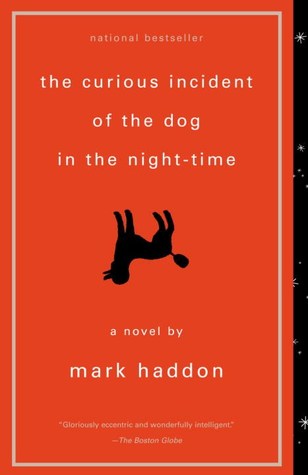
The Curious Incident of the Dog in the Night Time. Mark Haddon. 2003/2004. 226 pages. [Source: Borrowed] 

First sentence: It was 7 minutes after midnight.

Premise/plot: Christopher Boone, our (relatively) young hero, discovers a dead dog in his neighbor's yard. He is determined to figure out WHO killed the dog (and possibly WHY). This also involves another new endeavor--besides 'becoming' a detective--that of becoming a writer. He is going to write a true story--he does not understand lies or fiction--of what happens. His journey soon expands beyond the one mystery to one of far greater importance.

My thoughts: How could I have not known that this one involved a dead dog?!?! I partially blame myself for not taking care of myself and "guarding" my emotions. The dog is violently, senselessly murdered...and this is what drives the story for the first few chapters. This is a book that made me lose my temper; I was this close to screaming at the book in frustration and anger. Not just for the injustice towards the dog--but for injustice in general for how Christopher is treated. 

The writing is excellent, for the most part; but the story is depressing.

Quotes:
Prime numbers are what is left when you have taken all the patterns away. I think prime numbers are like life. They are very logical but you could never work out the rules, even if you spent all your time thinking about them. (12)
A lie is when you say something happened which didn't happen. But there is only ever one thing which happened at a particular time and a particular place. And there are an infinite number of things which didn't happen at that time and that place. And if I think about something which didn't happen I start thinking about all the other things which didn't happen. For example, this morning for breakfast I had Ready Brek and some hot raspberry milk shake. But if I say that I actually had Shreddies and a mug of tea I start thinking about Coco Pops and lemonade and porridge and Dr. Pepper and how I wasn't eating my breakfast in Egypt and there wasn't a rhinoceros in the room and Father wasn't wearing a diving suit and so on and even writing this makes me feel shaky and scared...(19)

© 2019 Becky Laney of Becky's Book Reviews

Monday, September 04, 2017

Espresso Tales

Espresso Tales (44 Scotland Street #2) Alexander McCall Smith. 2005. 345 pages. [Source: Library]

First sentence: It was summer. The forward movement of the year, so tentative in the early months of spring, now seemed quite relentless.

Premise/plot: Espresso Tales is the sequel to 44 Scotland Street. This novel was originally published serially in The Scotsman. One chapter per day. Imagine a soap opera in print with more wit than skin. I really enjoyed revisiting the characters. Most of the characters--though not all--were first introduced in 44 Scotland Street. There are some new characters introduced in this one.

My thoughts: One of the highlights for me is the character of Bertie. Bertie is being forced by his mother to do many things: saxophone lessons, Italian lessons, therapy sessions, etc. His mother has painted his room pink and insisted that he like it. She also makes him wear "crushed strawberry" colored dungarees. One of the funniest incidences in the book is when Tofu (a boy with vegan parents) offers to trade with Bertie. He really, really, really wants a hot dog. He's really to exchange his jeans for Bertie's awful dungarees. Of course, Bertie accepts that deal. But OH THE SCENE when Irene (his mother) finds out. Readers see a lot more of Bertie's father, Stuart, in this one. In another great scene, we see him put into practice his assertiveness training.

But there are so many characters in this one. I also love Domenica. Here's one of my favorite quotes.

"And what is wrong with being judgmental?" Domenica asked indignantly. "It drives me mad to hear people say: 'Don't be judgmental.' That's moral philosophy at the level of an Australian soap opera. If people weren't judgmental, how could we possibly have a moral viewpoint in society? We wouldn't have the first clue where we were. All rational discourse about what we should do would grind to a halt. No, whatever you do, don't fall for that weak-minded nonsense about not being judgmental. Don't be excessively judgmental, if you like, but always--always--be prepared to make a judgment. Otherwise you'll go through life not really knowing what you mean.

© 2017 Becky Laney of Becky's Book Reviews

Saturday, August 26, 2017

The Secret Diary of Hendrik Groen

The Secret Diary of Hendrik Groen, 83 1/4 Years Old. Henrik Groen. Translated by Hester Velmans. 2017. 384 pages. [Source: Library]

First sentence: Another year, and I still don't like old people. Their walker shuffle, their unreasonable impatience, their endless complaints, their tea and cookies, their bellyaching. Me? I am eighty-three years old.

Premise/plot: This is the 'diary' of Hendrik Groen. The jacket flap reads, "There's not one sentence that's a lie, but not every word is true." The novel spans the year 2013, and readers should know it's set in the Netherlands. It was originally titled, "Attempts to Make Something of Life." Essentially, our hero is bored with life in his retirement home. He starts a club, the OLD BUT NOT DEAD CLUB. Membership is limited to only the best of the best, his closest friends--his friends with the best sense of humor, his friends that still find moments of joy despite the aches, pains, worries, and fears of life. Each member plans an outing for the group. I'm sure I'll accidentally leave out one of his friends, but to the best of my ability the members are: Evert, Edward, Ria, Antoine, Grietje, and most importantly Eefje.

My thoughts: Our hero challenges himself to write in his diary every day. The original title perhaps captures his ambitions better.
Live as if today were your last day. (129)
Maybe I shouldn't grumble so much. I should just work harder at making sure that every day is worth living. Or at least every other day. There have to be rest days too, just like the ones in the Tour de France. (140)
His diary entries record what he's done that day (if anything), who he spent time with, what made him happy--or sad, or mad, etc. Also what he's feeling or thinking. The novel covers such a wide range of emotions. The book is at time funny and at other times depressing.
We lose some capacities as we age, but being a busybody isn't one of them. (292)
I heard that, on the heels of hospital clowns for sick children, special clowns are being deployed to cheer up lonely old folks. I don't know what they're called or where they come from, but I should like to warn them in advance: if any clown arrives to brighten my day, so help me God, I'll use my last ounce of strength to bash his jovial skull in with a frying pan. (276)
Someone ought to bring a class-action lawsuit against the packaging industry for physical damage and mental distress. They have to be doing it on purpose. If they can send people to the moon, surely they ought to be able to come up with an easy twist-off lid. (157)
One of my favorite quotes is on the last page of the novel. But to share it would be to spoil the novel for everyone else. So I won't. But note to self: I really loved the last page even if I was getting ready to put the entire book in the freezer for the last hundred pages.

Another note to self: This one openly discussed the idea of assisted suicide and euthanasia as a great positive. I was really worried for a while that this would come to be the main theme of the book and that this would be a hammer-you-over-the-head issue book. It never became that. And thinking big picture, it would only be natural that on any given day in a year a person would be/could be depressed now and then.


© 2017 Becky Laney of Becky's Book Reviews

Thursday, February 06, 2014

Half A Chance (2014)

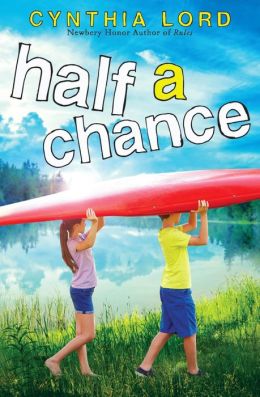
Half A Chance. Cynthia Lord. 2014. Scholastic. 224 pages. [Source: Review copy]

I really enjoyed Cynthia Lord's new novel, Half A Chance. Lucy and her family have just moved to New Hampshire. It is summer. Lucy is new and nervous about finding friends. She meets Nate and his family on her first night there. Lucy and Nate and Emily become friends quickly. But one of Nate's friends isn't so happy to see him spending time with Lucy: Megan. And if the truth is admitted, Lucy does seem to monopolize Nate's time with this new and exciting photography contest. Lucy and Nate have teamed up on this scavenger hunt and are trying to take amazing photos. Lucy is contemplating entering the contest even though her father is the judge of the contest.

Half A Chance is a very nature-friendly book. The kids are always, always outside and doing something. One of the stories in the book has them observing loons (and recording their observations and sending them off to a society).

What I enjoyed even more than the photography or the bird-watching was the focus on family and friendship. I really liked Nate's family. I loved his Grandma Lilah. I thought the handling of her dementia was nicely done. It was honest and bittersweet.

© 2014 Becky Laney of Becky's Book Reviews

Wednesday, May 01, 2013

Miss Billy Married (1914)

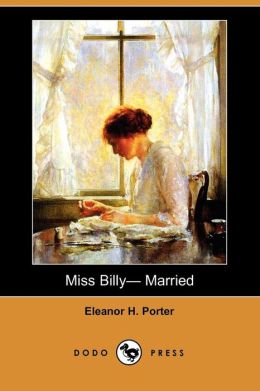
Miss Billy Married. Eleanor H. Porter. 1914. 240 pages.

Miss Billy Married is the conclusion to Eleanor H. Porter's Miss Billy trilogy. The first novel was Miss Billy and the second was Miss Billy's Decision. The first two Miss Billy novels were published before the oh-so-successful publication of the children's novel, Pollyanna in 1913. (Other popular authors of the time were Jean Webster, L.M. Montgomery, and Grace Livingston Hill.)

Billy has married Bertram Henshaw, and the two are living with brother William. (The other brother, Cyril, has moved with his wife, into a home of their own.) If Billy, our heroine, has a weakness, that weakness would definitely be thinking too much and making things more complicated than they need to be. (Though one could argue that she doesn't think enough in some places!) For example, Billy will read an article--or to be precise a quiz--in a magazine and become obsessed with it, obsessed with analyzing herself, analyzing her husband, analyzing her marriage, etc. And you can just imagine what Billy does with self-help books, cook books, and parenting books! The truth is that Billy is completely silly and ridiculous as a heroine. The book, for better or worse, is enjoyable--or entertaining--because it is comical. The laughs coming at Billy's expense for the most part. Is this a terrible thing? Has Billy lost some of her intelligence since getting married? After all, in the first two books, Miss Billy was managing just fine! She was composing music and having it published! She was popular, successful, and generous. She was absorbed in her music OR she was absorbed in her friends, making their lives better, making a contribution to society. Readers are presented with a whole new Billy in this one. Billy is facing her toughest trials: learning to manage without hired live-in servants, learning to cook and bake, learning to clean, learning when to make her husband, her "everything, and when to give him some space, learning to mother, learning that reading twenty conflicting parenting books is ridiculous, etc.

Example of the humor:
It was at this juncture that Billy ran across a book entitled "Correct Eating for Efficiency." She bought it at once, and carried it home in triumph. It proved to be a marvelous book. Billy had not read two chapters before she began to wonder how the family had managed to live thus far with any sort of success, in the face of their dense ignorance and her own criminal carelessness concerning their daily bill of fare.
At dinner that night Billy told Bertram and William of her discovery, and, with growing excitement, dilated on the wonderful good that it was to bring to them.
"Why, you don't know, you can't imagine what a treasure it is!" she exclaimed. "It gives a complete table for the exact balancing of food."
"For what?" demanded Bertram, glancing up.
"The exact balancing of food; and this book says that's the biggest problem that modern scientists have to solve."
"Humph!" shrugged Bertram. "Well, you just balance my food to my hunger, and I'll agree not to complain."
"Oh, but, Bertram, it's serious, really," urged Billy, looking genuinely distressed. "Why, it says that what you eat goes to make up what you are. It makes your vital energies. Your brain power and your body power come from what you eat. Don't you see? If you're going to paint a picture you need something different from what you would if you were going to—to saw wood; and what this book tells is—is what I ought to give you to make you do each one, I should think, from what I've read so far. Now don't you see how important it is? What if I should give you the saw-wood kind of a breakfast when you were just going up-stairs to paint all day? And what if I should give Uncle William a—a soldier's breakfast when all he is going to do is to go down on State Street and sit still all day?"
"But—but, my dear," began Uncle William, looking slightly worried, "there's my eggs that I always have, you know."
"For heaven's sake, Billy, what have you got hold of now?" demanded Bertram, with just a touch of irritation.
Billy laughed merrily.
"Well, I suppose I didn't sound very logical," she admitted. "But the book—you just wait. It's in the kitchen. I'm going to get it." And with laughing eagerness she ran from the room.
In a moment she had returned, book in hand.
"Now listen. This is the real thing—not my garbled inaccuracies. 'The food which we eat serves three purposes: it builds the body substance, bone, muscle, etc., it produces heat in the body, and it generates vital energy. Nitrogen in different chemical combinations contributes largely to the manufacture of body substances; the fats produce heat; and the starches and sugars go to make the vital energy. The nitrogenous food elements we call proteins; the fats and oils, fats; and the starches and sugars (because of the predominance of carbon), we call carbohydrates. Now in selecting the diet for the day you should take care to choose those foods which give the proteins, fats, and carbohydrates in just the right proportion.'"
"Oh, Billy!" groaned Bertram.
"But it's so, Bertram," maintained Billy, anxiously. "And it's every bit here. I don't have to guess at it at all. They even give the quantities of calories of energy required for different sized men. I'm going to measure you both to-morrow; and you must be weighed, too," she continued, ignoring the sniffs of remonstrance from her two listeners. "Then I'll know just how many calories to give each of you. They say a man of average size and weight, and sedentary occupation, should have at least 2,000 calories—and some authorities say 3,000—in this proportion: proteins, 300 calories, fats, 350 calories, carbohydrates, 1,350 calories. But you both are taller than five feet five inches, and I should think you weighed more than 145 pounds; so I can't tell just yet how many calories you will need."
"How many we will need, indeed!" ejaculated Bertram.
"But, my dear, you know I have to have my eggs," began Uncle William again, in a worried voice.
"Of course you do, dear; and you shall have them," soothed Billy, brightly. "It's only that I'll have to be careful and balance up the other things for the day accordingly. Don't you see? Now listen. We'll see what eggs are." She turned the leaves rapidly. "Here's the food table. It's lovely. It tells everything. I never saw anything so wonderful. A—b—c—d—e—here we are. 'Eggs, scrambled or boiled, fats and proteins, one egg, 100.' If it's poached it's only 50; but you like yours boiled, so we'll have to reckon on the 100. And you always have two, so that means 200 calories in fats and proteins. Now, don't you see? If you can't have but 300 proteins and 350 fats all day, and you've already eaten 200 in your two eggs, that'll leave just—er—450 for all the rest of the day,—of fats and proteins, you understand. And you've no idea how fast that'll count up. Why, just one serving of butter is 100 of fats, and eight almonds is another, while a serving of lentils is 100 of proteins. So you see how it'll go."
"Yes, I see," murmured Uncle William, casting a mournful glance about the generously laden table, much as if he were bidding farewell to a departing friend. "But if I should want more to eat—" He stopped helplessly, and Bertram's aggrieved voice filled the pause.
"Look here, Billy, if you think I'm going to be measured for an egg and weighed for an almond, you're much mistaken; because I'm not. I want to eat what I like, and as much as I like, whether it's six calories or six thousand!"
Billy chuckled, but she raised her hands in pretended shocked protest.
"Six thousand! Mercy! Bertram, I don't know what would happen if you ate that quantity; but I'm sure you couldn't paint. You'd just have to saw wood and dig ditches to use up all that vital energy."
"Humph!" scoffed Bertram.
"Besides, this is for efficiency," went on Billy, with an earnest air. "This man owns up that some may think a 2,000 calory ration is altogether too small, and he advises such to begin with 3,000 or even 3,500—graded, of course, according to a man's size, weight, and occupation. But he says one famous man does splendid work on only 1,800 calories, and another on even 1,600. But that is just a matter of chewing. Why, Bertram, you have no idea what perfectly wonderful things chewing does."
"Yes, I've heard of that," grunted Bertram; "ten chews to a cherry, and sixty to a spoonful of soup. There's an old metronome up-stairs that Cyril left. You might bring it down and set it going on the table—so many ticks to a mouthful, I suppose. I reckon, with an incentive like that to eat, just about two calories would do me. Eh, William?"
"Bertram! Now you're only making fun," chided Billy; "and when it's really serious, too. Now listen," she admonished, picking up the book again. "'If a man consumes a large amount of meat, and very few vegetables, his diet will be too rich in protein, and too lacking in carbohydrates. On the other hand, if he consumes great quantities of pastry, bread, butter, and tea, his meals will furnish too much energy, and not enough building material.' There, Bertram, don't you see?"
"Oh, yes, I see," teased Bertram. "William, better eat what you can to-night. I foresee it's the last meal of just food we'll get for some time. Hereafter we'll have proteins, fats, and carbohydrates made into calory croquettes, and—"
"Bertram!" scolded Billy.
But Bertram would not be silenced.
"Here, just let me take that book," he insisted, dragging the volume from Billy's reluctant fingers. "Now, William, listen. Here's your breakfast to-morrow morning: strawberries, 100 calories; whole-wheat bread, 75 calories; butter, 100 calories (no second helping, mind you, or you'd ruin the balance and something would topple); boiled eggs, 200 calories; cocoa, 100 calories—which all comes to 570 calories. Sounds like an English bill of fare with a new kind of foreign money, but 'tisn't, really, you know. Now for luncheon you can have tomato soup, 50 calories; potato salad—that's cheap, only 30 calories, and—" But Billy pulled the book away then, and in righteous indignation carried it to the kitchen.
"You don't deserve anything to eat," she declared with dignity, as she returned to the dining-room.
"No?" queried Bertram, his eyebrows uplifted. "Well, as near as I can make out we aren't going to get—much."
But Billy did not deign to answer this.
In spite of Bertram's tormenting gibes, Billy did, for some days, arrange her meals in accordance with the wonderful table of food given in "Correct Eating for Efficiency." To be sure, Bertram, whatever he found before him during those days, anxiously asked whether he were eating fats, proteins, or carbohydrates; and he worried openly as to the possibility of his meal's producing one calory too much or too little, thus endangering his "balance."
Billy alternately laughed and scolded, to the unvarying good nature of her husband. As it happened, however, even this was not for long, for Billy ran across a magazine article on food adulteration; and this so filled her with terror lest, in the food served, she were killing her family by slow poison, that she forgot all about the proteins, fats, and carbohydrates. Her talk these days was of formaldehyde, benzoate of soda, and salicylic acid.
Very soon, too, Billy discovered an exclusive Back Bay school for instruction in household economics and domestic hygiene. Billy investigated it at once, and was immediately aflame with enthusiasm. She told Bertram that it taught everything, everything she wanted to know; and forthwith she enrolled herself as one of its most devoted pupils, in spite of her husband's protests that she knew enough, more than enough, already. This school attendance, to her consternation, Billy discovered took added time; but in some way she contrived to find it to take.


© 2013 Becky Laney of Becky's Book Reviews

Saturday, February 13, 2010

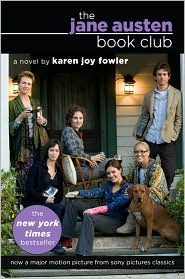
Jane Austen Book Club


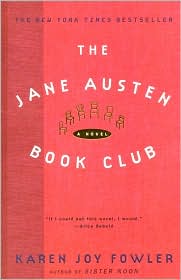
The Jane Austen Book Club. Karen Joy Fowler. 2004. Penguin. 288 pages.

Each of us has a private Austen.

Five women and one man come together to read all six of Jane Austen's novels in Karen Joy Fowler's The Jane Austen Book Club. Jocelyn. Sylvia. Allegra. Bernadette. Prudie. Grigg. Each of the six is responsible for leading one book. Each is struggling (a bit) in their personal lives. What effect can Austen have on their lives? Can reading Austen turn their lives around?

What I liked most about this one was the writing. Fowler can be very clever, very amusing, very observant in places. Some of the members made observations about the novels that I'd not noticed before. Their insights made me think about Austen's works in a new way. I'm not saying *all* of "the insights" of the members did. Not even close. But a few did. Take for example Grigg's observation on Sense and Sensibility:

"The whole beginning sequence has something of a fairy tale about it...With a lovely twist. Once upon a time, after the death of her beloved husband, a gentle stepmother was forced to live in a house ruled by her wicked stepdaughter." (46)
The book is a novel about friendships, about relationships, about people trying to find a way to be happy, to be loved, to be well.

Another thing I really appreciated were the small little details. For example, she includes "Questions for Discussion" with each of her characters (Jocelyn, Grigg, Bernadette, Prudie, Allegra, Sylvia) asking readers a few questions about Austen.

Grigg: Many science fiction readers also love Austen. Why do you suppose this is true? Do you think many Austen readers love science fiction?

Sylvia: Is love better the second time around? Is a good book better the second time around? Is the book you love most also the one you reread the most? Is the person you love most the person you want to spend the most time with?

Jocelyn: Is it rude to give a person a book as a gift and then ask later if the person liked it? Would you ever do that?
I don't know that I'd say I loved this one. But I did like it.

The movie. In some ways I liked it better than the book. I thought they did a good job in showing the dynamics of the group. And some of the back stories of the characters were reworked. Some just came up in dialogue. But other "past" stories became "present" stories so that they fit more within the narrative. But some of my favorite things about the book didn't make it into the movie, not in the same way at least. So I definitely liked reading this one. The movie is just different.

The trailer:


© Becky Laney of Becky's Book Reviews

Saturday, January 16, 2010

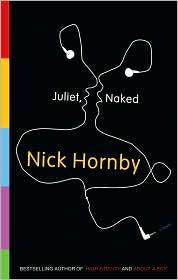
Juliet, Naked by Nick Hornby


Juliet, Naked. By Nick Hornby. 2009. [September 2009] Penguin. 352 pages.

They had flown from England to Minneapolis to look at a toilet.

This was my very first Nick Hornby, so I wasn't quite sure what to expect. But with a first sentence like that, I just had to know more. It helped that I'd heard great things about the author. But still. I can't deny that it was reading the first sentence, the first few paragraphs, that made this one a "must" to take home with me.

Juliet, Naked is an un-romance in a way. It looks more at the lives of couples who are falling out of love than those who are falling in love. In particular, it is the story of how Annie and Duncan finally parted ways. Our narrator, for the most part, is Annie. And we see Duncan mainly through her eyes. And what we see is a grown man who is beyond obsessed, almost stalkerish even, with his obsession for the now-retired-and-reclusive singer from the 80s. Tucker Crowe. The first section of the book deals with their trip to America, they are "touring" all the places Crowe has been, all the "significant" moments in his life, as they know them, at least.

Juliet is the title of Crowe's most famous album. In 2008, for the first time in decades (I think since 1986) there will be a "new" Crowe album, this one entitled Juliet, Naked. It is an album of the demos, the unpolished recordings from the Juliet sessions. Annie and Duncan both listen to the album--though Annie does the unthinkable (gasp!!!) and listens to it first, without him--and both write reviews for the 'official' fan site. Two very different reviews I might add. But only one will receive a personal message from Crowe himself.

I really enjoyed this one. I couldn't put it down. It just worked for me, and I can't quite explain why.

© Becky Laney of Becky's Book Reviews

Tuesday, July 07, 2009

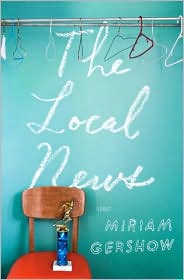
The Local News


Gershow, Miriam. 2009. The Local News. Spiegel & Grau. 360 pages.

After my brother went missing, my parents let me use their car whenever I wanted, even though I only had a learner's permit.

Lydia Pasternak, our narrator, has a difficult coming-of-age when her brother, Danny, whom she had a difficult and complex relationship with even on the best of days, goes missing and is later discovered dead. It's hard enough being sixteen without the added stress of having a missing brother. It's hard to be invisible at school when her very presence brings forth pity. Almost everyone loved her brother--especially the popular people, the pretty people, if you will. And now they want to reach out to Lydia. So she hangs out with new people. She goes to parties. But where does she belong in all this?

In some ways The Local News is an uneasy novel. I think this is intentional for the most part. Lydia certainly feels uncomfortable in her own skin, in her own life. And it is only natural that that rubs off on the reader. Lydia is uneasy for so many different reasons. She didn't really get along with her brother, hadn't gotten along with him for a while now, and now he is gone. She doesn't have much closure there. He's gone. That's it. They spend the better part of a year investigating the disappearance. When the police investigation isn't moving fast enough for the family, they hire their own private investigator to try to piece together the puzzle. And Lydia throws herself into this investigation, and throws herself at the investigator, Denis. Also her parents are not the same as they were. Her parents are absent--they've divorced themselves from their surviving child. They barely register her existence. And that's tough to take. Who does Lydia have in her life? A jumbled assortment of her former friends and her brother's former friends plus a foreign exchange student. I never felt comfortable with Lydia's friends. At all. Maybe because Lydia herself wasn't sure about them? Maybe because I felt there was too much awkwardness in the whole affair.

The Local News is an adult book narrated mostly by a young adult protagonist. The framework of the book is that Lydia is returning to her hometown ten years later for her reunion. This is bringing back memories of which many are painful and awkward and in-between. There is some distance between the events and the narration of those events.

I had a hard time liking Lydia because I had a hard time connecting with Lydia. I'm not sure why. Perhaps Lydia was emotionally distant and hard-to-get-to-know. If she was purposefully written that way, that would certainly make her authentic to the situation. She's had quite a shock and she's out of sorts.

Perhaps I just couldn't relate to her. She's a world-politics nerd who on the one hand enjoys being intellectual and debating and discussing real news, important news. On one hand, she despises the shallowness and phoniness of the typical high school crowd. There's probably a good reason she only had one friend before her brother disappeared.

But on the other hand, she's enjoying experimenting with the popular crowd, the crowd that loved and adored her older brother. She enjoys going to the parties and getting drunk and flirting with guys she really has no interest in. She likes going with the crowd and not really being true-to-herself. She likes pretending to be someone else maybe because it's easier, requires less thinking. Who knows? I just know I felt uncomfortable spending time with her and her friends. Especially David. He creeped me out. And I'm not sure if he was meant to or not. The ending left me confused. If you've read it, I'd be interested in hearing your thoughts about it.

© Becky Laney of Becky's Book Reviews