Saturday, July 08, 2017

Camille: The Lady of the Camellias

Camille. Alexandre Dumas, fils. 1848. Translated by Edmund Gosse. 254 pages. [Source: Library]

First sentence: In my opinion, it is impossible to create characters until one has spent a long time studying men, as it is impossible to speak a language until it has been seriously acquired.

Premise/plot: The narrator learns of the death of a famous Parisian courtesan, Marguerite Gautier, and decides to attend her estate sale where he purchases a book with a personal dedication. Some time later, he meets a young man named Armand Duval, Marguerite's lover, who asks for the book back. The narrator is happy to comply, and the two become friends. The narrator learns the whole story of their passionate but tragic love story directly from him.

My thoughts: I really enjoyed this one very much. If one can "enjoy" a tragic love story. It reminded me very much of the musical Moulin Rouge. (Except I think it was a lot less flashy.) The heroine was based on a real person who died about a year before this book was published. The author, I believe, was one of the men madly in love with this celebrity courtesan. (Her name was changed for the book. The name of the real courtesan was Marie Duplessis.) This heroine has been the subject of plays, movies, and operas. Verdi was inspired by Dumas' play and book to write La traviata.

Favorite quotes:
I must tell you the whole story; you will make a book out of it; no one will believe it, but it will perhaps be interesting to do.
How many ways does the heart take, how many reasons does it invent for itself, in order to arrive at what it wants.
The story of Marguerite is an exception, I repeat had it not been an exception, it would not have been worth the trouble of writing it.
© 2017 Becky Laney of Becky's Book Reviews

Prickly Jenny

Prickly Jenny. Sibylle Delacroix. 2015. 32 pages. [Source: Library]

First sentence: Jenny doesn't say good morning because, really, what's so good about it? Jenny doesn't want her new polka-dotted dress. She wants to wear her old T-shirt, and that's that.

Premise/plot: Jenny's mood is less than ideal in this picture book. As the title says, Jenny is prickly. Each page reveals that Jenny is still upset about something. In fact, it's EVERYTHING that's wrong.
Jenny says, "Leave me alone!" But she cries when Mommy goes away.
My thoughts: I like it. There are some illustrations that I really love. (Like when it's nap-time and Jenny is standing on her head!) The book isn't horribly unique. Finn Throws a Fit comes to mind, for example. And in my opinion, Finn is probably the better book. But there is something to be said for the simplicity of this one. It's less showy, less dramatic, more realistic than Finn perhaps.

Text: 4 out of 5
Illustrations: 4 out of 5
Total: 8 out of 10

© 2017 Becky Laney of Becky's Book Reviews

Friday, July 07, 2017

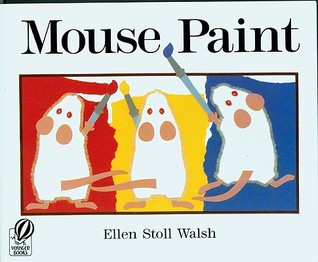
Mouse Paint

Mouse Paint. Ellen Stoll Walsh. 1989. 32 pages. [Source: Library]

First sentence: Once there were three white mice on a white piece of paper. The cat couldn't find them. One day, while the cat was asleep, the mice saw three jars of pain--one red, one yellow, and one blue. They thought it was Mouse Paint. They climbed right in.

Premise/plot: Mouse Paint is a concept picture book about colors. (Red and yellow make orange, etc.) But it's also a fun story about three mice who very much want to escape the attention of the cat.

My thoughts: I really enjoy this one. I have read it several times before, but never given it a review on the blog. My favorite line: "The red mouse stepped into a yellow puddle and did a little dance."

Text: 4.5 out of 5
Illustrations: 3.5 out of 5
Total: 8 out of 10

© 2017 Becky Laney of Becky's Book Reviews

Thursday, July 06, 2017

Dogzilla

Dogzilla. Dav Pilkey. 1993. 32 pages. [Source: Bought]

First sentence: It was summertime in the city of Mousopolis, and mice from all corners of the community had come together to compete in the First Annual Barbecue Cook-Off.

Premise/plot: This picture book is rated G--EG to be exact, for extremely goofy. In Dogzilla, the smell of barbecuing meat awakens a ferocious beast. This beast--Dogzilla--makes its way to the city and through the city. Can anything stop Dogzilla's rampage? Will the mice prove to be courageous?

My thoughts: I really like this one too. Both Kat Kong and Dogzilla are over-the-top silly.
"Gentlemice," said Professor O'Hairy, "this monster comes from prehistoric times. It is perhaps millions of years old." "Maybe we could teach it to do something positive for the community," suggested the Big Cheese. "I'm afraid not," said Professor O'Hairy. "You simply can't teach an old dog new tricks! If we're going to defeat this dog, we've got to think like a dog! We've got to find something that all dogs are afraid of--something that will scare this beast away from Mousopolis FOREVER!"
Text: 4 out of 5
Illustrations: 4 out of 5
Total: 8 out of 10


© 2017 Becky Laney of Becky's Book Reviews
Wednesday, July 05, 2017

Vincent and Theo: The Van Gogh Brothers

Vincent and Theo: The Van Gogh Brothers. Deborah Heiligman. 2017. 464 pages. [Source: Library]

First sentence: Theo's brother Vincent has been living with him for just over a year, and Theo cannot take it anymore.

Premise/plot: Love historical fiction? Love art? Love France? Consider reading Deborah Heiligman's new novel, Vincent and Theo: The Van Gogh Brothers. She tells their story in a compelling way, I think. But it isn't just the story of Vincent and Theo of their dependence on one another. It's also the story of Theo's wife, Jo. Without his sister-in-law's continual effort to keep Vincent's work alive after his death--to keep his work in front of the public, to make his name, his work KNOWN, would the world really have Vincent Van Gogh?!

My thoughts: I really enjoyed reading this one. If enjoyed is the right word. It's emotional, dramatic, and well-researched. The first few chapters begin near the end. But for the most part, the book is arranged chronologically. Each chapter leaves readers with a strong impression; each captures a moment in time. Oh the tension! There's drama, frustration, confusion, heartache, disappointment, loneliness, despair, love, and passion. There's a definite feeling of lost-ness hanging over the novel. Both brothers suffer from mental health issues--among other things.

The book is strongly influenced by his art. There are certain works that really impact how the story is told and arranged. For example, Vincent's picture of the Windmill became a symbol of the bond between the brothers. She states in the author's note that finding this work and realizing its significance was THE moment she found her book.
This walk in the rain seals their friendship, deepens it. Later both brothers will refer to it as a meeting of the minds, of the time they made a pledge to each other. They will always remember this day. Theo will use the walk in argument. So will Vincent. The brothers will come back to it again and again. It is an anchor, a promise of the future, a touchstone. (49)


I would recommend that readers also pick up a copy of Impressionism: 13 Artists Children Should Know by Florian Heine. It does NOT include Vincent Van Gogh, but, it does include many of his contemporaries. He knew several of these artists well; his work was exhibited alongside theirs.

© 2017 Becky Laney of Becky's Book Reviews