Tuesday, July 03, 2012

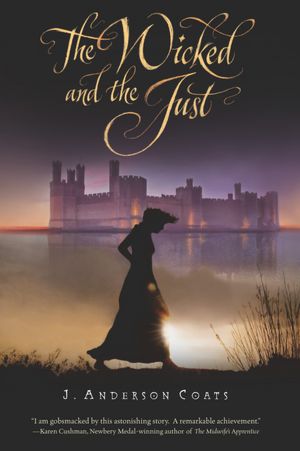
The Wicked and The Just (YA)

The Wicked and The Just. J. Anderson Coats. 2012. Houghton Mifflin Harcourt. 352 pages. 


Tonight at supper, over capon and relish, my father ruined my life. He smiled big, scrubbed his lips with the end of his cloak, and said, "We're moving house." 

I think there is a good chance you will like The Wicked and the Just more than I did. I seem to be in the minority on this one. Apparently I liked all the wrong characters, disliked all the wrong characters, and got my sympathies misplaced. If you happen to believe that there is one right way to read a novel. (I'm not saying that I do, just that some do.)

The Wicked and the Just is set in Wales in 1294. One of our narrators is Cecily, who provides the "English" perspective; the other narrator is Gwenhwyfar, who provides the Welsh perspective. I think I might be the only reader who sympathized more with Cecily and preferred her narrative. Did I love Cecily? No, not exactly. Did I like her? A little. Do I find her perfect and without fault? Hardly! How did I feel about Gwen? Well, I'm in the minority, but I did NOT like her at all, not even a little bit. I really, really, really did not like her narrative. Especially towards the end, after IT happens. I really HATED her. I did.

The King is encouraging the English to move to Wales and settle it. Cecily's father feels his chances are better in Wales than England--he can live cheaper, have better status and opportunity, etc. (He does not have his own estate to inherit or manage because he is a younger son.) The Welsh are not happy to be "managed" or "governed" by the English. They do not "enjoy" the rules and regulations the English put in place. They do not like the added-burden of having the English around. The past few years have been hard ones--famine, I believe--and having the English around telling them how to sell and trade, when to sell and trade, and deciding what is "fair" is too much. The English have the first and last word on what justice looks like, and there are differences depending on if you're Welsh or English. The English are treated preferentially. No doubt about it.

S
P
O
I
L
E
R

The novel is working towards a VIOLENT response to the injustice. There will be blood spilled. A LOT of blood. For the Welsh "rebels" will band together, form an uprising, and slaughter the English. Yes, slaughter. There will be bodies everywhere. Not just a few of the leaders, not just the government, not just the men. But of everyone. Why did they have to die? Because they were there, because they were English. Did it matter how they lived? What kind of person they were? No. Of course not. Everyone must die. The English must be "taught" a lesson. Cecily witnesses the violent slaughter of her father. It is horrific. And by my reckoning, that was not JUSTICE. The slaughter of a whole town is NOT JUSTICE. It is murder. How do two wrongs make a right? Ever?!  So what does this mean for Cecily? Don't expect mercy or compassion from the so-called heroine, Gwen. You won't find it. 

The character I happened to like best of all--better than Cecily, better than Gwen--is Gruffydd.

Read The Wicked and the Just
  • If you enjoy historical fiction set in medieval times
  • If you enjoy reading about peasant revolutions and uprisings
  • If you are looking for fiction set in Wales
© 2012 Becky Laney of Becky's Book Reviews

Monday, July 02, 2012

Austen in August Event!!!!


So excited to be joining Adam (Roof Beam Reader) for Austen in August!!! Ideally, I will be reading a balanced blend.

Amanda Grange:
  • Pride & Pyramids
  • Edmund Bertram's Diary
  • Captain Wentworth's Diary
  • Dear Mr. Darcy* (I would LOVE it if I could get a review copy of this!)
Nonfiction:
  • All Roads Lead to Austen by Amy Elizabeth Smith
  • Jane's Fame: How Jane Austen Conquered the World by Claire Harman
  • Jane Austen: A Life Revealed by Catherine Reef
Jane Austen
  • Emma
  • Mansfield Park 
  • Persuasion
Other fiction:
  • Jane Vows Vengeance by Michael Thomas Ford
  • Mansfield Park Revisted by Joan Aiken
  • Emma Watson: The Watsons Completed by Joan Aiken
  • Lady Vernon and Her Daughter by Jane Rubino and Caitlen Rubino-Bradway
  • Suspense and Sensibility by Carrie Bebris
  • The Deception at Lyme by Carrie Bebris
  • The Disappearance of Georgiana Darcy by Regina Jeffers
  • Murder at Mansfield Park by Lynn Shepherd
 I'll stop there. The truth is I could probably list fifty or so books that relate in one way or another to Jane Austen or her characters.


© 2012 Becky Laney of Becky's Book Reviews

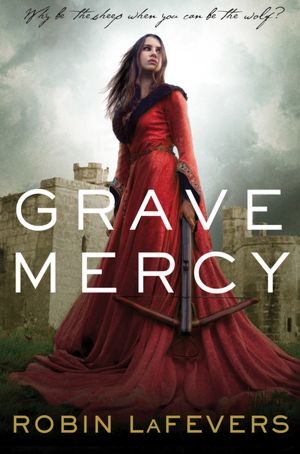
Grave Mercy (YA/Adult)

Grave Mercy. Robin LaFevers. 2012. Houghton Mifflin Harcourt. 560 pages.
Brittany 1485
I bear a deep red stain that runs from my left shoulder down to my right hip, a trail left by the herbwitch’s poison that my mother used to try to expel me from her womb. That I survived, according to the herbwitch, is no miracle but a sign I have been sired by the god of death himself.
I am told my father flew into a rage and raised his hand to my mother even as she lay weak and bleeding on the birthing bed. Until the herbwitch pointed out to him that if my mother had lain with the god of death, surely He would not stand idly by while my father beat her.
I risk a glance up at my husband-to-be, Guillo, and wonder if my father has told him of my lineage. I am guessing not, for who would pay three silver coins for what I am? Besides, Guillo looks far too placid to know of my true nature. If my father has tricked him, it will not bode well for our union. That we are being married in Guillo’s cottage rather than a church further adds to my unease.
I feel my father’s heavy gaze upon me and look up. The triumph in his eyes frightens me, for if he has triumphed, then I have surely lost in some way I do not yet understand. Even so, I smile, wanting to convince him I am happy—for there is nothing that upsets him more than my happiness.
Wow. If you're looking for two words: assassin nuns. Of course, our heroine, Ismae isn't a nun in the Catholic church. No, she's in a special nunnery, the nuns live to serve Death whom they call St. Mortain, and she's received very special training. They've taught her to kill, to be an assassin. The nuns are loyal to the Duchess of Brittany, and the victims are often her political enemies--foreign or domestic--those that pose the greatest threat to Brittany's independence.

While we do see her first few jobs carried out, most of the novel focuses on one job in particular. The abbess wants her to team up with Duval, the Duchess' older brother and her most trusted friend and advisor. She's to pose as his mistress, and travel with him to the Duchess' household. There she will "help him" find any possible traitors. He doesn't exactly trust her, he knows exactly what she's capable of, and who she serves. He knows that if given orders, she'd kill him to please her Lord. She doesn't exactly trust him either. Though the marque hasn't appeared on him yet--the special sign or symbol that she sees on her victims before they're killed--she knows that he could be lying to her, that his loyalty to the Duchess could be an act. But both know that it is of the utmost importance to protect the Duchess, and to find any traitors and uncover any conspiracies, if that means working together, so be it. Of course, this means spending a LOT of time with one another...

...the time will come when Ismae must choose who to trust and who to believe...

Politics. Romance. Drama. Dysfunctional Families. Poison. Murder. Betrayal. Mystery. Suspense.

This one probably won't please every reader. Some may not be able to get past the premise of old or ancient religions continuing to exist under the guise of Christianity. And this one isn't squeaky clean. For those that have no tolerance whatsoever when it comes to sensuality. (I would consider it mild up until the very end when their relationship changes.) But. For those that can, well, this is one COMPELLING read. My favorite character happens to be Duval. I just LOVED him. I did. He was such a swoon-worthy hero!!! And our heroine, Ismae, is quite strong and resourceful. I loved the drama. I loved the history. I loved seeing the court life and family drama play out. I enjoyed the setting, the characters, the writing. It worked really well for me.

Favorite quotes:
"Are you drunk?" I try to put as much scorn into my words as he did.
"No. Yes. Perhaps a little. Definitely not enough." The bleakness is back and he turns to stare into the flames.
I am torn between wanting to leave him to wallow in his despair and wanting to rush to his side and chase that look from his eyes. That I long to do this appalls me, sets panic fluttering against my ribs.
"I suggest you return to your room," Duval says, his gaze still fixed woodenly on the fire. "Unless you have come to practice your lessons of seduction on me?" His mouth twists in bitter amusement. "That could well entertain me till sunrise."
I jerk my head back as if I have been slapped. "No, milord. I had thought only to pray for your soul if Madame Hivern had seen fit to poison you. Nothing more." And with that, I turn and flee the room, then bolt the door against the disturbing glimpse of both his soul and mine. Whatever games are being played here, he is master at them, and I will do well to remember that. (155)
"What is my fair assassin so afraid of? I wonder."
"I'm not afraid."
Duval tilts his head to the side. "No?" He studies me a long moment, then rises out of his chair. I hold my breath as he crosses to my bed. "Are you afraid I will draw closer, perhaps?" His voice is pitched low, little more than a purr. My breath catches in my throat, trapped by something I long to call fear but that doesn't feel like fear at all. (174)
His smile flashes, quick and surprising in the darkness. "When one consorts with assassins, one must expect to dance along the edge of a knife once or twice. I bid you good night." (218)
Read Grave Mercy
  • If you're a fan of Robin LaFevers
  • If you're a fan of historical romance, with a fantasy feel to it (mythology/supernatural)
  • Also if you're a fan of mystery/suspense/political thrillers

© 2012 Becky Laney of Becky's Book Reviews

Sunday, July 01, 2012

Ten Stories by Ray Bradbury

A few years ago I made a good attempt to read The Stories of Ray Bradbury. This collection of short stories is over 1,100 pages!!! I did manage to read just over 400 pages. But. It wasn't until his death that I decided I really needed to make a second attempt. Here are the three posts that cover the first attempt: first twelve, next twenty-six, next three. 

"The Man Upstairs"
He remembered how carefully and expertly Grandmother would fondle the cold cut guts of the chicken and withdraw the marvels therein; the wet shining loops of meat-smelling intestine, the muscled lump of heart, the gizzard with the collection of seeds in it. 
My thoughts: While this one wouldn't normally ever be listed among my favorites, viewed solely in terms of the ten stories I'm sharing today, it would probably be among the best. It is creepy, odd, and the details are, well, disgusting. But it actually made sense, a twilight zone kind of sense, but sense. You knew what the beginning, middle, and end all meant. As for what it is about, well, let's just say something not quite human moves into Grandma's boarding house, and, Douglas, the young hero of the story, sees it for what it is.

"Touched With Fire"
They stood in the blazing sunlight for a long while, looking at the bright faces of their old-fashioned railroad watches, while the shadows tilted beneath them, swaying, and the perspiration ran out under their porous summer hats.
My thoughts: This one would be among my favorites--viewed solely in terms of this ten. This story is about two men who try their very best to warn a cranky old woman to watch her attitude. Why? Well, they know HOW VERY HOT it is, and how the heat is getting to everyone, and they have a theory that 92 degrees is the perfect degree for murder.
More murders are committed at ninety-two degrees Fahrenheit than any other temperature. Over one hundred, it's too hot to move. Under ninety, cool enough to survive. But right at ninety-two degrees lies the apex of irritability, everything is itches and hair and sweat and cooked pork. The brain becomes a rat rushing around a red-hot maze. The least thing, a word, a look, a sound, the drop of a hair--and irritable murder. Irritable murder, there's a pretty and terrifying phrase for you. (422)
Will she listen? Will the thermometer make it that fatal degree?

"The Emissary"
Martin knew it was autumn again, for Dog ran into the house bringing wind and frost and a smell of apples turned to cider under trees.
My thoughts: Not a favorite, but it gets worse. Martin LOVES his Dog because Dog always brings back visitors to visit Martin. He does have a favorite visitor, Miss Haight. When Miss Haight dies, Martin gets lonely, then, Dog disappears too...will he ever get visitors again... This one is creepy, and would be perfect for the R.I.P challenge, and it does still make sense. It's a creepy story that won't necessarily be for everyone. But I still knew what happened in it.

"The Jar"
It was one of those things they keep in a jar in the tent of a sideshow on the outskirts of a little, drowsy town. 
My thoughts: Didn't like this one. I'm not sure I hated it, but I didn't care for it. Every one sees something different in this jar--one sees a dead baby, one sees a dead kitten, one sees a dead jellyfish, etc. So what is really in the jar? Well, no one knows...for sure...and would knowing be a good thing or a bad thing?

"The Small Assassin"
Just when the idea occurred to her that she was being murdered she could not tell. 
My thoughts: For the first two or three pages, I thought, well, this might be a good companion piece to "The Yellow Wallpaper." A few more pages, and I thought THIS IS THE WORST STORY EVER. I seriously hate this one. HATE, HATE, HATE. It is about a woman who thinks her newborn baby is trying to KILL her. I won't spoil this one, I won't. But believe me it is AWFUL.

"The Next in Line"
It was a little caricature of a town square.
My thoughts: I'm not sure I understood enough of this one to actually hate it. I'm not sure if it's just unreliable narrators at work, if there's a thread of insanity at play, or, if it's meant to be one of those bizarre Twilight-Zone type stories where there is no explanation, but, by the end of the story I was very confused and a bit annoyed. It appears to be about a couple on vacation in Mexico, and the woman keeps getting more and more anxious because they seem "trapped" in this town--their car broke down and the mechanic is supposed to be fixing it.

"Jack in the Box"
He looked through the cold morning windows with the Jack-in-the-Box in his hands, prying the rusted lid.
My thoughts: Does this story make sense to anyone? Am I the only one who is confused? This story is 90% nonsense, the only paragraphs that make sense are the last two or three. The only thing that has changed is the narrator--we go from a child to an outsider adult perspective. But I couldn't say exactly what this one is about.

"The Leave-Taking"
She was a woman with a broom or a dustpan or a washrag or a mixing spoon in her hand.
My thoughts: I liked this one. It's not that I love it exactly, though it is perhaps the most normal, most sane of the ten I'm discussing today. This story is about the death of a great-grandmother and how she gathers her family around her, talks to them, passes along words of wisdom, and welcomes death.

"Exorcism"
She came out of the bathroom putting iodine on her finger where she had almost lopped it off cutting herself a chunk of coconut cake.
My thoughts: I believe this one is supposed to be a comedy! I certainly read it that way. A rivalry gone wrong between two women who want to be president of the same club. One woman, the narrator, is the clumsiest woman in town. She's accusing her neighbor and fellow club-member of being a witch and using witchcraft to keep her from winning the election. (She always has only one vote--her own.) She also writes out a list of every "accident" and illness she's had in the past year. (She totals it all up and says that this other woman is responsible for $98 worth of medicine.) No one is taking her seriously, which, is a good thing I suppose. It ends in laughter and tears.

"The Happiness Machine"
On Sunday morning Leo Auffmann moved slowly through his garage, expecting some wood, a curl of wire, a hammer or wrench to leap up crying, "Start here!" But nothing leaped, nothing cried for a beginning.
My thoughts: The story of a man obsessed with building a "happiness machine" doesn't realize that happiness is made of of small passing moments, that happiness isn't something that you can program into a machine, it isn't something that can be bought or manufactured. He is driving his family--particularly his wife--CRAZY with his obsession to build this machine. He just doesn't get it...will he ever?

Current Progress: 540/1112

© 2012 Becky Laney of Becky's Book Reviews

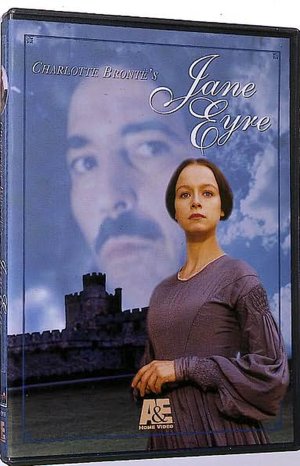
The Sunday Salon: Watching Jane Eyre (1997)

Today I'm sharing my thoughts on the 1997 adaptation of Charlotte Bronte's Jane Eyre. This film stars Samantha Morton and Ciaran Hinds.

Was it faithful to Charlotte Bronte's novel? No and Yes. OR, if you prefer, yes and no. Did every character from the book make it into the film? NO. Did every scene from the book make it into the film? NO. Did every important character and every important scene make it into the film? Well? I don't know how to answer that.

For example, in this adaptation, Jane does NOT learn that the Rivers are her cousins, and she does NOT inherit the money from her dead uncle. Rosamond Oliver and Mary Rivers have both disappeared from this adaptation. But how important are the Rivers to the story as a whole? Do people love Jane Eyre because she runs away and spends time with cousins she didn't even know she had? Or is the romance itself most important to readers and viewers?

Another example, in this adaptation, Jane does leave Thornfield Hall to visit her dying aunt, but, if you blink you'll miss it. Because within seconds of her leaving she's returned. We're told she spent a month there, but, we don't see a minute of it. You have to ask yourself if you love Jane Eyre because of those scenes, that time spent with her dying aunt, and her Reed cousins, or do you love Jane Eyre because of the main story with Mr. Rochester and his mad wife. 

Was it faithful to the book where it counted the most? Was it faithful in the character of Jane Eyre? Was it faithful in the character of Mr. Rochester? Did it do justice to their romance? Were the scenes between Jane and Edward done properly? Did the actors interpret the characters in a way that was true to the book? Did anything feel off? 

I happened to enjoy Samantha Morton as Jane Eyre. I really, really liked her in this role. I thought she did a great job being Jane. I loved her narration, for example. I thought she did a good job with getting the character right. She is definitely a good reason to watch this adaptation.

As for Ciaran Hinds, well, it's hard for me to say. For one thing, a couple of his scenes made me want to cringe. Truly. I did not like the way he portrayed Mr. Rochester. There were a couple of scenes I thought he was TOO angry, TOO violent, TOO forceful, TOO scary, TOO intimidating, TOO dramatic. Particularly the oh-so-crucial after-the-non-wedding, post-big-reveal scene. His temper tantrum is just so out of character. He's way too physical, too physically abusive--bordering on it anyway. And the whole scene just makes me cringe. That is NOT the way it's supposed to go, that is NOT how it was handled in the book.

And at times I felt Hinds' Mr. Rochester was not dimensional enough, sure, he got a few of the emotions down, but, did he capture the full complexity of Bronte's hero?! I'm not sure he did. Also, on a more personal note, the mustache and sideburns bothered me. From certain angles, I kept seeing Tennessee Ernie Ford. (When I wasn't thinking of this animated villain.)

Was this adaptation faithful when it comes to portraying the relationship between Jane and Edward? I think it was. I think the dialogue between them worked. I think many of their scenes were faithful to the book--for the most part. 

I thought this was a very comfortable Jane Eyre to watch. It was just around two hours. You could sit and watch it comfortably all at once. Yes, it condensed things, yes, certain things were missing from this adaptation. But it made sense, it flowed smoothly. I found many, many things delightful about it. I enjoyed many of the scenes, of course, I had issues with a couple of scenes. I didn't particularly love the first meeting between Jane Eyre and Mr. Rochester, I thought it was way too dramatic, definitely over-the-top. But other scenes made up for it, in my opinion.

I did think the film did a good job creating ambiance--at capturing the gothic elements of this one. There were scenes that captured the mystery, suspense, and horror of the original.

I thought Abigail Cruttenden brought something unique to Blanche Ingram--for better or worse. In this film, she was portrayed sympathetically, or more sympathetically than in other adaptations. While we're still told that she was mainly after Mr. Rochester's money, she's not portrayed one-dimensionally as vain and haughty. While she may not be exactly friendly towards "the governess." She doesn't come across as mean and deserving of what she gets. (That is Mr. Rochester using and manipulating her, leading her to believe one thing, but in all truth just trying to make Jane jealous.) Is that a good thing? Well, I suppose that depends on your perspective. Would a nice Caroline Bingley work in Pride and Prejudice? Are people so determined to not like Blanche Ingram that this slightly modified Blanche would offend? I'm not sure.

 St. John Rivers is likewise portrayed sympathetically. He doesn't come across as offensively as he does in other adaptations. He actually seems quite nice, quite pleasant, as someone who actually has people-skills.

Have you seen this adaptation? What did you think of it?

Watch Jane Eyre
  • If you're a fan of the book
  • If you're a fan of Victorian period dramas 
Other Jane Eyre (movie) reviews


© 2012 Becky Laney of Becky's Book Reviews