Showing posts with label 1901. Show all posts

Tuesday, August 12, 2025

89. The First Men in the Moon


89. The First Men in the Moon. H.G. Wells. 1901. 213 pages. [Source: Library] [3 stars, adult science fiction, classic]

First sentence: As I sit down to write here amidst the shadows of vine-leaves under the blue sky of southern Italy, it comes to me with a certain quality of astonishment that my participation in these amazing adventures of Mr. Cavor was, after all, the outcome of the purest accident. It might have been any one. I fell into these things at a time when I thought myself removed from the slightest possibility of disturbing experiences.

Premise/plot: Mr. Bedford has money troubles; he is looking for a relatively quick and easy 'out' for those troubles. He is trying his hand at writing a play. He's gone to the country to write that play and obviously hopes for peace and quiet. Dr. Cavor, his neighbor, is anything but quiet. He's a mad scientist though perhaps Mr. Bedford doesn't realize quite how 'mad' this mad scientist is when they meet. Mr. Bedford, perhaps, should have minded his own business and not lost his temper. Then again, that would have been a short book indeed! Dr. Cavor is out to create a gravity-defying element--which, of course, he'll name Cavorite. Working together--somewhat--they decide to use Cavorite on a sphere Dr. Cavor builds to go to the moon. Obviously. What else would you do if you could defy gravity?! What they find on the moon is quite shocking, especially to Mr. Bedford though he has his regrets before even leaving earth.

My thoughts: I enjoyed the book. It was silly. It requires you to suspend your disbelief. But it was good. I definitely enjoyed it more the second time around. HOWEVER, I will say that the movie adaptation from the 1960s while not faithful to the book particularly, was certainly more entertaining. They added a LOVE INTEREST to Mr. Bedford and had her 'accidentally' forced along for the ride. The ending is much improved in the movie, in my opinion. I also loved seeing CHICKENS IN SPACE. It was silly and over the top but also delightful.

Quotes:

"Can it be," he said, "that I have formed a Habit?"

What is this spirit in man that urges him for ever to depart from happiness and security, to toil, to place himself in danger, to risk even a reasonable certainty of death? It dawned upon me up there in the moon as a thing I ought always to have known, that man is not made simply to go about being safe and comfortable and well fed and amused.

"Good Lord!" I exclaimed. "Just think of all the trouble we took to get into this pickle! What did we come for? What are we after? What was the moon to us or we to the moon? We wanted too much, we tried too much. We ought to have started the little things first.

"It was I found the way here, but to find a way isn't always to be master of a way. If I take my secret back to earth, what will happen? I do not see how I can keep my secret for a year, for even a part of a year. Sooner or later it must come out, even if other men rediscover it. And then...governments and powers will struggle to get hither, they will fight against one another, and against these moon people; it will only spread warfare and multiply the occasions of war....What good would the moon be to men? Even of their own planet what have they made but a battle-ground and theatre of infinite folly? Small as his world is, and short as his time, he has still in his little life down there far more than he can do.

I think that going to bed was one of the luckiest ideas I have ever had in an emergency.


© 2025 Becky Laney of Becky's Book Reviews

Wednesday, November 14, 2018

Me? Listen to Audio?! #41

The Shadow of A Doubt. (A Play) Edith Wharton. 1901.  Introduced by Laura Rattray. Adapted for radio by Melissa Murray. Directed by Emma Harding. BBC Radio 3. Aired October 2018. 1 hour and a half.

In 2017, two academics--Laura Rattray and Mary Chinery--discovered one of Edith Wharton's lost plays. "The Shadow of a Doubt" was written in 1901 but never performed on stage. It debuted on BBC Radio. And I believe there are current plans to stage it in 2019.

John Derwent has a new wife. Not everyone is pleased--some are quite skeptical. Is his second wife, Kate, as worthy as his first wife Agnes? Kate is from a different social class than his first wife. Kate was, in fact, the one who nursed his first wife during her last days. Some suspect that perhaps--just perhaps--Kate might have seen an opportunity and taken advantage of it. (Did she murder his first wife so she could step into her shoes and raise her child?)

Is she guilty? Is she innocent? Should her husband believe her beyond a shadow of a doubt--wholeheartedly giving himself to her? Or is he wise to hold back until he knows the whole story? Once he begins to doubt can he ever stop himself?

Can this marriage be saved?! Should it be saved?! At one point, Kate is in favor of separation--if her husband doesn't believe her, he doesn't believe her. She's not going to beg him to stay--not if he doesn't trust her. At another point, the father of the first wife--the grandfather of her step-daughter--is advocating for divorce and offering to bribe her with substantial amounts of money if she'll only agree to end the marriage permanently. But her biggest critic may end up being her biggest supporter....

I really enjoyed this one. I have not read any of Wharton's novels, but I have read quite a few of her short stories. I would love to see this one in print. But it made for a good listen. 

© 2018 Becky Laney of Becky's Book Reviews
Thursday, January 04, 2018

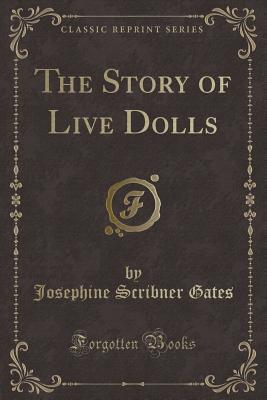
The Story of Live Dolls

The Story of Live Dolls. Josephine Scribner Gates. Illustrated by Mabel Rogers. 1901. 1920. 116 pages. [Source: Read online]

First sentence:  "Look, what's coming!" and with a shout of delight the children of Cloverdale village left their play and rushed into the street.

Premise/plot: Janie is super-excited one June day when she witnesses a spectacular site. The Queen of Dolls rides through town in a carriage pulled by kittens. She's tossing bills as she goes, bills that proclaim that on June 4th--the very next day--ALL the dolls in the town will come alive, and stay alive, for the whole month of June.

Janie rushes to tell her mother. (As I'm sure all the other little girls do). She spends the rest of the day preparing for the big day. But she's not as considerate as she might have been. Poor Dinah! Still, she makes an effort to be a good steward.

Most of the book is about that magical month of June. It isn't all fun and games. There are a few lessons not so subtly tucked away into the text. For example, the Queen of Dolls finds it necessary to have a doll ambulance visit each girls' home to carry off dolls that need a trip to the doll hospital. It's sadly too late for one doll in particular. A doll that was drowned by her owner.

The book reflects an honest enough look at how dolls are treated. Early on in the novel, it's revealed that some of Janie's dolls are--dare I say it, STARK NAKED. She's not the only doll owner about to be judged and found wanting. Still, better to be a naked doll than to have a cracked head, a missing limb, or be DEAD.

Here's the scene where Janie's baby doll, Dollie, comes to life:
"O you dear little mamma, I am so glad you are awake. I want to come into your bed," and up she popped and climbed in under the covers and snuggled up exactly as Janie often snuggled up to her mamma. (14)
Here's the disturbing scene where a doll is declared dead:
One poor little thing lay apart from the others and was dripping wet. Her companions sobbed aloud as they told in low tones of how she was fished out of a water barrel, stone dead. Not even the Queen could bring her to life. (39)
And the agenda comes straight to the point:
She told them how kind they ought always to be to their dolls--just as kind as they wished their mammas to be to them....Her eyes filled with tears as she spoke of the poor little dead one; and she said she could always tell what kind of heart a little girl had by the way she treated her doll. Those who made the sweetest and tenderest mammas were those who had taken the most loving care of their dollies when they were little girls. She wanted them to begin over, and see who could be the best mother during the few weeks that followed. (52-3)
My thoughts: I definitely enjoyed discovering this one. Would I have loved to have my dolls come to life as a child? Probably. Would I have been judged harshly by the Queen of Dolls? It would depend on the doll. There were a few dolls that were a bit out of favor, you might say. I didn't play with them--nor care if they were ever dressed. My mom could tell a few stories on me. BUT thankfully, she's not online.

The story is dated. Dinah is one of the dolls, she's a black cook with a wig askew (though she has a kerchief) and a broken leg that was hastily put on BACKWARDS. That's why I said poor Dinah. I suppose in 1901, when the story was first published, having a black cook in a household was nothing out of the ordinary.

© 2018 Becky Laney of Becky's Book Reviews

Saturday, April 26, 2014

Melisande (1901)

Melisande. E. Nesbit. Illustrated by P.J. Lynch. 1901/1988/1999. Candlewick. 48 pages. [Source: Book I Bought]

When the Princess Melisande was born, her mother, the Queen, wished to have a christening party, but the King put his foot down and said he would not have it. 
"I've seen too much trouble come of christening parties," said he. "However carefully you keep your visiting book, some fairy or other is sure to get let out, and you know what that leads to. Why, even in my own family the most shocking things have occurred. The Fairy Malevola was not asked to my great-grandmother's christening, and you know all about the spindle and the hundred years' sleep."
"Perhaps you're right," said the Queen. "My own cousin by marriage forgot a stuffy old fairy when she sent out the cards for her daughter's christening, and the old wretch turned up at the last moment. The girl drops toads out of her mouth to this day."

 Don't you just love stories that start out like this?! I know I do! E. Nesbit's Melisande is practically perfect in every way. It's pure delight through and through. The premise is simple: a king and queen are so sure that a christening party is a bad idea that they decide to skip it all together. But in their eagerness to escape everything-you'd-expect, they didn't take into account every possible scenario. Seven hundred not-so-happy fairies turn up! All thinking that there had been a christening without them! Malevola is the loudest and boldest. She declares that the new princess will be bald. The king shows his cleverness and the remaining fairies are dismissed; he asserts, only ever ONE fairy is forgotten and since that ONE fairy has already given her ill-wishing gift, the others can all go back home.The King lessens his wife's sorrow, to a certain extent, by promising to give Melisande, his daughter, a wish he never used himself. (His fairy godmother gave him a wish for his wedding.) He wants to WAIT until Melisande is all grown up and can decide her own wish.

The Queen strongly influences Melisande's wish when the time comes. Melisande's wish has consequences!
I wish I had golden hair a yard long, and that it would grow an inch every day, and grow twice as fast every time it was cut...
Poor Melisande! Within a few weeks, she has realized how HORRIBLE and TERRIBLE this wish of hers was.
When it was three yards long, the Princess could not bear it any longer, it was so heavy and so hot, so she borrowed Nurse's scissors and cut it all off, and then for a few hours she was comfortable. But the hair went on growing, and now it grew twice as fast as before so that in thirty-six days it was as long as ever. The poor Princess cried with tiredness, and when she couldn't bear it any more she cut her hair and was comfortable for a very little time. The hair now grew four times as fast as at first, and in eighteen days it was as long as before, and she had to have it cut. Then it grew eight inches a day, and the next time it was cut it grew sixteen inches a day, and then thirty-two inches and sixty-four inches and a hundred and twenty eight inches a day and son, growing twice as fast after each cutting.
Soon Melisande and her parents are desperate for help! Is there a way to stop the madness?! Will she ever be happy again?!

I definitely recommend getting an illustrated edition of Melisande. The illustrations by P.J. Lynch are WONDERFUL.

© 2014 Becky Laney of Becky's Book Reviews

Wednesday, February 05, 2014

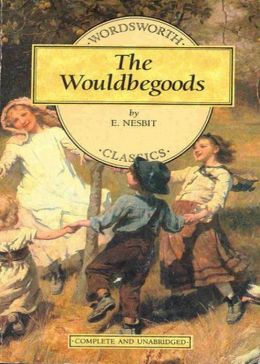
The Wouldbegoods

The Wouldbegoods. E. Nesbit. 1901. 156 pages. [Source: Book I Bought]

“Children are like jam: all very well in the proper place, but you can’t stand them all over the shop — eh, what?” These were the dreadful words of our Indian uncle. They made us feel very young and angry; and yet we could not be comforted by calling him names to ourselves, as you do when nasty grown-ups say nasty things, because he is not nasty, but quite the exact opposite when not irritated. And we could not think it ungentlemanly of him to say we were like jam, because, as Alice says, jam is very nice indeed — only not on furniture and improper places like that.
The Wouldbegoods is the further adventures of the Bastable children: Dora, Oswald, Dicky, Alice, Noel, and H.O. Add in a few neighbors for a recipe of trouble and mishap. It is not that the Bastable children set out to be bad, to make trouble for themselves and for their father, far from it. The children intend to be really, really good, which is why they form a club about being good, recording and rewarding their good deeds. The chapters read more like a collection of stories than a novel. Each chapter contains an adventure or misadventure!
For readers looking for old-fashioned family-oriented stories, this one is a quick, fun read. It is not my favorite E. Nesbit novel. But. Oswald is a good friend.  

© 2014 Becky Laney of Becky's Book Reviews
Tuesday, January 01, 2013

L.M. Montgomery Short Stories, 1896-1901

L.M. Montgomery Short Stories, 1896-1901. L.M. Montgomery. 142 pages.

This short story collection features nineteen short stories by L.M. Montgomery. Stories in this collection include: "A Case of Trespass," "A Christmas Inspiration," "A Christmas Mistake," "A Strayed Allegiance," "An Invitation Given on Impulse," "Detected by the Camera," "In Spite of Myself," "Kismet," Miriam's Lover," "Miss Calista's Peppermint Bottle," "The Jest That Failed," "The Pennington's Girl," "The Red Room," "The Setness of Theodosia," "The Story of An Invitation," "The Touch of Fate," "The Waking of Helen," "The Way of Winning Anne," and "Young Si." While I didn't absolutely love each and every story in this collection, I enjoyed almost all of the stories. A few I really did LOVE.

I really did love "The Jest That Failed" perhaps because it reminded me a little of Edith Wharton's Roman Fever. In "The Jest That Failed," a few mean students decide to play a trick on Grace Seeley, a poor classmate that they look down upon. Wouldn't it be absolutely hysterical if Grace thought the most popular senior boy, Sidney Hill, was asking her to the prom? But their trick doesn't work like they hoped!

I also enjoyed "An Invitation Given on Impulse." This is how Montgomery described the heroine, Ruth Mannering..."If they had thought about it at all, they would probably have decided that they did not like her; but for the most part they simply overlooked her" and "painfully shy and reserved." This story is how one of the more popular girls decided to go with her impulse and invite "poor Ruth" to her home for the holidays instead of her best friend. This visit transformed Ruth in oh-so-many ways, and for the first time the girl catches a glimpse of what friendship is all about.

"Kismet," is an interesting story of a failed marriage that has been given a second chance...depending on the results of a horse race! This husband and wife meet accidentally after years of living separately. Both are surprised to see each other again, neither thought the other would be at the races. Conversation is strained at first, but, eventually these two happen upon an agreement. She's bet her money on one horse, he's bet on another horse...can these two make a success of it?

There is a wide variety of stories: some Christmas stories, some happily-ever-after romances, some tragic romances, some comedies, some rags-to-riches, some coming-of-age stories. They do range in sentiment. Almost all of the stories are interesting, however. All of them display human nature at its best and give a glimpse of Montgomery's greatest gift: her way of capturing human character and spirit with very few words.

Read this short story collection:
  • If you're a fan of L.M. Montgomery
  • If you enjoy short stories
  • If you'd like to enjoy short stories but are somewhat resistant or hesitant to pick up short story collections
  • If you enjoy a wide variety of stories: rags to riches, coming-of-age, family-friendly "feel-good" pieces, love stories--happy and tragic, ghost stories, comedies, etc.
 
© 2013 Becky Laney of Becky's Book Reviews