Showing posts with label Connie Willis. Show all posts

Friday, December 27, 2024

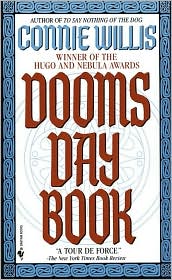
109. Doomsday Book

109. Doomsday Book. Connie Willis. 1992. Random House. 592 pages.  [Source: Book I Bought]

First sentence: Mr. Dunworthy opened the door to the laboratory and his spectacles promptly steamed up.
"Am I too late?" he said, yanking them off and squinting at Mary.
"Shut the door," she said. "I can't hear you over the sound of those ghastly carols."
Dunworthy closed the door, but it didn't completely shut out the sound of "O Come, All Ye Faithful" wafting in from the quad. "Am I too late?" he said again.  

 Premise/plot: In a world where historians learn their subject firsthand by time travel, Kivrin, our heroine--one of them--is sent to the middle ages to learn just "how exaggerated" (according to her professor/advisor Gilchrist) the accounts of the Black Death were. That's spinning it a bit. Kivrin is there to LEARN and OBSERVE and ABSORB. Technically, she's to be sent to 1320--the Advent/Christmas/Epiphany season in OXFORD. But that's if all goes according to plan and there are no mix-ups or mistakes. 

Mr. Dunworthy, our hero, has a bad feeling that those in charge of the project are incapable and incompetent and imbeciles. The book opens moments before she is sent back in time....it isn't long before Dunworthy has reason to panic...But this book isn't about one man's panic--his helicopter teaching, if you will. It is about TWO pandemics. One is set in the present of 2054. This pandemic requires a quarantine, contact tracing, mask-wearing, and safety protocols. With it comes toilet paper shortages--along with soap! The present story line is full of mystery and action. The other is set in the past--the Black Death. There is a theme of helplessness in both.

My thoughts: Doomsday Book by Connie Willis is one of my favorite, favorite, favorite, favorite, favorite books. This is my seventh? time to read and review it. I last reviewed it in 2023. I love and adore this book so much. It is set during Christmas/Epiphany. It's just a book that calls out to me every year to reread. I am surprised it has never been adapted into a film. The world needs more action Christmas movies.


© 2024 Becky Laney of Becky's Book Reviews

Friday, February 19, 2021

19. Blackout


Blackout. Connie Willis. 2010. 610 pages. [Source: Bought]

First sentence: Colin tried the door, but it was locked.

I thought I'd start with a word of warning. When you get to the end of Blackout, you're going to NEED to have a copy of All Clear ready to go. Because, chances are, you're going to want to pick it up right away. There is no 'real' ending in Blackout. There is no resolution. There's no peace to be had. Usually I might say that's not such a positive thing in a book, but in this case, I'm forgiving.

You might also find it helpful to know that Blackout can be read as part of a series of time travel books by Connie Willis.  

Premise/plot: Several time travelers find themselves TRAPPED in the past in Connie Willis' thrilling novel Blackout. Time travel has its dangers--of course--but the net is supposed to have safety features built in to protect time and time travelers. But the 'logic' of the net is changing, and, the systems seem to be failing. Though it seems like a few people are aware of this calamity-in-the-making (Mr. Dunworthy surely has his suspicions? Why else would he be rearranging all the scheduled comings and goings of the historians?) The historians themselves are being kept in the dark, out of the loop. 

There are three main characters--three main narrators--in Blackout. Each is a historian, a time traveler. Each has plans for multiple assignments in the twentieth century. Each is experiencing frustration as these drops are rearranged and rescheduled. The historians are Merope who is 'observing' the evacuation of children from London to the country. She 'becomes' Eileen O'Reilly and works as a nurse or maid in one of the homes. Under her care are two very, very wild children. Of course, she's responsible for more than two children. Her employer has taken in many children--over a dozen, I think? But those two are the ones that make her life more than a little unpleasant. Her assignment is for the spring of 1940. Polly "Sebastian" is a historian observing the London Blitz in the fall of 1940. Her assignment has her working in a shop on Oxford Street. She is curious in observing how the Blitz effects people. How they are able to cope with the bombs falling over their heads. How they are able to cope with the terror of it all--knowing each and every night that they could die. The third historian is Michael Davies. Since he was supposed to observe Pearl Harbor first, he's got an implant to give him an American accent. But with the shuffling of assignments, he's now observing the Dunkirk evacuation in June 1940. His research has him observing heroes. He's looking to observe the qualities that make someone brave and heroic, what makes a person risk their lives to save others.

If all went according to plan, these three would NOT have met--in the past. Their assignments in 1940 would not have overlapped in time or place. But not all went according to plan...and now these three are going to need each very, very much if they're going to survive...

My thoughts: I really love Connie Willis' time travel novels. Blackout and All Clear perhaps would have perhaps been better as one CHUNKY book. The two are essentially one book with one story. These two can be read on their own without previously reading the other two books. (Again each of those two could be read as stand alone novels.)  

I love historical fiction. I love historical fiction set during the second world war. I love historical fiction set in England.

I love time travel stories. This one is INTENSE.

© 2021 Becky Laney of Becky's Book Reviews

Thursday, January 28, 2021

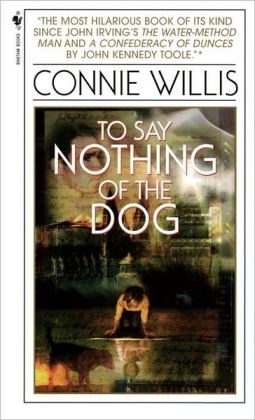
10. To Say Nothing of the Dog


To Say Nothing of the Dog. (Oxford Time Travel #2) Connie Willis. 1998. 512 pages. [Source: Bought]

First sentence: There were five of us--Carruthers and the new recruit and myself, and Mr. Spivens and the verger. It was late afternoon on November the fifteenth, and we were in what was left of Coventry Cathedral, looking for the bishop's bird stump. Or at any rate I was. 

Premise/plot: Ned Henry narrates the novel. And he does a great job. When we first meet him, he's suffering from time-lag. He's spent too much time--of late--jumping through time. He's not alone. There is someone doing her very, very best to drive EVERYONE in his department crazy. Lady Schrapnell is a woman on a mission--a RICH woman on a mission. And she won't take no for an answer. If Lady Schrapnell volunteers you for a job, well, you stay volunteered until the job is done to her satisfaction. And what does Lady Schrapnell want most of all? The bishop's bird stump. Her project is the rebuilding of Coventry Cathedral--a cathedral destroyed/damaged during World War II. And she HAS to know if the bishop's bird stump was still in the church during the raid. She needs to know if it should be replicated as part of the 'restoration.' So Ned Henry is just one of dozens looking IN THE PAST for the answers as to what happened to the bishop's bird stump.

But that 'mission' becomes almost secondary....when it is 'discovered' that there's been an incongruity. At first they think it's simple, it's easily fixed. One of the time travelers interfered when she shouldn't. But. They'll just send another time traveler to fix that interference, and things should go smoothly. But since the time traveler they send is Ned Henry, since he's suffering from exhaustion and time-lag, since he barely heard his instructions, since he jumped into the Net to avoid being discovered by an angry Lady Schrapnell, nothing is simple. What Ned Henry soon realizes is that his arrival in June 1888 has changed things. His arrival has kept two people from meeting (and subsequently falling in love and marrying), and that's just the start.

But he isn't the only one in the past. He isn't the only time-traveler working to restore things. Verity Kindle. The beautiful Verity Kindle has a role to play as well....

Verity Kindle is the heroine of To Say Nothing of the Dog. She is on a mission of her own. While Ned Henry was given the assignment of finding out the whereabouts of the bishop's bird stump, Verity's assignment is to read Tocelyn's diary. The diary is available to read in the future. But the most relevant pages to the Coventry Cathedral project were damaged. So she's been sent to the oh-so-important summer of 1888 to read the newly written diary entries. She's having about as much success as Ned Henry. In other words, not much luck at all! These two work together as best they can. Verity manages to travel back and forth a few times to the future. Their mission--as they see it has changed a bit. They worry that they've damaged the future and that something horrible may happen as a result. Like Tocelyn, they know, was supposed to marry a "Mr. C". They know this for a fact from future diary entries. Yet here they are and she's engaged to someone else! Their "new mission" is to find the identity of "Mr. C." and make sure they meet when they're supposed to meet....

My thoughts: Read this book. That's all I have to say about that. No, not really. I have plenty to say about this one. But I don't think my review will be able to do this one justice. What is To Say Nothing of the Dog? It's a funny sci-fi mystery with a smidgen of romance.

I have a weakness for time travel. I do. And this one is a great example of a time-traveling sci-fi novel that just works really well. It's smart. It's funny. 

I loved this one. I have always loved this one. It is a delightful time travel novel. I love the humor! I do! It's so very, very funny! And I love the details and the dialogue. This one is just a joy cover to cover!

Quotes:

2 Quotes About the bishop's bird stump:

"Perhaps it was removed for safekeeping," he said, looking at the windows. "Like the east windows."
"The bishop's bird stump?" I said incredulously. "Are you joking?"
"You're right," he said. "It isn't the sort of thing you'd want to keep from being blown up. Victorian art!" He shuddered. (7)

I must be getting light-headed from lack of sleep. No one, even badly shell-shocked, would steal it. Or buy it at a jumble sale. This was the bishop's bird stump. Even the munitions scrap iron drive would turn it down. Unless of course someone recognized its potential as a psychological weapon against the Nazis. (12)

About time-lag:

One of the first symptoms of time-lag is a tendency to maudlin sentimentality, like an Irishman in his cups or a Victorian poet cold-sober. (9)

And isn't this the truth:

There is nothing more helpful than shouted instructions, particularly incomprehensible ones. (153)

Verity Kindle on mystery novels:
"Of course they're usually about murder, not robbery, but they always take place in a country house like this, and the butler did it, at least for the first hundred mystery novels or so. Everyone's a suspect, and it's always the least likely person, and after the first hundred or so, the butler wasn't anymore--the least likely person, I mean--so they had to switch to unlikely criminals. You know, the harmless old lady or the vicar's devoted wife, that sort of thing, but it didn't take the reader long to catch on to that, and they had to resort to having the detective be the murderer, and the narrator, even though that had already been done in The Moonstone. The hero did it, only he didn't know it. He was sleepwalking, in his nightshirt, which was rather racy stuff for Victorian times, and the crime was always unbelievably complicated. In mystery novels. I mean, nobody ever ever just grabs the vase and runs, or shoots somebody in a fit of temper, and at the very end, when you think you've got it all figured out, there's one last plot-twist, and the crime's always very carefully thought out, with disguises and alibis and railway timetables and they have to include a diagram of the house in the frontispiece, showing everyone's bedroom and the library, which is where the body always is, and all the connecting doors, and even then you don't have a prayer of figuring it out, which is why they have to bring in a world-famous detective--"
"Who solves it with little gray cells?" I said.
"Yes. Hercule Poirot, that's Agatha Christie's detective, and he says it isn't at all necessary to go running about measuring footprints and picking up cigarette ends to solve mysteries like Sherlock Holmes. That's Arthur Conan Doyle's detective--"
"I know who Sherlock Holmes is." (205)


Well, it wasn't exactly the ending of an Agatha Christie mystery, with Hercule Poirot gathering everyone together in the drawing room to reveal the murderer and impress everyone with his astonishing deductive powers. And it definitely wasn't a Dorothy Sayers, with the detective hero saying to his heroine sidekick, "I say, we make a jolly good detectin' team. How about makin' the partnership permanent, eh, what?" and then proposing in Latin. (431)
Verity and Ned:

She peered at me. "It isn't fair, you know."
"What isn't?" I said warily.
"Your boater. It makes you look just like Lord Peter Wimsey, especially when you tilt it forward like that." (254)

"The first time I ever saw you, I thought, he looks just like Lord Peter Wimsey. You were wearing the boater and--no, that wasn't the first time," she said accusingly. "The first time was in Mr. Dunworthy's office, and you were all covered in soot. You were still adorable, though, even if your mouth was hanging open." (254)

"Lord Peter took a nap," she said. "Harriet watched him sleep, and that's when she knew she was in love with him."
She sat up again. "Of course, I knew it from the second page of Strong Poison, but it took two more books for Harriet to figure it out. She kept telling herself it was all just detecting and deciphering codes and solving mysteries together, but I knew she was in love with him. He proposed in Latin. Under a bridge. After they solved the mystery. You can't propose till after you've solved the mystery. That's a law in detective novels."
She sighed. "It's too bad. 'Placetne, magistra?' he said when he proposed, and then she said, 'Placet.' That's a fancy Oxford don way of saying yes. I had to look it up. I hate it when people use Latin and don't tell you what they mean..." (259)


© 2021 Becky Laney of Becky's Book Reviews

Thursday, December 10, 2020

150. Doomsday Book


Doomsday Book. Connie Willis. 1992. Random House. 592 pages.  [Source: Book I Bought]

First sentence: Mr. Dunworthy opened the door to the laboratory and his spectacles promptly steamed up.
"Am I too late?" he said, yanking them off and squinting at Mary.
"Shut the door," she said. "I can't hear you over the sound of those ghastly carols."
Dunworthy closed the door, but it didn't completely shut out the sound of "O Come, All Ye Faithful" wafting in from the quad. "Am I too late?" he said again.   

 Premise/plot: In a world where historians learn their subject firsthand by time travel, Kivrin, our heroine--one of them--is sent to the middle ages to learn just "how exaggerated" (according to her professor/advisor Gilchrist) the accounts of the Black Death were. That's spinning it a bit. Kivrin is there to LEARN and OBSERVE and ABSORB. Technically, she's to be sent to 1320--the Advent/Christmas/Epiphany season in OXFORD. But that's if all goes according to plan and there are no mix-ups or mistakes. Mr. Dunworthy, our hero, has a bad feeling that those in charge of the project are incapable and incompetent and imbeciles. The book opens moments before she is sent back in time....it isn't long before Dunworthy has reason to panic...

But this book isn't about one man's panic--his helicopter teaching, if you will. It is about TWO pandemics. One is set in the present of 2054. This pandemic requires a quarantine, contact tracing, mask-wearing, and safety protocols. With it comes toilet paper shortages--along with soap! The present story line is full of mystery and action. The other is set in the past--the Black Death. There is a theme of helplessness in both.

My thoughts: Doomsday Book by Connie Willis is one of my favorite, favorite, favorite, favorite, favorite books. I believe this is my fifth time to read it and review it for Becky's Book Reviews. The last time I read it, I believe, was 2015

Reading Doomsday Book in 2020 was like reading it with FRESH EYES and in a NEW LIGHT. I noticed hundreds of things that I never really absorbed or processed before. Much of the present story line is set IN THE HOSPITAL and follows doctors and nurses as they care for patients trying to make sense of a virus they know little about. They are TRYING to save lives--but wrestling with the unknown. They are protecting themselves to the best of their ability--wearing all the gowns, masks, gloves, shields, etc.--but they themselves are getting sick and even dying while trying to save lives. 

The book also has a bit to say about the mob mentality--those who are critical of quarantines, of wearing masks; those whose first reaction is to throw science and common sense out of the window making prejudicial and unfounded claims, spreading fear and propaganda. 

The book also has a bit to say about POLITICS. No not politics in terms of political parties, governments, and candidates. But PERSONAL and PROFESSIONAL "politics." Readers see the belittling and childish behavior of the spats between Dunworthy and Gilchrist. No doubt Gilchrist is the bigger fool--perhaps the biggest fool in the book--but these two professors are from "dueling" schools. Gilchrist is so concerned with maintaining authority and control and looking good that he has no concern for others, especially his enemies. 

There is talk between characters of a PANDEMIC twenty or so years before this one opens. 

I have always deeply appreciated the novel in terms of RELATIONSHIPS. This still holds true. I love the characters and the development of relationships throughout both story lines. I think I love the character of Colin the best. Colin's relationship with Mr. Dunworthy--a stranger at the start, but family by the end--is just so endearing and PERFECT. I think the characters are just so authentically and believably HUMAN. These characters live and breathe. 

It's an emotional ride from start to finish. 

It isn't without humor. There's quite a bit considering the subject matter. Some of the humor comes at the expense of other characters. I don't know if the author meant it as a running gag--but I thought the MYSTERY of where Basingame was a running gag.

It asks some deep questions without ever once providing an answer. I am not saying that is a good thing or a bad thing--just an observation of mine. 

Ringing bells recur throughout the book--in both time lines. I am sure there is some significance to having so many ringing bells. I haven't puzzled out exactly what. But if I were still in school and wanting to write a paper on it, I'm sure I could brainstorm and do some research.

Quotes:

  • “I said, mufflers are always an appropriate Christmas gift for boys, don’t you think?” He looked at the muffler she was holding up for his inspection. It was of dark gray plaid wool. He would not have been caught dead in it when he was a boy, and that had been fifty years ago.  “This century doesn’t have the Black Death.” “It had the Pandemic, which killed sixty-five million people. And the Black Death wasn’t in England in 1320,” “It didn’t reach there till 1348.” She put her mug down on the table, and the figurine of Mary fell over. “But even if it had, Kivrin couldn’t get it. I immunized her against bubonic plague.” Besides, she would never get the plague because we’re both worrying over it. None of the things one frets about ever happen. Something one’s never thought of does.” 
  • For a time I worried about not knowing what to worry about, and then I didn’t worry at all. Fretting doesn’t work properly unless one can visualize disasters in all their particulars, including the weather and the time of day. 
  • Gilchrist was saying. “Attitudes toward death in the 1300s differed greatly from ours. Death was a common and accepted part of life, and the contemps were incapable of feeling loss or grief.” 
  • The original regulations had required it in every case of “unidentified disease or suspicion of contagion,” but those had been passed in the first hysteria after the Pandemic, and they had been amended and watered down every few years since then till Dunworthy had no idea what they were now. 
  • “Explain! Perhaps you’d like to explain it to me, too. I’m not used to having my civil liberties taken away like this. In America, nobody would dream of telling you where you can or can’t go.” And over thirty million Americans died during the Pandemic as a result of that sort of thinking, he thought. 
  • “No, sir, I’m just on my way. What should I do about supplies, sir? We’ve adequate stores of soap, but we’re very low on lavatory paper.” 
  • “Should I ration the lavatory paper, do you think, sir,” Finch said, “or put up notices asking everyone to conserve?” “I’ve taken steps to remedy the lavatory paper situation. I’ve put up notices with the motto: Waste Leads to Want.”
  • “Tell her we haven’t any room. Tell her the dormitories are being sterilized.”  “I did, sir, but she said in that case she would room with William. I don’t like to do that to him, sir.” “No,” Dunworthy said. “There are some things one shouldn’t have to endure, even in an epidemic. Have you told William his mother’s coming?”  The medical staff are always the first exposed. If they come down with it, or the supply of antimicrobials gives out, this century could be the one that’s a ten.
  • “Are they still holding the Christmas Eve service?” Dunworthy said. “I shouldn’t think anyone would come under the circumstances.” “He said the Interchurch Committee had voted to hold it regardless,” Finch said...The priest from Holy Re-Formed is going to read from the Mass in Time of Pestilence.” “Ah,” Dunworthy said. “That should help in keeping up morale.”
  • “Here’s your Scripture. It’s from the King James this year. The Church of the Millennium insisted on it, but at least it’s not the People’s Common like last year.
  • The King James may be archaic, but at least it’s not criminal.”
  • “What are they all doing here?” Dunworthy said. “Don’t they realize we’re in the midst of an epidemic?” “It’s always this way,” the vicar said. “I remember the beginning of the Pandemic.
  • “One sees the same sort of thing during wartime. They come for the drama of the thing.” “And spread the infection twice as fast, I should think,” Dunworthy said. “Hasn’t anyone told them the virus is contagious?” “I intend to,” the vicar said. “
  • The King James is archaic, he thought. And where Kivrin is, it hasn’t been written yet. 
  • On top was an NHS directive headed: “Early Symptoms of Influenza. 1.) Disorientation. 2.) Headache. 3.) Muscle Aches. Avoid contracting it. Wear your NHS regulation face mask at all times.” “Face mask?” Dunworthy asked.“The NHS delivered them this morning,” Finch said. “I don’t know how we’re going to manage the washing up. We’re nearly out of soap.”
  • “Isn’t there some sort of volunteer work she could do at Infirmary or something?” Finch asked. “To keep her out of college?” “We can hardly inflict her on poor helpless flu victims. It might kill them. What about asking the vicar? He was looking for volunteers to run errands.” “Have a heart, Mr. Dunworthy. I’m working for the vicar.”  “The priest from Holy Re-Formed then,” Dunworthy said. “He’s fond of reciting the Mass in Time of Pestilence for morale. They should get along swimmingly.”
  • A man in a sandwich board was standing outside the door in the rain. The sandwich board said, “The doom we feared is upon us,” which seemed oddly fitting. 
  • The carillon was massacring “In the Bleak Midwinter,” which also seemed fitting, and the streets were still deserted, but as they turned down the Broad, a familiar figure hurried toward them, hunched against the rain. 
  • “That paper the NHS sent around said disorientation, fever, and headache, but that isn’t any good. The bells always give us headaches.”  One of them grabbed Dunworthy’s arm. “The government’s got no right to keep you here against your will,” he said, thrusting his striped face up to Dunworthy’s face mask.
  • And He shall smite thee with Mrs. Gaddson, he thought, and she shall read you Scriptures to keep your morale up. 
  • Heating systems and the EC and time travel. During the Pandemic it had been the American germ warfare program and air conditioning. Back in the Middle Ages they had blamed Satan and the appearance of comets for their epidemics.
  • Doubtless when the fact that the virus had originated in South Carolina was revealed, the Confederacy, or southern fried chicken, would be blamed. 
  • Her SPG’s looked like she’d slept in them, and her mask dangled from her neck by one tie. 
  • Finch, helping assemble the cots and make beds, announced that they were nearly out of clean linens, face masks, and lavatory paper. 
  • “I’ve posted notices asking that everyone conserve lavatory paper, but it’s done no good at all. The Americans are particularly wasteful.” 
  • “They’re saying it’s some sort of biological weapon,” Colin said. “They’re saying it escaped from a laboratory.” 
 

 © 2020 Becky Laney of Becky's Book Reviews

Friday, October 03, 2014

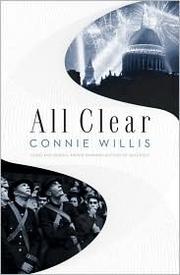
Reread #40 All Clear

All Clear. Connie Willis. 2010. Random House. 645 pages. [Source: Bought]

If you want a gushing review of the book, I recommend visiting my first review of the book.  It is always interesting to me to see which books reread well, and which ones don't. Mood obviously comes into it. And apparently, I was not in the mood for All Clear. Perhaps because I was taking my time, instead of rushing through, I found myself less enthusiastic with the stories and characters. Too much time to think and ask questions, maybe?!

Is All Clear a disappointing novel? Yes and no. On the one hand, I certainly didn't LOVE, LOVE, LOVE it the same way I loved Doomsday Book and To Say Nothing of the Dog. Since I love reading books set during World War II, one would think that I'd almost have to love, love, love these two time travel books set in England during the war. I mean, I love time travel, I love books set during this time period. It would seem like the most natural thing in the world for me to ecstatically love Blackout and All Clear. But. That is not the case. On the other hand, the books are enjoyable enough. I certainly came to care about the characters and wanted to know what happened next. But there wasn't an urgency to KNOW if you know what I mean. I found both books less compelling than the previous time travel books. I found a handful of characters enjoyable or interesting. But I didn't LOVE any of the characters.

Would the books have been better if they'd been published as one book, perhaps an edited-down one book? Probably. Hard to say for sure. It wasn't that any one section or chapter proved boring or irrelevant. It is just that both books were so very, very thick. And the books weren't necessarily action-packed. Which I don't have a problem with actually. I prefer character-driven books typically. But essentially the books are just about three characters realizing they are trapped in the past and may never get back to the future. They think about being trapped a lot. They brainstorm. They panic. They brainstorm. They cling to hope but give into worrying.

Without any previous books in the series to compare it too, Blackout and All Clear are certainly enjoyable enough on their own. It is really only in comparison to Willis' earlier time travel novels that the novels become a bit disappointing.

I liked All Clear. I didn't love All Clear.

© 2014 Becky Laney of Becky's Book Reviews

Friday, September 26, 2014

Reread #39 Blackout

Blackout. Connie Willis. 2010. Random House. 495 pages. [Source: Bought]


This year I've decided to reread all of Connie Willis' time travel books. This is the third book I've reread. I've also reread Doomsday Book and To Say Nothing of the Dog. I first reviewed Blackout in November 2010. I reviewed it again in January 2012.


Blackout is about (three) time travelers studying World War II. For the most part, the novel is set in the year 1940. However, the novel also contains other stories--almost like riddles. These small stories are set in 1944 and 1945, they feature other characters--or do they?--studying World War II: V1 Rockets and V-E Day.

Merope Ward (aka Eileen O'Reilly) has gone back to study the evacuation of children to the country. She is working as a nurse/maid on a country estate. Her assignment was for the spring of 1940.

Polly "Sebastian" (she takes on a different Shakespearean last name for every assignment) has gone back to study the London Blitz. She wants to work as a London shopgirl. Her assignment was for the fall of 1940.

Michael Davies (Mike) has gone back to observe the Dunkirk evacuation. His assignment was for the summer of 1940.

They've heard over and over again that historians cannot change the past, that historians cannot damage the timeline, that historians can merely observe past events. But what if everyone was wrong? What if time travel is dangerous and risky? Not just dangerous for the time traveler who may find himself/herself in trouble, but dangerous for everyone. What if there are negative consequences for time travel?

Eileen, Polly, and Mike will question what they've all been told when they find themselves trapped in 1940 unable to return to Oxford and their own time. Eileen missed her deadline because of a quarantine initially. Months later she tried to use her drop and failed. She thought it was because there were too many people nearby--the military has just taken possession of the estate where she worked. She remembers that Polly Churchill will be in London soon. She wants to find her and use her drop to go back. Mike was injured during the Dunkirk evacuation. An injury that kept him trapped for weeks. His drop is also impossible to use. He remembers Polly's assignment. He goes to London desperate to find another time traveler. These three reunite only to discover what Polly already knew--her own drop was damaged--she thinks because of a bomb. She was hoping that THEY were there to rescue her. Being trapped changes everything.

Blackout is an intense read. Primarily the focus is on what war was like on the homefront, what the war was like for Londoners. I definitely recommend this one. But it does come with a warning. It is only half the story. All Clear is the sequel, and, you'll want to read it to finish the story. Blackout does not stand on its own.

© 2014 Becky Laney of Becky's Book Reviews

Friday, July 11, 2014

Reread #28 To Say Nothing of the Dog

To Say Nothing of the Dog. Connie Willis. 1998. Bantam. 493 pages. [Source: Bought]

I have every intention of rereading all four Oxford time travel books by Connie Willis this year. Earlier in the year, I reread the first book, Doomsday Book. To Say Nothing of the Dog, the second book, is a book I originally read and reviewed in July 2009. While the first book offers drama, drama, more drama, with just a touch of humor now and then, the second book is a romantic comedy. I happen to love both books though they are very different from one another.

Ned Henry is the hero of To Say Nothing of the Dog. He is on a mission, not a mission of his own choosing perhaps, but a big mission all the same. He is one of many time travelers working for Lady Schrapnell on her latest project: restoring Coventry Cathedral. The novel opens with a very overworked Ned Henry beginning to show severe signs of time-lag. What he needs is rest, permission to rest. That isn't likely to happen if Lady Schrapnell learns his whereabouts. For better or worse, Ned Henry is sent to the past--to Victorian times--to recuperate. He's been given another mission too. This time by someone much nicer and calmer than Lady Schrapnell. The problem? Ned Henry wasn't capable of listening and understanding. Now he's in the past without a real clue of WHY he's there and what he's supposed to accomplish.

Verity Kindle is the heroine of To Say Nothing of the Dog. She is on a mission of her own. While Ned Henry was given the assignment of finding out the whereabouts of the bishop's bird stump, Verity's assignment is to read Tocelyn's diary. The diary is available to read in the future. But the most relevant pages to the Coventry Cathedral project were damaged. So she's been sent to the oh-so-important summer of 1888 to read the newly written diary entries. She's having about as much success as Ned Henry. In other words, not much luck at all! These two work together as best they can. Verity manages to travel back and forth a few times to the future. Their mission--as they see it has changed a bit. They worry that they've damaged the future and that something horrible may happen as a result. Like Tocelyn, they know, was supposed to marry a "Mr. C". They know this for a fact from future diary entries. Yet here they are and she's engaged to someone else! Their "new mission" is to find the identity of "Mr. C." and make sure they meet when they're supposed to meet....

I loved this one. I have always loved this one. It is a delightful time travel novel. I love the humor! I do! It's so very, very funny! And I love the details and the dialogue. This one is just a joy cover to cover!

© 2014 Becky Laney of Becky's Book Reviews

Friday, January 17, 2014

Reread #3 Doomsday Book

Doomsday Book. Connie Willis. 1992. Random House. 592 pages.  [Source: Book I Bought]

Mr. Dunworthy opened the door to the laboratory and his spectacles promptly steamed up.
"Am I too late?" he said, yanking them off and squinting at Mary.
"Shut the door," she said. "I can't hear you over the sound of those ghastly carols."
Dunworthy closed the door, but it didn't completely shut out the sound of "O Come, All Ye Faithful" wafting in from the quad. "Am I too late?" he said again. 

I first read and reviewed Doomsday Book in October 2010. I reread it in December of 2011. Yes, this is my third time to read Connie Willis' award-winning novel, Doomsday Book. (It won the Hugo and Nebula!) Quite simply Doomsday Book is one of my favorite, favorite, favorite books. It combines my love of history (the measly middle ages!) and my love of science fiction (time travel!!!). It is set--in the future and the past--during the Advent-Christmas-Epiphany season.

Kivrin has a dream. She'll be the first time traveler historian to go to the fourteenth century. If all goes well, and why wouldn't it boasts Gilchrist, then she'll spend two or three weeks in 1320 before returning. But Mr. Dunworthy (and subsequently Badri, the tech guy) aren't as confident that things will go smoothly. Dunworthy is sure that something will go wrong. Even if something doesn't go wrong with the time travel aspect (she lands in the right time, the right place), he's worried that something will happen to her in the past (she'll get beaten up, she'll get raped,  she'll be mistaken for a witch, she'll get sick, she'll die).

From the start, there is something wrong with the drop. It starts with the technician, Badri, becoming ill. Soon the whole area is quarantined. Cases start coming in--and soon medical staff are overwhelmed. What is this disease--this illness? How is it spread? Where did it come from? Is it fatal? Is there a cure? Did he have a chance to pass this on to Kivrin before she went through the Net? What was Badri trying to communicate to Dunworthy at the last minute?

Willis does a great job building the past--the fourteenth century--and the "present" which is a time-traveling future. (The story alternates between past and present.) She blends mystery, science fiction, and historical fiction--and blends them well! Readers meet dozens of characters in both centuries as this mystery unfolds. And while it is serious--dramatic--and emotional--people will die--it's not without its lighter moments of wit. There are personalities. The characters are oh-so-human.


Favorite quotes:
"I've just thought who you remind me of," Mary said, setting down her plate and a napkin. "William Gaddson's mother."
That was a truly unfair remark. William Gaddson was one of his first-year students. His mother had been up six times this term, the first time to bring William a pair of earmuffs. (23)
"Your tech seems to have done a passable job," Gilchrist said, turning to Dunworthy. "Medieval would like to arrange to borrow him on our next drop. We'll be sending Ms. Engle to 1355 to observe the effects of the Black Death. Contemporary accounts are completely unreliable, particularly in the area of mortality rates. The accepted figure of fifty million deaths is clearly inaccurate, and estimates that it killed one third to one half of Europe are obvious exaggerations. I'm eager to have Ms. Engle make trained observations."
"Aren't you being rather premature?" Dunworthy said. "Perhaps you should wait to see if Kivrin manages to survive this drop or at the very least gets through to 1320 safely."
Gilchrist's face took on its pinched look. "It strikes me as somewhat unjust that you constantly assume Medieval is incapable of carrying out a successful drop," he said. "I assure you we have carefully thought out its every aspect. The method of Kivrin's arrival has been researched in every detail. Probability puts the frequency of travelers on the Oxford-Bath road as one every 1.6 hours, and it indicates a 92 percent chance of her story of an assault being believed, due to the frequency of such assaults. A wayfarer in Oxfordshire had a 42.5 percent chance of being robbed in winter, 58.6 percent in summer. That's an average of course. The chances were greatly increased in parts of Otmoor and the Wychwood and on the smaller roads."
Dunworthy wondered how on earth Probability had arrived at those figures. The Domesday Book didn't list thieves, with the possible exception of the king's census takers, who sometimes took more than the census, and the cutthroats of the time surely hadn't kept records of whom they had robbed and murdered, the locations marked neatly on a map. Proofs of deaths away from home had been entirely de facto: the person had failed to come back. And how many bodies had lain in the woods, undiscovered and unmarked by anyone? (29)
"Mr. Dunworthy, I've been looking for you everywhere," Finch said. "The most dreadful thing's happened."
"What is it?" Dunworthy said. He glanced at his digital. It was ten o'clock. Too early for someone to have come down with the virus if the incubation period was twelve hours. "Is someone ill?"
"No sir. It's worse than that. It's Mrs. Gaddson. She's in Oxford. She got through the quarantine perimeter somehow."
"I know. The last train. She made them hold the doors."
"Yes, well, she called from hospital. She insists on staying at Balliol..."
"Tell her we haven't any room. Tell her the dormitories are being sterilized."
"I did, sir, but she said in that case she would room with William. I don't like to do that to him, sir."
"No," Dunworthy said. "There are some things one shouldn't have to endure, even in an epidemic." (117)
"I thought there'd be more going on," Colin said, sounding disappointed. "Sirens and all that."
"And dead-carts going through the streets, calling 'Bring out your dead'?" Dunworthy said. "You should have gone with Kivrin. Quarantines in the Middle Ages were far more exciting than this one's likely to be...(191)
19 December 1320 (Old Style). I'm feeling better. I can go three or four careful breaths at a time without coughing, and I was actually hungry this morning, though not for the greasy porridge Maisry brought me. I would kill for a plate of bacon and eggs. And a bath. I am absolutely filthy. Nothing's been washed since I got here except my forehead, and the last two days Lady Imeyne has glued poultices made of strips of linen covered with a disgusting-smelling paste to my chest. Between that, the intermittent sweats that I'm still having, and the bed (which hasn't been changed since the 1200s), I positively reek, and my hair, short as it is, is crawling. I'm the cleanest person here. (200)
Finch went to the door and then turned back. "About Mrs. Gaddson, sir. She's behaving dreadfully, criticizing the college and demanding that she be moved in with her son. She's completely undermining morale."
"I'll say," Colin said dumping the muffins on the table. "The Gallstone told me hot breads were bad for my immune system."
"Isn't there some sort of volunteer work she could do at Infirmary or something?" Finch asked. "To keep her out of college?"
"We can hardly inflict her on poor helpless flu victims. It might kill them. What about asking the vicar? He was looking for volunteers to run errands."
"The vicar?" Colin said. "Have a heart, Mr. Dunworthy. I'm working for the vicar."
"The priest from Holy Re-Formed then," Dunworthy said. "He's fond of reciting the Mass in Time of Pestilence for morale. They should get along swimmingly. (264)
© 2014 Becky Laney of Becky's Book Reviews