Friday, February 10, 2012

The Great Migration

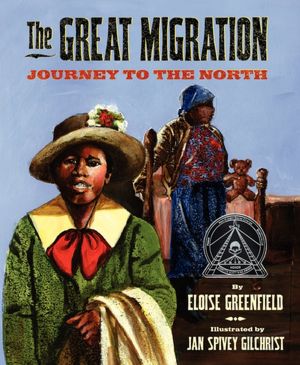
The Great Migration: Journey to the North. Eloise Greenfield. Illustrations by Jan Spivey Gilchrist.  2011. HarperCollins. 26 pages.

Between 1915 and 1930, more than a million African Americans left their homes in the South, the southern part of the United States, and moved to the North. This movement was named "the Great Migration." 

The Great Migration is a poetry book that won a 2012 Coretta Scott King Honor in the author category. What I liked best about this poetry book is the diversity of narrative voices. Greenfield tells the story of the Great Migration through a series of different voices--old, young, man, woman, boy, girl. Some find leaving bittersweet; others can't wait to start a new life. Some are anxious, hesitant. Others are exuberant and confident. All of the poems feel personal.

My favorite may be "IV. Question: Men and Women"

Will I make a good life
for my family,
for myself?
The wheels are singing,
"Yes, you will,
you will, you will!"
I hope they're right.
I think they're right.
I know they're right.
We're going to have
a great life. Got to try it.
Going to do it. Going to
make it. No matter what.

Read The Great Migration
  • If you enjoy poetry written for children
  • If you enjoy poetry with a historical subject
  • If you're interested in this time period, 1915-1930
  • If you are interested in African American history

© 2012 Becky Laney of Becky's Book Reviews

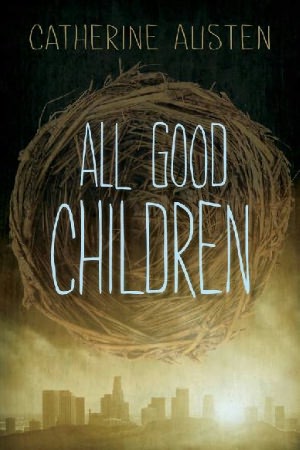
All Good Children (YA)

All Good Children. Catherine Austen. 2011. Orca. 300 pages.

The airport security guard is not amused when I drop my pants in front of her. 

All Good Children is a dystopian novel with a school setting. In this futuristic all-too-troubled society, a town is about to force a change. For the better, they say. But should we trust them?! The members of the school board, the members of the community--the powers that be--feel that some kids are too disruptive. Some 'problem' kids are keeping the majority of other students from learning. Or as learning as much as they potentially could. If, you know, obedience was enforced, and nonconformity not an option. If children would just do as they're told, and only as they're told, wouldn't the lives of teachers and parents go more smoothly? Wouldn't parents and teachers be relieved to see such a dramatic change in their children? No more fighting. No more rebelling. No more nagging. No more drama. Just peace and quiet. But. They're not talking about drugging a few children, targeting the students with obvious behavior issues. Every boy. Every girl. From kindergarten on up. One grade at a time. One school at a time. A whole town is being transformed. No child is left capable of thinking or acting for themselves.  They're mindlessly content to stay on task, mindlessly repeating the rules they've been taught. The hero of All Good Children has escaped this punishment...so far...his mom is a nurse, a nurse in the know, and she was able to prevent her son and his best friend from receiving the shots. (She only pretended.) But they are forced to act mindless all the same. Because they know what will happen if they show some life...so what would you do, where would you go, what kind of escape can be found?

All Good Children had an interesting premise. I'm not sure that I loved it. I have a feeling that I'd have found Maxwell Connors annoying as a narrator if I hadn't been forced to pity him for his situation. Because it is hard for Maxwell to witness this phenomenon.

Read All Good Children
  • If you're looking for a novel with a Twilight-Zone feel to it
  • If you're a fan of dystopias
  • If you're looking for yet another dystopian novel published in 2011 with an educational focus (like Scored, like The Predicted, like The Wikkeling)

© 2012 Becky Laney of Becky's Book Reviews
The Friendship Doll (MG)

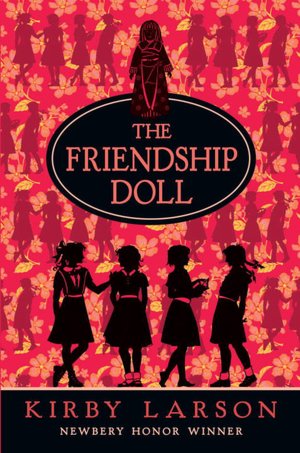
The Friendship Doll. Kirby Larson. 2011. Random House. 208 pages.

The old doll-maker Tatsuhiko poured boiling water into the teapot with trembling hands and inhaled deeply. It was the last of his tea. He portioned out his breakfast rice and took a seat on a tatami mat. One of the blessings of growing old was that it did not take much to make his stomach content. And this morning his heart was so full that food seemed trivial.

One Japanese doll, Miss Kanagawa, sent in friendship in 1927, finds herself 'awakened' to the joys and sorrows of humanity in Kirby Larson's The Friendship Doll. Miss Kanagawa will be seen by many, many people in her travels. Especially at the beginning. When she's on display, when she's on tour, with the other friendship dolls. But can a doll touch others--touch human lives--if she herself can't be touched or played with?

The Friendship Doll is historical fiction with a touch of fantasy. (Readers will have to believe that a doll is capable of thinking and loving, etc.) The book is a series of stories, the main connection between the stories being the doll. Each story is set in its own time period. The first is set in 1927; the second in 1933; the third in 1937; the fourth covers a handful of years--1939 to 1941. (There is an epilogue that brings it closer to the present.)

For much of the novel Miss Kanagawa acts as a conscience for a handful of heroines. She does this without saying a word, of course. But Miss Kanagawa is more than just a scolding sort of doll. She becomes more 'alive' with each experience. She has always been observant, but she becomes wiser and more compassionate with each adventure. (More human, less doll-like).

Did I like this one? Yes!!! I definitely liked this one! It was interesting to see the different characters. I think I liked the 1933 and 1937 stories best of all. But I enjoyed all of them.

Read The Friendship Doll
  • If you like stories about dolls. Like Hitty, Her First Hundred Years. Like Miss Hickory. Like The Miraculous Journey of Edward Tulane. Like The Velveteen Rabbit.
  • If you like historical fiction set in the 1920s, 1930s, 1940s.
© 2012 Becky Laney of Becky's Book Reviews

Thursday, February 09, 2012

Sylvia & Aki (MG)

Sylvia & Aki. Winifred Conkling. 2011. Random House. 160 pages.

Sylvia Mendez imagined her first day of third grade at Westminster School. She would use her freshly sharpened yellow pencils to write her name in cursive at the top of her worksheets. Her just-out-of-the-shoe-box black Mary Janes would glide across the polished linoleum of the hallway. At the end of the day, she would come home and her father would hug her and ask, "What did you learn today?" Then she would tell him about her teacher and her classmates and everything else.
Sylvia never imagined the one that that actually happened even before her first day of school: she was turned away.

This wonderful little book is based on true events. The main characters Sylvia Mendez and Aki Munemitsu are real people, the novel is based on their experiences during World War II.

Sylvia Mendez and her siblings have been told they cannot attend Westminster School because they are Mexican. They will need to attend the Mexican school in the county. Every Mexican--no matter where they live--are to go to the same school. To say that the two schools are anywhere close to equal would be a joke. But Sylvia's father takes his children's education VERY seriously. And the answer the school board gives him just isn't acceptable to him. What he sees is injustice, and he wants it to end. This fight for justice and equality will end in court. And the chapters focused on this trial are fascinating and disturbing. Those chapters alone would make this one a worthy read.

Aki Munemitsu and her family are one of many families of Japanese descent being deported from California after the bombing of Pearl Harbor. Her family is being sent to an internment camp in Arizona. The novel focuses on her experiences during those years.

So how do these two stories connect? Sylvia's father is leasing the farm from Aki's family. Sylvia is living in Aki's house, sleeping in her bedroom. Sylvia discovers Aki's doll, the doll she had to leave behind. Sylvia decides to go with her dad on one of his trips to the internment camp to pay rent. The two girls meet and decide to write one another.

I liked this one. I did. It was a wonderful little novel. I found it informative and fascinating. I learned so much while reading this one. I would definitely recommend it!

Favorite quotes:

After weeks of trying to convince people to sign his letter to the school board stating that Mexican and white children should go to school together, Sylvia's father had collected only eight signatures.
"What are you going to do with the letter?" Sylvia asked her father. She didn't think he would turn it in with so few names.
"I'm going to deliver it," he said. "It would be the right thing to do, even if no one else is willing to sign."
Sylvia rode with her father to the courthouse in Santa Ana on the day he dropped off the letter. Just a couple of blocks from the courthouse Sylvia saw a sign posted in a diner window: NO DOGS OR MEXICANS. The words made her feel sick. She was glad her father had spotted someone he knew on the street and hadn't noticed the sign.
That sign is talking about me, she thought. Dogs and Mexicans and me. The sign gnawed at Sylvia all afternoon and into the evening. Before drifting off to sleep that night, she stared at the ceiling and thought about how those four little words could hurt her so much. Then she recalled the hateful signs she had seen posted in town about the Japanese--hand-lettered signs reading JAPS GO HOME and government-printed notices telling them that they had to go away, to leave their houses, to go to the camps. This made her think of the girl she knew only from a photograph and the few scraps of her life that were left in what was now Sylvia's bedroom.
How did Aki feel when she saw those signs and read those posters? Sylvia wondered. Did Aki feel as hurt as I do now?
Sylvia looked over at her dolls. Carmencita leaned against the corner of one shelf, and Keiko stood in the corner of another.
Sylvia got out of bed and moved Keiko to the shelf next to Carmencita. She placed the dolls side by side, then stood back. How nice they look together--almost like sisters. She rested Keiko's pale china hand in Carmencita's brown cloth one. It seemed right and good to see them so close. I wonder if I will ever meet Aki. Could we ever be friends? (65-6)

Read Sylvia and Aki
  • If you like historical books written for children
  • If you like books written about this time period, the second world war
  • If you like books written about different cultures

© 2012 Becky Laney of Becky's Book Reviews

Wednesday, February 08, 2012

Earth Abides

Earth Abides. George R. Stewart. 1949/2006. (Introduction to this edition by Connie Willis!) Random House. 368 pages.

Just as he pulled himself up to the rock ledge, he heard a sudden rattle, and felt a prick of fangs.

Earth Abides almost leaves me speechless. I almost don't know what I could say about this one. I am definitely glad I read it.

Did I find it thrilling and compelling and wonderful? Sometimes. Maybe not as thrilling as you might expect a futuristic apocalyptic novel to be. Think more along the lines of Robinson Crusoe. Slow and steady with some adventuresome scenes. But mainly a more thoughtful novel.

Ish Williams, our hero, was bitten by a rattle snake. He makes it to his cabin before the sickness completely overwhelms him, and he does what he can to try to survive the snake bite. But nothing is certain, and he knows it. What he didn't expect, what he couldn't possibly have imagined, is that while he's been off camping, off having his nature-inspired adventures, his own brush with death via snake bite, the whole world has changed. The earth's population has dropped to almost nothing. In fact, it takes Ish a couple of chapters, at least, to find another survivor. And several more chapters to find a survivor sober enough, rational enough to want to spend any amount of time with. But Ish is determined and intellectual, a real thinker. He will find some way to go on with life, find some way to build a little pocket of society again.

The novel is broken into several sections. Some sections cover a few months, a few years, and other sections cover twenty or thirty years. Some sections are very detailed, very focused on individuals, others not so much. Some characters are definitely developed well, others not so much. Ish is definitely one of the most developed characters, most introspective and reflective characters that I've encountered in science fiction. (Perhaps not more than Ender or Andrew Wiggin in his Speaker of the Dead status.) That doesn't mean I love him necessarily, but it may mean I remember him.

Earth Abides isn't as emotional as it might have been or could have been. Ish just isn't a show-your-emotions type of guy. He is reflective and intellectual. He's resourceful. He knows a little bit about everything. He's a handy guy to have around. But he's not going to go on and on and on about his feelings. He's not going to weep or go crazy. He's not going to lose it just because the world as he knows it has ended. He's disconnected, in a way, yet his detachment may enable him to survive in this new world.

Read Earth Abides
  • If you're looking to read vintage science fiction, a classic apocalyptic, post-apocalyptic novel
  • If you're interested in survival stories
  • If you're interested in a generational story

© 2012 Becky Laney of Becky's Book Reviews