Friday, January 14, 2022

9. Waking Romeo


Waking Romeo. Kathryn Barker. 2022. [January] 384 pages. [Source: Library]

First sentence: I'm sitting in the chapel for school assembly when Headmistress Cisco says, "And now we'll hear a special tribute from Rosaline."

It has been said a million times (or more) that two wrongs don't make a right. (But what if they did????) If you've been a long-term follower of my reviews, you already know that I am NOT a fan of William Shakespeare's Romeo and Juliet OR Emily Bronte's Wuthering Heights. 

Kathryn Barker's imaginative new novel Waking Romeo plays with a handful of characters from these two classics. Specifically, readers meet JULES, a troubled teen whose life has not been the same since her attempted suicide and Romeo's "death" and ELLIS one of a handful of time travelers that can go *backwards* and *forwards* in time. 

Ellis (and his 'Deadender' "family") live at the end of time in an abandoned bus. They go on missions throughout time in a grand seemingly-impossible attempt to save the world (from itself). Their missions all seem to center in and around this idea of...you guessed it...WAKING ROMEO. But Romeo has been in a coma--I guess coma is the right word--for years.

Jules, as I mentioned, is a mess. One of her outlets is writing a play in the style of William Shakespeare. She is writing her and Romeo's story. Only she knows deep down that what is on the page is far, far, far from the truth. Still, if it was not 'true love' if it was just two kids being idiots, how can she make what happen mean something? How can she come to terms with her rock bottom if it was all for nothing???

Ellis (and friends) meet Jules in her time--2083--and thus begin their adventures and misadventures in waking Romeo...

I definitely like Waking Romeo a thousand times better than Wuthering Heights and Romeo and Juliet.

The world-building is slushy. I'll try to explain. Some things are clear and straight-forward. Someone created time-travel pods--maybe in the 2050s???---and it became trendy to travel. But there's a catch, travelers can only go *forward* in time. Traveling thus disrupts families, generations, society, and culture. If everyone keeps leaping ahead, there is no one left behind to do the work--the maintenance needed to take care of the world, of society. Travelers may not like what they see so they keep jumping and jumping and jumping ahead. Those who can afford the pods to travel, well, they just think I'll keep jumping until I find paradise...but such does not exist. Thus 'the end of the world' is the dead-end. Time travel has a DARK side, for sure. This highlights in a way the moral/ethical laziness of the human race. Where it gets a bit slushy--aka a bit unclear--is the TIME TRAVEL itself. Instead of the time travel being lovely little loops or such, imagine a Gordian knot. I simply don't know if any reader could truly "understand" or "comprehend" *ALL* of the time-trips and piece them together in any sort of order that would make sense. 

S

P

O

I

L

E

R

S

In particular when there are multiple copies of each person in play. A middle-aged Jules and a middle-aged Ellis PLUS a teenage Jules and teenage Ellis. 


© 2022 Becky Laney of Becky's Book Reviews

Wednesday, January 12, 2022

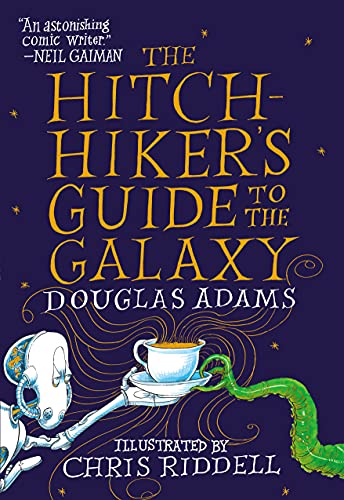
8. The Hitchhiker's Guide to the Galaxy


The Hitchhiker's Guide to the Galaxy. Douglas Adams. Illustrated by Chris Riddell. 1979/2021. 289 pages. [Source: Library]

First sentence: The house stood on a slight rise just on the edge of the village. It stood on its own and looked out over a broad spread of West Country farmland. Not a remarkable house by any means – it was about thirty years old, squattish, squarish, made of brick, and had four windows set in the front of a size and proportion which more or less exactly failed to please the eye. The only person for whom the house was in any way special was Arthur Dent, and that was only because it happened to be the one he lived in. He had lived in it for about three years, ever since he had moved out of London because it made him nervous and irritable. He was about thirty as well, tall, dark haired and never quite at ease with himself. The thing that used to worry him most was the fact that people always used to ask him what he was looking so worried about. He worked in local radio, which he always used to tell his friends was a lot more interesting than they probably thought. It was, too – most of his friends worked in advertising.

The Hitchhiker's Guide to the Galaxy is all about the journey and NOT the destination. Arthur Dent, one of our heroes, is one of two survivors of Earth's destruction--the other being a stranded alien named Ford Prefect. Earth was 'set' to be demolished on the same day that Arthur Dent's house was set to be demolished... many adventures or misadventures follow once these two hitch a ride on a spaceship (or two). 

The Hitchhiker's Guide to the Galaxy follows a dream logic of sorts. The less you think about it, the more you go with the flow, you can almost relax into the story and it works. It's silly and outrageous, but, you're content to go along for the laughs. It helps that it is quite quotable in places. But like a dream, the ending is abrupt. You can't help wanting to close your eyes and try to get back into the dream to see if you can wrap things up. 

The ending was my least favorite part. The humor was my most favorite part.

Quotes:

I like the cover,’ he said. ‘Don’t Panic. It’s the first helpful or intelligible thing anybody’s said to me all day.’
‘I’ll show you how it works,’ said Ford. He snatched it from Arthur who was still holding it as if it was a two-week-dead lark and pulled it out of its cover.
‘You press this button here, you see, and the screen lights up giving you the index.’
A screen, about three inches by four, lit up and characters began to flicker across the surface.
‘You want to know about Vogons, so I enter that name so.’ His fingers tapped some more keys. ‘And there we are.’
The words Vogon Constructor Fleets flared in green across the screen.
Ford pressed a large red button at the bottom of the screen and words began to undulate across it. At the same time, the book began to speak the entry as well in a still quiet measured voice. This is what the book said.
‘Vogon Constructor Fleets. Here is what to do if you want to get a lift from a Vogon: forget it. They are one of the most unpleasant races in the Galaxy – not actually evil, but bad-tempered, bureaucratic, officious and callous. They wouldn’t even lift a finger to save their own grandmothers from the Ravenous Bugblatter Beast of Traal without orders signed in triplicate, sent in, sent back, queried, lost, found, subjected to public inquiry, lost again, and finally buried in soft peat for three months and recycled as firelighters. The best way to get a drink out of a Vogon is to stick your finger down his throat, and the best way to irritate him is to feed his grandmother to the Ravenous Bugblatter Beast of Traal.
‘On no account allow a Vogon to read poetry at you.’
Arthur blinked at it.
‘What a strange book. How did we get a lift, then?’
‘That’s the point, it’s out of date now,’ said Ford, sliding the book back into its cover. ‘I’m doing the field research for the new revised edition, and one of the things I’ll have to do is include a bit about how the Vogons now employ Dentrassi cooks, which gives us a rather useful little loophole.’
A pained expression crossed Arthur’s face. ‘But who are the Dentrassi?’ he said. ‘Great guys,’ said Ford. ‘They’re the best cooks and the best drinks mixers and they don’t give a wet slap about anything else. And they’ll always help hitchhikers aboard, partly because they like the company, but mostly because it annoys the Vogons.


Vogon poetry is of course the third worst in the Universe. The second worst is that of the Azgoths of Kria. During a recitation by their Poet Master Grunthos the Flatulent of his poem ‘Ode To A Small Lump of Green Putty I Found In My Armpit One Midsummer Morning’ four of his audience died of internal haemorrhaging, and the President of the Mid-Galactic Arts Nobbling Council survived by gnawing one of his own legs off. Grunthos is reported to have been ‘disappointed’ by the poem’s reception, and was about to embark on a reading of his twelve-book epic entitled My Favourite Bathtime Gurgles when his own major intestine, in a desperate attempt to save life and civilization, leapt straight up through his neck and throttled his brain.
The very worst poetry of all perished along with its creator Paula Nancy Millstone Jennings of Greenbridge, Essex, England in the destruction of the planet Earth.

All right,’ said Ford, ‘just stop panicking!’
‘Who said anything about panicking?’ snapped Arthur. ‘This is still just the culture shock. You wait till I’ve settled down into the situation and found my bearings. Then I’ll start panicking!’
‘Arthur, you’re getting hysterical. Shut up!’ Ford tried desperately to think, but was interrupted by the guard shouting again. ‘Resistance is useless!’


All right,’ said Deep Thought. ‘The Answer to the Great Question…’
‘Yes…!’
‘Of Life, the Universe and Everything…’ said Deep Thought.
‘Yes…!’
‘Is…’ said Deep Thought, and paused.
‘Yes…!’
‘Is…’
‘Yes …!!! …?’
‘Forty-two,’ said Deep Thought, with infinite majesty and calm.


© 2022 Becky Laney of Becky's Book Reviews

Tuesday, January 11, 2022

7. The Shattered Castle


The Shattered Castle (Ascendance #5) Jennifer A. Nielsen. 2021. [October 19] 332 pages. [Source: Library]

First sentence: Throughout the years, I'd faced death more times than I could count, fought a war, endured the loss of my parents, and survived torture, cruelty, and multiple insults i nthe form of overcooked meat at the supper table. I thought that I had already faced the worst of anything this world might offer.

The Shattered Castle is the fifth and possibly the final book in the series. It is closely connected to the fourth book, Captive Kingdom, and both Captive Kingdom and The Shattered Castle occur in the story BEFORE the end of the third book. Both books are 'after thoughts' (if you will) of the original trilogy. The books fill in the blanks of that missing year between the end of the war and the marriage of King Jaron and Imogen.

The fourth book introduced new villains or antagonists. The fourth book ended with a temporary pause in hostilities. He had won that battle, but, probably most likely it wasn't going to be THE END of that conflict. He had just bought his kingdom time--maybe a little, maybe a lot. The fifth book opens with several "conflicts." His future mother-in-law has arrived, and she is displeased at best with how things are. HE is not good enough for HER daughter. No matter that he is the king. He is trouble with a capital T. The son of a former regent--one removed from the position because of his actions/choices--has arrived demanding that he be allowed to take his father's position as regent. Jaron has a strong instinct that he is TROUBLE. But the third conflict, well, he wasn't expecting trouble SO SOON and so sudden.

This novel EXPLODES with action quickly. The title is to be taken quite literally.

This novel gives King Jaron a dozen plus opportunities to reassess his life, his choices, his priorities. WHAT MATTERS MOST. That is what is on the back of his mind--not the front and center, mind you. That is taken up with things like SURVIVING, PLOTTING, PLANNING, SCHEMING and trying to stay a few steps ahead of his enemies. 

I didn't love, love, love the fourth book. I didn't. I wasn't so crazy about this one either--for most of the journey--but it began to redeem itself a bit halfway through. By the end, I was glad I kept reading. All that being said, if you reach the third book and you're like WOW what a great way to end a great series. This is oh-so-satisfying...I couldn't ask for a better, more fulfilling ending...then probably don't seek out these two late additions???

It's not that they are bad. They're not. I love, love, love, love, crazy love these characters. I've grown super attached to them. But at the end of the day, we're still right back at the ending with the third book....only now we've read about three or four dozen close-calls with Jaron and his friends almost dying. Jaron does grow as a character. So there is that at least. Jaron grows in each and every book in this series. And that's a great thing.


© 2022 Becky Laney of Becky's Book Reviews
Monday, January 10, 2022

6. Once Upon a Camel


Once Upon A Camel. Kathi Appelt. 2021. [September] 336 pages. [Source: Library]

First sentence: "Incoming!" Even in her sleep, Zada recognized that voice. The old camel raised one eyelid. It was still dark.

Premise/plot: Once Upon a Camel is Kathi Appelt's newest animal fantasy. It is set in Texas circa 1910 (though it has flashbacks dating from the 1850s) and stars a camel, Zada, and a family of kestrels. A sand storm is coming--and fast--and all are in danger. It is ultimately up to 'Auntie' Zada (and her stories) to save the lives of the chicks Wims and Beulah. These two are left in her care--atop her head to be precise--when their parents Perlita and Pard are blown away or caught up in the storm. Can she keep them safe? Will they make it to the mission? (their prearranged meeting spot after the storm) Will everyone survive?

My thoughts: Once Upon a Camel is animal fantasy with a historical setting that very much celebrates stories and the idea of linking stories and survival. Zada's stories--selectively covering her past--give her the mental/emotional/spiritual boost she needs to keep going, keep hoping, keep it together. And the chicks, well, they love Zada's stories. The stories are both entertainment, distraction, and love language.

I was a little nervous about this one so I had my mom read it first. I don't handle SAD well. She highly recommended that I read this one. I'm so glad I did. I definitely found it a captivating story. Though I don't consider myself a 'bird person' I soon got caught up in the story. I was hoping that all would be well and that Wims and Beulah would be reunited with their parents. 

The ending was GOOD.

© 2022 Becky Laney of Becky's Book Reviews

Thursday, January 06, 2022

2022 Back to the Classics Reading Challenge


Back to the Classics Reading Challenge 2022
Hosted by Books and Chocolate (sign up here)
January - December 2022
# of books: 9 to 12 is my goal

Categories for 2022

1. A 19th century classic. Any book first published from 1800 to 1899
 
Our Mutual Friend. Charles Dickens. 1865. 801 pages. [Source: Bought]

2. A 20th century classic. Any book first published from 1900 to 1972. All books must have been published at least 50 years ago; the only exceptions are books which were written by 1972 and posthumously published.

Exodus. Leon Uris. 1958. 610 pages. [Source: Library]

3. A classic by a woman author.

Katherine. Anya Seton. 1954. 512 pages. [Source: Bought]

4. A classic in translation.  Any book first published in a language that is not your primary language. You may read it in translation or in its original language, if you prefer. 
 
Mio, My Son. Astrid Lindgren. 1954/2015. NYR Children's Collection. 184 pages. [Source: Library]

5. A classic by BIPOC author. Any book published by a non-white author.

A Raisin in the Sun. Lorraine Hansberry. 1959/2011. 160 pages. [Source: Library]

6.
 Mystery/Detective/Crime Classic. It can be fiction or non-fiction (true crime). Examples include Murder on the Orient Express, Crime and Punishment, In Cold Blood.
 
Death on the Nile. Agatha Christie. 1937/2007. Black Dog & Leventhal. 352 pages. [Source: Bought]

7. A Classic Short Story Collection. Any single volume that contains at least six short stories. The book can have a single author or can be an anthology of multiple authors. 

I, Robot. Isaac Asimov. 1950. 304 pages. [Source: Library]

8. Pre-1800 Classic. Anything written before 1800. Plays and epic poems, such as the Odyssey, are acceptable in this category. 

Don Quixote. Miguel de Cervantes Saavedra. Translated by Edith Grossman. 1605. 940 pages. [Source: Bought]

9. A Nonfiction Classic. Travel, memoirs, and biographies are great choices for this category.

A Night to Remember. Walter Lord. 1955. 182 pages. [Source: Library]

10. Classic That's Been on Your TBR List the Longest. Find the classic book that's been hanging around unread the longest, and finally cross it off your list!  

The Forsyte Saga. (The Forsyte Chronicles #1-3). John Galsworthy. 1922. 872 pages. [Source: Bought]

11. Classic Set in a Place You'd Like to Visit. Can be real or imaginary -- Paris, Tokyo, the moon, Middle Earth, etc. It can be someplace you've never been, or someplace you'd like to visit again.

Hawaii. James A. Michener. 1959. 1136 pages. [Source: Library]

12. Wild Card Classic. Any classic you like, any category, as long as it's at least 50 years old

 Endurance: Shackleton's Incredible Voyage. Alfred Lansing. 1959/2015. 357 pages. [Source: Library]

© 2022 Becky Laney of Becky's Book Reviews