Friday, August 05, 2011

They Do It With Mirrors

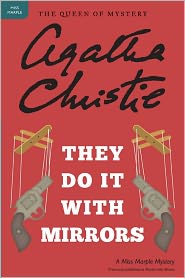
They Do It With Mirrors. (Miss Marple). Agatha Christie. 1952/2011. HarperCollins 224 pages.

Mrs. Van Rydock moved a little back from the mirror and sighed. 

Ruth Van Rydock wants her good friend, Jane Marple, to do her a favor. She's worried about their mutual friend Carrie Louise Serrocold. She has a feeling that Carrie Louise is in trouble or in danger. And so she's arranged a visit for Miss Marple. After a few small lies are told to smooth the way, Carrie Louise is happy to welcome her old friend into her home. Miss Marple is introduced to the STRANGE, STRANGE bunch of folks living or working on the estate. Her husband, Lewis. Her daughter, Mildred. Her granddaughter, Gina, and her husband, Walter. Her stepsons from her second marriage, Stephen and Alex Restarick. Her companion-caretaker, Juliet Bellever. Her husband's assistant, Edgar Lawson. (Carrie Louise has been married three times--and it shows. She's carried over wealth and property, but, also children and grandchildren, etc.) Her husband's pet project has him working with juvenile delinquents with part of the estate being converted into a school of sorts. I won't lie, it was a bit confusing at first to see how these characters connect to one another--if they connect to one another. It helps that almost every character seeks out Miss Marple in the days after her arrival. One by one they "unburden" themselves and complain freely about anything and everything.

Of course, it turns out that Ruth had VERY good reason to worry about her friend. And Miss Marple it seems arrived just in time for the drama. Soon there's a murder to be solved...can she solve it in time before more lives are lost?

I enjoy Miss Marple. I do. There is just something satisfying about reading Agatha Christie. While They Do It With Murders isn't my new favorite or anything, it is an enjoyable mystery. Not perfect. But definitely enjoyable enough to recommend.

Ruth to Miss Marple:
"You've always been a sweet innocent looking creature, Jane, and all the time underneath nothing has ever surprised you, you always believe the worst."
"The worst is so often true," murmured Miss Marple.
"Why you have such a poor idea of human nature, I can't think--living in that sweet peaceful village of yours, so old world and pure."
"You have never lived in a village, Ruth. The things that go on in a pure peaceful village would probably surprise you."
"Oh I daresay. My point is that they don't surprise you." (9)

Inspector Curry and Miss Marple:
"This is all very distressing I know. But we've just got to get the facts clear. Get it all clear."
"Oh yes, I know," said Miss Marple. "So difficult, isn't it? To be clear about anything, I mean. Because if you're looking at one thing, you can't be looking at another. And one so often looks at the wrong thing, though whether because one happens to do so or because you're meant to, it's very hard to say. Misdirection, the conjurers call it. So clever, aren't they?" (90)

© 2011 Becky Laney of Becky's Book Reviews

Tuesday, August 02, 2011

The Boxcar Children

The Boxcar Children. Gertrude Chandler Warner. 1942. 155 pages.

One warm night four children stood in front of a bakery. No one knew them. No one knew where they had come from. The baker's wife saw them first, as they stood looking in at the window of her store. The little boy was looking at the cakes, the big boy was looking at the loaves of bread, and the two girls were looking at the cookies.

Henry, Jessie, Violet, and Benny are orphans. Scared of a grandfather they never met, these children are running away. When the novel opens, they are seeking refuge for the night, asking permission to sleep on the benches of the bakery shop. (They bought bread). After hearing the couple discuss them--on how they should "keep" the three oldest because they would be useful to have around as workers, but how the youngest one would need to go to a Children's Home--Henry and Jessie decide to wake everyone and leave while they still have a chance. They walk most of the night, sleep most of the day. Their journey takes them into the woods, and during a storm, they seek shelter in an abandoned boxcar. It doesn't take the children very long to realize that if a boxcar is good shelter from a storm, it would be a good home for always. There is a town within walking distance so that Henry can find work and buy food. And the rest of the children can do what they can to make it a real home. And that is just what they do...day by day creating a home for themselves.

I liked  The Boxcar Children. I did. I had read it more than a few times growing up, but it had been at least fifteen or twenty years since I'd last read it. It was such a treat to read it again. It's a simple book, in many ways, yet it's got its charms. I liked how these children do make a home for themselves. How they work together as a family. While I wouldn't say that I ever loved this one as much as Mandy or Anne of Green Gables or The Secret Garden, I have definitely always liked it.

© 2011 Becky Laney of Becky's Book Reviews

Monday, August 01, 2011

By His Own Hand?

By His Own Hand? The Mysterious Death of Meriwether Lewis. Edited by John D.W. Guice. Contributions by James J. Holmberg, John D.W. Guice, and Jay H. Buckley. Foreword by Elliott West. Introduction by Clay S. Jenkinson. 2006. University of Oklahoma Press. 208 pages.

From the foreword: In darker moments I sometimes wonder whether we require our most favored historical characters to die in particular ways. 

From the preface: Late in the afternoon on 10 October 1809 one of the nation's great heroes reined his horse off the Natchez Trace to spend the night at Grinder's Stand. The rustic homestead consisted of two rough-hewn log cabins a few paces apart and a distant barn. It was a pleasant fall day some seventy miles southwest of Nashville, Tennessee. What occupied Meriwether Lewis's mind we will never know, but we do know that shortly after sunup the next morning he died there. Who held the weapon or weapons that fired the fatal shots during the night? Did Lewis take his own life or did an assassin? After nearly two centuries, this remains one of the most fascinating, puzzling, and enduring questions in all of American history. 


I found By His Own Hand? a fascinating read, a true mystery.

In the first chapter, James J. Holmberg presents his case for suicide. He presents the facts of the case and argues that suicide is the most logical explanation, or the best educated guess for what happened that night. He examines several primary resources--letters, written accounts of oral testimonies or oral histories, etc. One of his main points is that Lewis' closest friends--those who knew him best, men like Thomas Jefferson and William Clark--believed that their friend took his own life. The information in the letters primarily comes from the account of Priscilla Grinder. Several men wrote letters recounting these events, but they got their story from talking to her. There were no other witnesses at the inn to verify what Priscilla Grinder heard or saw that night.

In the second chapter, John D.W. Guice presents his case for homicide. He goes over the facts yet again. He provides further context--in some areas--for readers. He argues that while it cannot be proven that it was not suicide, while it can not be thoroughly proven that it was in fact murder, enough questions remain that there is definitely reasonable doubt. Suicide may satisfy some, but for those historians on the other side, there are still so many unanswered questions that they can't just accept that it was suicide. They would need more facts, more answers. While the first chapter tried to argue that Lewis was in a bad state of mind, that he was depressed and suicidal and anxious, that he'd already tried and failed to commit suicide in the weeks leading up to his death, this second chapter tries to argue the opposite. They try to prove that while Lewis was human, while he had moments of doubts or anxieties, there were still plenty of indicators in his life to show that he had not given up, that he had every intention of living. And these rumors of previous suicide attempts are questionable. While one man writes of them, he does not give any clues at all as to the when or the where or the how. If he knew these attempts to be true, why not include at least some detail. If he really, truly thought this man was a danger to himself, why didn't he do something about it? And, of course, that is just one example. The chapter argues that the "witnesses" in the case are not infallible, and in some cases quite questionable. Priscilla Grinder's story changed, and changed quite a bit with each telling or retelling. And her story does not make that much sense even if she'd kept it the same. She claims that she heard two gunshots, when she went to investigate, she saw Lewis walking around begging for help, begging for water, begging for someone to finish the job. She did absolutely nothing...except wait for him to die. Many--if not all--primary accounts of Lewis' death depend on facts as shared by Mrs. Grinder. So William Clark and Thomas Jefferson learned of events second or third hand. Another point argued in this chapter is why would Lewis do such a horrible, horrible job at killing himself? Would he really do such a horrible job aiming twice so that he lingers for hours? Did he really linger for hours or was that Grinder adding drama to the story?

The third chapter by Jay H. Buckley is "a postmortem trial." Buckley provides summaries of the arguments from chapter one and two. He examines the strengths and weaknesses of the suicide theory and the strengths and weaknesses of the assassination theory. He does a great job in highlighting both sides. His goal, of course, is to get readers engaged, to challenge readers to think for themselves and decide which is most likely.

All of the chapters are well written. All are fascinating. Both sides argue quite well...
I really loved the mystery of this one. There are some things in history that are just mysteries. We don't know what happened--what really happened. And sometimes these mysteries are a bit hidden away. Some historians write what they think happened and leave it at that, taking some of the mystery out of life.

© 2011 Becky Laney of Becky's Book Reviews

Sunday, July 31, 2011

July Reflections

I read a lot of MG fiction in July! Included are some great classics like Heidi, The Light Princess, The Trumpeter of Krakow, and The Story of the Amulet. I also discovered some great new-to-me authors like Anya Seton, George MacDonald, P.D. James, and Bo Caldwell. This month I've read some GREAT books that I've just loved and adored. But it also had some not-so-great books. Still I'm pleased with what I accomplished this month. 

As far as challenges go, I was able to read at least one book for each of these challenges: New Author Challenge, 2011 TBR Challenge, TBR Pile Challenge, Historical Fiction, Victorian Literature Challenge, The Classic Bribe Challenge, Agatha Christie Reading Challenge,  Cruisin' Thru the Cozies.

This month I read 36 books. 

Board books: 2; Picture books: 1; Middle Grade: 13; Young Adult: 4; Adult: 5; Christian Fiction: 6; Christian Nonfiction: 4; Nonfiction: 1.

Review copies: 11; Library books: 18; Books I bought: 7.

My top five six: 

City of Tranquil Light. Bo Caldwell. 2010. Henry Holt. 304 pages.
Trauma Queen. Barbara Dee.
Heidi. Johanna Spyri. 
The Light Princess. George MacDonald.
Withering Tights. Louise Rennison. 
Mine is the Night. Liz Curtis Higgs.

Reviews at Becky's Book Reviews: 

Elephants Can Remember. Agatha Christie. (Hercule Poirot). 1972. 212 pages.
Cover Her Face. P.D. James. 1962. 254 pages.
Sense and Sensibility. Jane Austen. 1811. (The Complete Novels) Random House. p. 3-175.
My Theodosia. Anya Seton. 1941/2007. Chicago Review Press. 432 pages.
Dragonwyck. Anya Seton. 1944/2005. Chicago Review Press. 352 pages.
The Search for Wondla by Tony DiTerlizzi. 2010. Simon & Schuster. 477 pages.
Trauma Queen. Barbara Dee. 2011. Simon & Schuster. 272 pages.
No Passengers Beyond This Point. Gennifer Choldenko. 2011. Penguin. 256 pages.
Smells Like Treasure. Suzanne Selfors. 2011. Little, Brown. 416 pages.
 The Story of the Amulet. E. Nesbit. 1906. 228 pages.
The Hidden Gallery (The Incorrigible Children of Ashton Place #2) Maryrose Wood. 2011. HarperCollins. 320 pages.
Heidi. Johanna Spyri. 1880/2009. Puffin Classics/Penguin.  320 pages.
Heidi Grows Up. Charles Tritten. 1938. 190 pages.
Heidi's Children. Charles Tritten. 1939. 255 pages.
The Light Princess. George MacDonald. 1864. 110 pages.
The Trumpeter of Krakow. Eric P. Kelly. 1928. 208 pages.
Swift Rivers. Cornelia Meigs. 1932/2004. Walker. 288 pages.
Alice in Time. Penelope Bush. 2011. Holiday House. 208 pages.
Star-Crossed. Linda Collison. 2006. Random House. 416 pages.
Possession. Elana Johnson. 2011. Simon & Schuster. 416 pages.
Withering Tights. Louise Rennison. 2011. HarperCollins. 288 pages.
Are You Going To Kiss Me Now? Sloane Tanen. 2011. Sourcebooks. 368 pages.
Genrefied Classics: A Guide to Reading Interests in Classic Literature. Tina Frolund. 2007. Libraries Unlimited. 392 pages.

Reviews at Young Readers:

I Like Vegetables. Lorena Siminovich. 2011. Candlewick Press. 10 pages.
I Like Toys. Lorena Siminovich. 2011. Candlewick Press. 10 pages.
Grump. Janet Wong. Illustrated by John Wallace. 2001. Simon & Schuster. 32 pages.

Reviews at Operation Actually Read Bible:

My First Read and Learn: Book of Prayer. Dr. Mary Manz Simon. 2007. Scholastic. 40 pages.
Mine is the Night. Liz Curtis Higgs. 2011. Waterbrook. 464 pages
Read Your Bible One Book At A Time: A Refreshing Way To Read God's Word with New Insight and Meaning. Woodrow Kroll. 2002. Gospel Light Publications. 150 pages.
How to Find God in the Bible: A Personal Plan For the Encounter of Your Life. Woodrow Kroll. 2004. Multnomah. 204 pages.
City of Tranquil Light. Bo Caldwell. 2010. Henry Holt. 304 pages.
Embrace Grace: Welcome to the Forgiven Life. Liz Curtis Higgs. 2006. Waterbrook Press. 160 pages.
To The One Who Conquers: 50 Daily Meditations on the Seven Letters of Revelation 2-3. Sam Storms. 2008. Crossway Books. 240 pages.
Bookends. Liz Curtis Higgs. 2000. Multnomah. 340 pages.
Safely Home. Randy C. Alcorn. 2011. Tyndale. 434 pages.
Mixed Signals. Liz Curtis Higgs. 1999. Multnomah. 384 pages.


© 2011 Becky Laney of Becky's Book Reviews

The Sunday Salon: Week In Review #31

What I reviewed at Becky's Book Reviews:

My Theodosia. Anya Seton. 1941/2007. Chicago Review Press. 432 pages.
Dragonwyck. Anya Seton. 1944/2005. Chicago Review Press. 352 pages.
Are You Going To Kiss Me Now? Sloane Tanen. 2011. Sourcebooks. 368 pages.
Alice in Time. Penelope Bush. 2011. Holiday House. 208 pages.

What I reviewed at Operation Actually Read Bible:

Safely Home. Randy C. Alcorn. 2011. Tyndale. 434 pages.
Mixed Signals. Liz Curtis Higgs. 1999. Multnomah. 384 pages.


© 2011 Becky Laney of Becky's Book Reviews