Showing posts with label 1924. Show all posts

Thursday, February 15, 2018

So Big

So Big. Edna Ferber. 1924/2005. Kessinger Publishing. 376 pages. [Source: Library]
First sentence: Until he was almost ten the name stuck to him.

Premise/plot: So Big won the Pulitzer Prize in 1924. After her father's death, Selina Peake, the novel's heroine, becomes a school teacher in the High Prairie of Illinois. The settlement is mostly--if not exclusively--Dutch Reformed. That first winter she begins teaching a young farmer, Pervus DeJong, in the evenings. They fall in love and marry. A year later they have a son, Dirk, who is nicknamed "So Big" when he's a toddler. Most of the novel focuses on what happens to this mother and son after Pervus dies. Selina has grit, determination, and smarts. But will it be enough to thrive in the world? Selina's driving ambition: make it possible for Dirk to have a better life than hers with more opportunities for success and happiness.

My thoughts: I enjoyed this one in parts and pieces. I think I would have enjoyed it more if the book actually had an ending. Whether or not the ending was happy or sad, I need books to have a proper ending...and not just end with a character taking a nap, or trying to take a nap.

As for the writing, it was okay for me. I didn't find it "rollicking" or "stunning" or "brilliant" or "unforgettable." Perhaps there should be a law that I never read back covers.

Quotes:
Except you stop living you can't run away from life. (77)

© 2018 Becky Laney of Becky's Book Reviews

Sunday, January 08, 2017

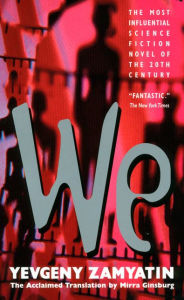
We

We. Yevgeny Zamyatin. Translated by Clarence Brown. 1924/1993. 225 pages. [Source: Bought]

First sentence: I shall simply copy, word for word, the proclamation that appeared today in the One State Gazette...

Premise/plot: The Russian novel, We, consists of journal entries of D-503, the chief architect of the rocket ship Integral. Is he a reliable narrator? Maybe. At the very least his sanity is touch and go. And perhaps he's sanest when he's sickest? Readers meet a handful of characters--all designated by letters and numbers--as the plot moves forward to the testing of the ship.

This dystopian novel features a love triangle of sorts. One thing I know for certain is O-90 loves, loves, loves D-503. He doesn't seem to feel the same about her, though she is familiar and comfortable to be around on designated sexual days--sex requires pink coupons. He becomes obsessed with I-330. Obsessed is the right word in my opinion. He finds her mysterious, unpredictable, illogical, nonconformist. He doesn't stand a chance of ever understanding her, yet he can't help risking everything for more glimpses of her. I-330 remains a mystery to me honestly.

Without a doubt, this is a political book. But without D-503 being so physically drawn to I-330 I'm not sure he would have become as interested in her politics. But. I-330 is so much more than 'just a woman.' 

Does D-503 develop a soul through the course of the novel? That is what may be happening. He has become comfortable with the idea of being a unique individual, of forsaking logic for love and jealousy. He has begun thinking independently of the One State. And he's started bending rules and going his own way.

My thoughts: Well, it's certainly an atmospheric read with thorough world-building. The narrative style is distinct and difficult. The world is so foreign to readers--to me--that while engaging at times it is also confusing. The last third of the novel in particular. D-503 stumbles across a big life-changing secret and he discusses it with at least two or three people; but his journal entries are so cryptic to me that I don't know what it is.

Favorite quotes:
  • A man must think, at least a little. It helps. (11)
  • The only means of ridding man of crime is ridding him of freedom. (35)
  • There is only one truth, and one true way; this truth is two times two, and the true way--four. (67)
  • There are clay ideas, and there are ideas forever carved of gold or of our precious glass. (115)
  • A human being is like a novel; until the last page you don't know how it will end. (162)
  • Revolutions are infinite. (174)
  • Children are the only bold philosophers. (175)


© 2017 Becky Laney of Becky's Book Reviews
Sunday, August 11, 2013

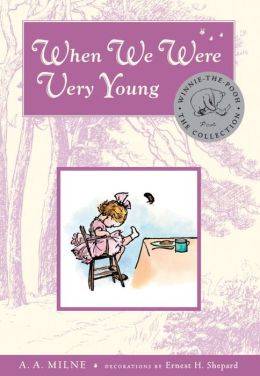
Sunday Salon: Reading When We Were Very Young (1924)

When We Were Very Young. A.A. Milne. 1924. 100 pages. [Source: Library]

 If I loved poetry more, I think I would appreciate When We Were Very Young more than I do. I found the introduction charming. It does contain plenty of poems that I like, love, or even adore. Poems that are easier perhaps to adore if you were lucky enough to have heard them sung. (Winnie the Pooh: 17 Songs from the Pooh Song Book: Starring Jack Gilford. The album features: "Sing Ho! For the Life of A Bear," "Cottleston Pie," "Lines Written By A Bear of Very Little Brain," "Oh! The Butterflies are Flying," "I Lay On My Chest," "3 Cheers for Pooh," "They All Went Off To Discover the Pole," "Christopher Robin is Going," "Missing," "In the Fashion," "Halfway Down," Buckingham Palace," "Politeness," "The Christening," "Brownie," "Lines and Squares," and "Vespers."). My favorite poems from When We Were Very Young are:
 
Buckingham Palace
Lines and Squares
Politeness
Missing
Halfway Down
Teddy Bear

From Teddy Bear
A bear, however hard he tries,
Grows tubby without exercise.
Our Teddy Bear is short and fat
Which is not to be wondered at;
He gets what exercise he can
By falling off the ottoman,
But generally seems to lack
The energy to clamber back.
From Missing
Has anybody seen my mouse?
I opened his box for half a minute,
Just to make sure he was really in it,
And while I was looking, he jumped outside!
I tried to catch him, I tried, I tried...
I think he's somewhere about the house.
Has anyone seen my mouse?
From Buckingham Palace
They're changing guard at Buckingham Palace--
Christopher Robin went down with Alice.
Alice is marrying one of the guard.
"A soldier's life is terrible hard,"
Says Alice.
Do you have a favorite Milne poem? 

© 2013 Becky Laney of Becky's Book Reviews

Wednesday, July 04, 2012

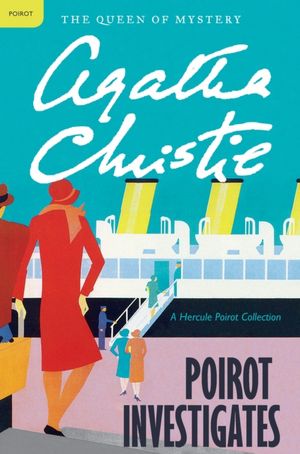
Poirot Investigates

Poirot Investigates. Agatha Christie. 1924/2011. HarperCollins. 256 pages.

I loved Poirot Investigates. Perhaps because I had low expectations? This was my first experience reading Christie's short stories. And since I'm not generally a fan of short stories, I didn't have great expectations for enjoying these fourteen stories. Each story is narrated by Captain Hastings. And he is a character that I tend to love and adore. I've found that Hercule Poirot needs a little help either from Hastings or Ariadne Oliver to help tame his arrogance. I have definitely come to love Hercule Poirot through the mysteries I've read, but, it was a long road for me. It wasn't instantaneous like it was with Miss Marple.

This collection of short stories was originally published in 1925. So it is "early" Poirot. The short stories in this collection are:

The Adventure of the Western Star
The Tragedy at Marsdon Manor
The Adventure of the Cheap Flat
The Mystery of Hunter's Lodge
The Million Dollar Bond Robbery
The Adventure of the Egyptian Tomb
The Jewel Robbery at the Grand Metropolitan
The Kidnapped Prime Minister
The Disappearance of Mr. Davenheim
The Adventure of the Italian Nobleman
The Case of the Missing Will
The Veiled Lady
The Lost Mine
The Chocolate Box

It's not that any one story is amazing or incredible. That's not why I loved this collection. For me it is all about the relationship between Poirot and Hastings. Their conversations. Their friendship. Seeing these two together. There is just something DELIGHTFUL about spending time in their company. 

© 2012 Becky Laney of Becky's Book Reviews
Tuesday, June 12, 2012

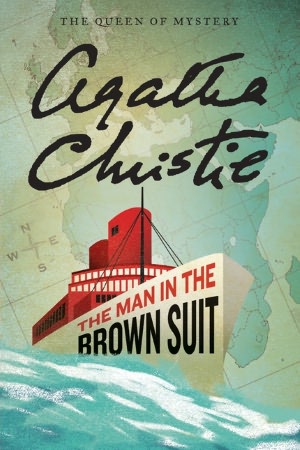
The Man in the Brown Suit

The Man in the Brown Suit. Agatha Christie. 1924/2012. HarperCollins. 320 pages.

While I'm not sure it's exactly fair to say that this is one of my least favorite Christie novels, I'm tempted to say it anyway. Because I just didn't care for this one. The narration was a bit strange to me. Most of the novel is narrated by a young woman whose father has just died, Anne Beddingfeld. She's left with practically nothing except her good looks and charm. There's just something about her that makes everyone want to take care of her and trust her. She by chance witnesses an accident, and the "doctor" on the scene of the accident puzzles her greatly though it took her a few hours to figure out just why. A little while later (either that day, or the next) a woman's body is discovered in a house. The house was for sale or for rent, and she had dropped by to see it. There are very few reasons why anyone would connect the two cases together, but, our narrator Anne does. And she takes it upon herself to solve this mystery and discover the identity of the "man in the brown suit." This mystery leads her to a ship bound for South Africa. And it's a trip with danger and risk for both on the ship and off, a number of attempts are made on her life. Along the way, she seems to make a new best friend and fall in love. I didn't exactly like the diary chapters provided by Sir Eustace Pedler. I'm not sure how helpful they were in adding to the story, they proved more distracting than anything else, which I think was the point. The ending, however, is what disappoints me most. The statements the narrator makes about the murderer almost infuriate me. 

Read The Man in the Brown Suit
  • If you're a big, big, big fan of Agatha Christie and want to read every mystery she wrote
  • If you're expectations are low and you're looking for just something--anything--to read to pass the time

© 2012 Becky Laney of Becky's Book Reviews
Tuesday, February 07, 2012

We

We. Yevgeny Zamyatin. Translated by Mirra Ginsburg. 1921/1972*. HarperCollins. 233 pages.

I shall simply copy, word for word, the proclamation that appeared today in the One State Gazette... 

We is a dystopian novel. I've been wanting to read it for almost as long as I've been blogging.

What did I think of We?

I found the novel interesting but not necessarily comprehensible. I struggled to make sense of this one. (I think I followed about a third of it.) I'm sure I missed much of what was going on simply because I was trying to make sense of this world, this society. Could the problem--for me--be this society's emphasis on math and logic?

The narrator of We is a state mathematician named D-503. (I did figure out that men have a consonant and an odd number; women have a vowel and an even number). Everything is calculated and precise and governed or regulated. Even intimate relationships. D-503 has two registered partners--O-90 and I330. O-90 desperately wants a child, a dream that isn't likely to come true. And I330 is a big, big tease who manipulates men in oh-so-many ways. Perhaps because D-503 cannot understand her at all, cannot predict anything about her, she fascinates him, enslaves him.

So one of D-503's projects is working on the spaceship, Integral. One State has plans to conquer the universe. Perhaps because of what he does, I-330 sees an opportunity to use him to get what she wants...
A human being is like a novel: until the last page you don't know how it will end. Or it wouldn't be worth reading... (162)

Read We
  • If you are looking for a literary quality to your science fiction
  • If you enjoy a challenge as you read; if you enjoy complexity
  • If you are looking to read a science fiction classic
  • If you are interested in Russian literature from this time period
*It was first translated into English (according to Wikipedia) in 1924, this translation by Mirra Ginsburg was done in 1972. 

© 2012 Becky Laney of Becky's Book Reviews