American Girl: A Girl Named Misty: The True Story of Misty Copeland. Kelly Starling Lyons. 2018. Scholastic. 48 pages. [Source: Review copy]
First sentence: Misty Copeland loved to dance.
Premise/plot: A Girl Named Misty is an early chapter book biography of Misty Copeland, an accomplished African American ballerina. It is one of the new books in the nonfiction series by AmericanGirl. Other titles include A Girl Named Hillary and A Girl Named Rosa.
My thoughts: I enjoyed this one! I know I've said this a thousand times--and a thousand times I've meant it--but biographies have come a LONG way since I was in elementary school. I won't say I wish I'd read it as a child because that would be impossible for several reasons. One being that Misty Copeland would have still been in elementary school herself. The second being that there's still the problem of time travel! But I am so happy that nonfiction books have improved greatly in recent decades. That there are more choices than ever before in terms of subjects.
© 2018 Becky Laney of Becky's Book Reviews
Friday, May 04, 2018
Books for Star Wars Day
I saw this SUPER-FUN idea at Paula Vince's wonderful blog. The rules are simple. Just choose a book to fit each of these categories, based on Star Wars characters.
LEIA: A book that splits your heart in two.
Most recently Neal Shusterman's Thunderhead.
HAN SOLO: A book you didn't want to read but loved.
Uncle Tom's Cabin. Harriet Beecher Stowe.
PADME: A book where the character fell in love with the wrong person.
Great Expectations. Charles Dickens.
KYLO REN: A dramatic character we all love.
Mr. Rochester in Jane Eyre.
REY: A strong female character.
Reign the Earth by A.C. Gaughen.
Shalia.
FINN: A couple you shipped but didn't happen.
Mansfield Park. I really liked Henry Crawford and Fanny Price. But I also love John and Lily from Small House at Allington.
YODA: A book with a different chronological order.
How To Stop Time by Matt Haig comes to mind.
JAR JAR: A book you found boring and abandoned.
If I could have brought myself to do it, I would have abandoned So Big by Edna Ferber.
© 2018 Becky Laney of Becky's Book Reviews
LEIA: A book that splits your heart in two.
Most recently Neal Shusterman's Thunderhead.
HAN SOLO: A book you didn't want to read but loved.
Uncle Tom's Cabin. Harriet Beecher Stowe.
PADME: A book where the character fell in love with the wrong person.
Great Expectations. Charles Dickens.
KYLO REN: A dramatic character we all love.
Mr. Rochester in Jane Eyre.
REY: A strong female character.
Reign the Earth by A.C. Gaughen.
Shalia.
FINN: A couple you shipped but didn't happen.
Mansfield Park. I really liked Henry Crawford and Fanny Price. But I also love John and Lily from Small House at Allington.
YODA: A book with a different chronological order.
How To Stop Time by Matt Haig comes to mind.
JAR JAR: A book you found boring and abandoned.
If I could have brought myself to do it, I would have abandoned So Big by Edna Ferber.
© 2018 Becky Laney of Becky's Book Reviews
Thursday, May 03, 2018
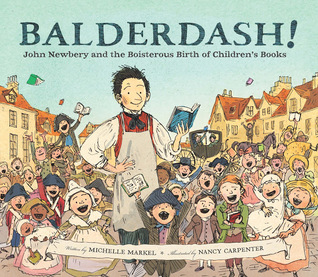
Balderdash
Balderdash! John Newbery and the Boisterous Birth of Children's Books. Michelle Markel. Illustrated by Nancy Carpenter. 2017. 44 pages. [Source: Library]
First sentence: Welcome! This book's for you. Every page, every picture, every word, and even its letters are designed for your pleasure. Lucky, lucky reader. Be glad it's not 1726.
Premise/plot: Balderdash is the story of the origins of children's book publishing. It is the story of one man in particular, John Newbery, and his contribution to the world. And it is a BIG contribution to be sure. The narrative begins by taking readers back to a time when books were decidedly NOT for children. "In those days of powdered wigs and petticoats, England was brimming with books. Books of pirates and monsters and miniature people. Tales of travels and quests and shipwrecks and crimes. At the fairs, in the market stalls, in the bookshop windows were hundreds of wonderful books. But not for children." (Where there any materials written with children in mind? Some. "Preachy poems and fables, religious texts that made them fear that death was near...")
John Newbery was a boy who LOVED reading who grew up to be a publisher. He wanted to publish books for the WHOLE family including children. SHOCKER. Books written and published specifically for children to READ AND ENJOY! If that wasn't shocking enough. He marketed his books to sell with TOYS. ("Price of book alone, 6 pence, with a ball or pincushion, 8 pence...") He soon expanded to publishing magazines for children. His ideas were novel and wonderful!
Can you imagine a world without children's books?!
My thoughts: I LOVED this one. I LOVED, LOVED, LOVED it. I found it fascinating and packed with detail. I was not completely unfamiliar with the history of children's literature. In fact, one of my favorite graduate courses was the history of children's literature. There was a huge difference between the before and after. If you weren't thankful for children's books before the course, you certainly would be afterwards. It was a great way to celebrate PROGRESS. The same is true of reading this picture book. IT reminds us of where we've been and how far we've come. It celebrates the legacy of one man's contribution, but it also celebrates READING in general.
Text: 5 out of 5
Illustrations: 5 out of 5
Total: 10 out of 10
© 2018 Becky Laney of Becky's Book Reviews
First sentence: Welcome! This book's for you. Every page, every picture, every word, and even its letters are designed for your pleasure. Lucky, lucky reader. Be glad it's not 1726.
Premise/plot: Balderdash is the story of the origins of children's book publishing. It is the story of one man in particular, John Newbery, and his contribution to the world. And it is a BIG contribution to be sure. The narrative begins by taking readers back to a time when books were decidedly NOT for children. "In those days of powdered wigs and petticoats, England was brimming with books. Books of pirates and monsters and miniature people. Tales of travels and quests and shipwrecks and crimes. At the fairs, in the market stalls, in the bookshop windows were hundreds of wonderful books. But not for children." (Where there any materials written with children in mind? Some. "Preachy poems and fables, religious texts that made them fear that death was near...")
John Newbery was a boy who LOVED reading who grew up to be a publisher. He wanted to publish books for the WHOLE family including children. SHOCKER. Books written and published specifically for children to READ AND ENJOY! If that wasn't shocking enough. He marketed his books to sell with TOYS. ("Price of book alone, 6 pence, with a ball or pincushion, 8 pence...") He soon expanded to publishing magazines for children. His ideas were novel and wonderful!
Can you imagine a world without children's books?!
My thoughts: I LOVED this one. I LOVED, LOVED, LOVED it. I found it fascinating and packed with detail. I was not completely unfamiliar with the history of children's literature. In fact, one of my favorite graduate courses was the history of children's literature. There was a huge difference between the before and after. If you weren't thankful for children's books before the course, you certainly would be afterwards. It was a great way to celebrate PROGRESS. The same is true of reading this picture book. IT reminds us of where we've been and how far we've come. It celebrates the legacy of one man's contribution, but it also celebrates READING in general.
Text: 5 out of 5
Illustrations: 5 out of 5
Total: 10 out of 10
© 2018 Becky Laney of Becky's Book Reviews
Wednesday, May 02, 2018
A Wreath for Rivera
A Wreath for Rivera (Roderick Alleyn #15) Ngaio Marsh. 1949. 336 pages. [Source: Bought]
First sentence: From Lady Pastern and Bagott to her niece by marriage, Miss Carlisle Wayne...
Premise/plot: Carlisle Wayne has been invited to visit by her aunt and uncle, Lord and Lady Pastern and Bagott. Her eccentric uncle will be performing in a band, a jazz band, and it will be an experience. Whether it will be fun or a disaster remains to be seen. Also coming to witness the spectacle is Edward Manx, a family cousin. Lord and Lady Pastern would love for their daughter, Felicite, to marry Edward. Anyone would be preferable to her current love interest, Carlos Rivera. That love affair is a bit rocky. Or else Felicite wouldn't be writing the advice column of a local newspaper!
Lord Pastern's BIG debut does not quite go according to plan. The plan includes the firing of a gun and playacting. In actuality, a murder is committed in front of an audience. Will Roderick Alleyn and his team be able to solve the crime?
My thoughts: I definitely enjoyed this one! (It is the third I've read in the series. I've also read A Man Lay Dead and The Final Curtain.) I couldn't help wanting a little more however. I was intrigued by Carlisle. I felt teased by Marsh. Was Carlisle in love with Edward? Was Edward in love with Carlisle? Had they been seeing each other? How close had they gotten? Was she jealous when her cousin started flirting with Edward seemingly out of the blue? Did they work out their misunderstanding? Did they end up together? I NEED TO KNOW. As for the solving of the crime, I had two suspects in mind. I don't know that the clues definitely led to just one firm suspect. In fact, most of the clues were only given to readers AFTER the case had been solved. The detectives had an excuse for that--but it was mighty convenient for the author.
© 2018 Becky Laney of Becky's Book Reviews
First sentence: From Lady Pastern and Bagott to her niece by marriage, Miss Carlisle Wayne...
Premise/plot: Carlisle Wayne has been invited to visit by her aunt and uncle, Lord and Lady Pastern and Bagott. Her eccentric uncle will be performing in a band, a jazz band, and it will be an experience. Whether it will be fun or a disaster remains to be seen. Also coming to witness the spectacle is Edward Manx, a family cousin. Lord and Lady Pastern would love for their daughter, Felicite, to marry Edward. Anyone would be preferable to her current love interest, Carlos Rivera. That love affair is a bit rocky. Or else Felicite wouldn't be writing the advice column of a local newspaper!
Lord Pastern's BIG debut does not quite go according to plan. The plan includes the firing of a gun and playacting. In actuality, a murder is committed in front of an audience. Will Roderick Alleyn and his team be able to solve the crime?
My thoughts: I definitely enjoyed this one! (It is the third I've read in the series. I've also read A Man Lay Dead and The Final Curtain.) I couldn't help wanting a little more however. I was intrigued by Carlisle. I felt teased by Marsh. Was Carlisle in love with Edward? Was Edward in love with Carlisle? Had they been seeing each other? How close had they gotten? Was she jealous when her cousin started flirting with Edward seemingly out of the blue? Did they work out their misunderstanding? Did they end up together? I NEED TO KNOW. As for the solving of the crime, I had two suspects in mind. I don't know that the clues definitely led to just one firm suspect. In fact, most of the clues were only given to readers AFTER the case had been solved. The detectives had an excuse for that--but it was mighty convenient for the author.
© 2018 Becky Laney of Becky's Book Reviews
Tuesday, May 01, 2018
The Magnificent Century
The Magnificent Century (The Plantagenets #2). Thomas B. Costain. 1951. 324 pages. [Source: Library]
First sentence: October 19, 1216. King John was dead.
Premise/plot: The Magnificent Century is the second volume in Thomas B. Costain's history of the Plantagenets. The first volume is The Conquering Family.
The first volume focused mainly on the royal family itself over several generations--centuries. The second volume has a much broader--yet narrower focus. (Narrower in that it just covers the reign of one king, Henry III. Broader in that it goes way beyond the royal family.) History. Religion. Science. Architecture. Politics. King vs. Parliament. Wars. Costain believes the thirteenth century to be a MAGNIFICENT century. In this volume, readers learn about Henry III and his family, the Marshal family, Hubert de Burgh, Simon de Montfort, and Roger Bacon.
My thoughts: I was less familiar with this time period. I was not equally interested in ALL the chapters. The chapters on war and civil war confused me a bit. I'm not sure if that's because war interests me less than other subjects of if Costain's narrative was unclear. Either is possible.
My absolute favorite chapter was probably "Queen's Men, King's Men, and the Villain of the Piece." Apparently there was a LOT of strife caused in England by the king's extended family. Namely Henry III's half brothers who came to England from France AND his in-laws. Henry's wife was unpopular, but his his wife's family was REALLY unpopular. Everyone WANTED something from Henry.
© 2018 Becky Laney of Becky's Book Reviews
First sentence: October 19, 1216. King John was dead.
Premise/plot: The Magnificent Century is the second volume in Thomas B. Costain's history of the Plantagenets. The first volume is The Conquering Family.
The first volume focused mainly on the royal family itself over several generations--centuries. The second volume has a much broader--yet narrower focus. (Narrower in that it just covers the reign of one king, Henry III. Broader in that it goes way beyond the royal family.) History. Religion. Science. Architecture. Politics. King vs. Parliament. Wars. Costain believes the thirteenth century to be a MAGNIFICENT century. In this volume, readers learn about Henry III and his family, the Marshal family, Hubert de Burgh, Simon de Montfort, and Roger Bacon.
My thoughts: I was less familiar with this time period. I was not equally interested in ALL the chapters. The chapters on war and civil war confused me a bit. I'm not sure if that's because war interests me less than other subjects of if Costain's narrative was unclear. Either is possible.
My absolute favorite chapter was probably "Queen's Men, King's Men, and the Villain of the Piece." Apparently there was a LOT of strife caused in England by the king's extended family. Namely Henry III's half brothers who came to England from France AND his in-laws. Henry's wife was unpopular, but his his wife's family was REALLY unpopular. Everyone WANTED something from Henry.
© 2018 Becky Laney of Becky's Book Reviews
Labels:
1951,
adult classics,
books reviewed in 2018,
classics,
history,
library book,
Nonfiction
Subscribe to:
Posts (Atom)


