Wednesday, September 18, 2013

Blackmoore (2013)

Blackmoore Julianne Donaldson. 2013. Shadow Mountain (Proper Romance). 282 pages. [Source: Review Copy]

I absolutely LOVED, LOVED, LOVED this Regency Romance novel by Julianne Donaldson. I admit it wasn't immediate love. It took me a few chapters to settle into the story, get acquainted with the author's style, her use of flashbacks, and the building of the mystery, but soon it was LOVE. Blackmoore stars an independent heroine, Kate Worthington. (Don't dare call her Kitty!) Kate is sure of one thing: she will NEVER marry. It doesn't matter what her mother says, what she threatens. She will never marry. But just because she's firm and determined on this matter doesn't mean that her dreams of traveling to India with her aunt are certain. Kate isn't sure how she can break completely free from her family and follow her dreams. Her acceptance of her mother's challenge is completely impulsive. Her mother will allow her daughter freedom--the freedom to go to India--IF she receives and rejects three marriage proposals during her country visit to Blackmoore, the estate of a good friend. At first all Kate seems to hear is India. It is only later that she realizes that she must act in such a way that three men will propose to her in just a few weeks. How is she going to accomplish that?! But Kate loves a challenge, and she is clever.

The main reason I loved this romance novel is the hero, Henry. I adored him. I adored them together I should say. Every single scene with the two of them worked. Most were completely giddy-making in fact. The dialogue was wonderful! The storytelling was just what I needed. This was a purely satisfying historical romance. I can't think of a single thing I'd change!!! I think this is one I'll definitely want to reread again and again!!!

The author has also written Edenbrooke. I definitely want to read that one soon!

Blackmoore is on tour this September. Other bloggers reviewing it today, September 18th:

Raising Memories – REVIEW
Writing, the Universe and Everything Books – REVIEW
Reading Girls – REVIEW
Becky’s Book Reviews – REVIEW
So Many PreciousS Books, So Little Time – FEATURE / GIVEAWAY
Tressa’s Wishful Endings – REVIEW
About To Read – REVIEW

© 2013 Becky Laney of Becky's Book Reviews

Tuesday, September 17, 2013

Blood & Beauty: The Borgias (2013)

Blood & Beauty: The Borgias. Sarah Dunant. 2013. Random House. 528 pages. [Source: Library]

I loved, loved, loved Sarah Dunant's Blood & Beauty. It is a novel of the Borgia family. Readers get an 'inside' glimpse into the lives of Alexander (Pope Alexander VI, Rodrigo Borgia), Cesare (Cardinal Valencia, Duke Valentinois), Juan (Giovanni, Duke of Gandia), Lucrezia, and Jofre. The best thing about this novel? Every single character--every major character, every minor character--has substance and depth. There is a richness, a complexity that was lacking in another Borgia novel I read earlier this year. The characters are all too human. Yes, characters are flawed, but dynamically so.

(Other characters include Vannozza (Alexander's former mistress, the mother of the four children), Giulia Farnese (Alexander's mistress while he was the pope), Sancia of Aragon (Jofre's wife), Pedro Calderon (family messenger and sometimes personal bodyguard for Cesare), Michelotto (personal body guard for Cesare), Giovanni Sforza (Lucrezia's first husband), Alfonso d'Aragon (Lucrezia's second husband, brother to Sancia) Alfonso d'Este (Lucrezia's third husband).

The novel opens with Rodrigo Borgia hopeful that he can indeed bribe the cardinals into making him the next pope. Victory is his within the first few chapters, and then the dynasty-making truly begins. The family dynamics is interesting, very complex. He loves all his children, but, some he loves more than others, and some he trusts more than others. I loved getting stories on ALL of his children. Juan has an army; he can be reckless and impulsive; he also LOVES women. Wherever he goes, he ends up being talked about. The same can almost be said about Cesare, except, he's presented as being more in control, more calculating, more intellectual. He's a strategist, capable of seeing the big picture, seeing possible outcomes, calculating risks, making bold moves when needed. He has his share of women too. And he's presented as being very charismatic. Lucrezia's portrayal is interesting. This was the first time I really saw her as being so young. Her father and brother manage her relationships to a certain degree. They arrange her first marriage. They arrange when her husband can come visit her, stay with her; they are the ones to decide if she's to stay in Rome or go to live with her husband. They are the ones to analyze the 'success' of the marriage and decree it not worth keeping. They encourage strongly the need for an annulment. And that's marriage number one... Lucrezia is depicted as being clever and observant, as being bold enough to give advice and ask questions of her father and brother; she's seen as young, religious, compassionate. She is not portrayed as a sexually immoral woman. However, her sister-in-law, Sancia, is, the novel mentioning her relationships with all three Borgia brothers. Joffre, the youngest, is depicted as being immature and not as bright as his two older brothers. He idolizes his brothers, envies their strength and popularity. But he is presented as not being smart enough or charismatic enough to be politically useful.

I loved the depth to the characters. The book was fascinating and entertaining. I appreciated the author including a bibliography that showed her research into the time period, into the family. This is very much a novel about power--political and military power--and ambition.

Link to Borgia Family Song

© 2013 Becky Laney of Becky's Book Reviews

Monday, September 16, 2013

The Life of Cesare Borgia (1912)

The Life of Cesare Borgia: A History and Some Criticisms. Rafael Sabatini. 1912. 326 pages. [Source: Bought]

Rafael Sabatini would NOT have approved of Horrible Histories' Borgia Family. The truth is, however, that I would never have sought out Sabatini's biography of Cesare Borgia if I'd not fallen in love with the video. It was Mat's "I am the mostest, powerfulest, evilest of all" that made me curious and seeking. I wasn't that impressed by my first attempt to learn more. The fictional Borgia Bride was awful. Fortunately, I discovered Sabatini's biography. It was LOVE.  It wasn't love because it fit into any preconceived notions about how I wanted the Borgia family to be. It was love because it respected human nature and historical fact. It embraced common sense and used dry wit, in part, to argue and persuade.

I journaled my reading in four parts. The first post tackled the preface and introduced Sabatini's goal in writing. It was WONDERFUL. The second post examined Cesare's father, Alexander VI (Rodrigo). The third post focused almost exclusively on Cesare. The fourth post focused on Sabatini as an author, his narrative style, his technique of criticizing other authors and sources. 
Life is an ephemeral business, and we waste too much of it in judging where it would beseem us better to accept, that we ourselves may come to be accepted by such future ages as may pursue the study of us.
But if it be wrong to judge a past epoch collectively by the standards of our own time, how much more is it not wrong to single out individuals for judgement by those same standards, after detaching them for the purpose from the environment in which they had their being? How false must be the conception of them thus obtained! We view the individuals so selected through a microscope of modern focus. They appear monstrous and abnormal, and we straight-way assume them to be monsters and abnormalities, never considering that the fault is in the adjustment of the instrument through which we inspect them, and that until that is corrected others of that same past age, if similarly viewed, must appear similarly distorted.
Hence it follows that some study of an age must ever prelude and accompany the study of its individuals, if comprehension is to wait upon our labours.
Sabatini just came across to me as practical, witty, sometimes wise, and sometimes poetic.
Mind being the seat of the soul, and literature being the expression of the mind, literature, it follows, is the soul of an age, the surviving and immortal part of it; (6)
Anyway, here is Sabatini's thesis--his goal for writing this biography. If you can embrace this premise, then chances are you'll find this one well worth the read!!!
Before we admit facts, not only should we call for evidence and analyse it when it is forthcoming, but the very sources of such evidence should be examined, that, as far as possible, we may ascertain what degree of credit they deserve. In the study of the history of the Borgias, we repeat, there has been too much acceptance without question, too much taking for granted of matters whose incredibility frequently touches and occasionally oversteps the confines of the impossible. (12)
If the author has a mercy to crave of his critics, it is that they will not impute it to him that he has set out with the express aim of "whitewashing"—as the term goes—the family of Borgia. To whitewash is to overlay, to mask the original fabric under a superadded surface. Too much superadding has there been here already. By your leave, all shall be stripped away. The grime shall be removed and the foulness of inference, of surmise, of deliberate and cold-blooded malice, with which centuries of scribblers, idle, fantastic, sensational, or venal, have coated the substance of known facts.
But the grime shall be preserved and analysed side by side with the actual substance, that you may judge if out of zeal to remove the former any of the latter shall have been included in the scraping.
(13)
If Sabatini was alive to refute current fictional portrayals of Cesare in romance novels...
Women play no part whatever in his history. Not once shall you find a woman's influence swaying him; not once shall you see him permitting dalliance to retard his advancement or jeopardize his chances. With him, as with egotists of his type, governed by cold will and cold intellect, the sentimental side of the relation of the sexes has no place. With him one woman was as another woman; as he craved women, so he took women, but with an almost contemptuous undiscrimination. 
The biography is rich in detail. It doesn't just focus on Cesare. It tries to cover more than that--to look at an age, to capture a time and place. It is ALL ABOUT context for Rafael Sabatini. And I really enjoyed his technique overall. 

© 2013 Becky Laney of Becky's Book Reviews

Sunday, September 15, 2013

Two Pop and Play Board Books

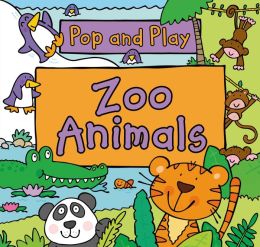
Zoo Animals. (Pop & Play). Simon Abbott. 2013. Kingfisher. 10 pages. [Source: Review copy]

Monkeys swing through the trees.
What noise do they make?
Chatter! Chatter!
Pandas eat bamboo.
Crunch!
Peekaboo!
Say hello to the tiger.
Count the bugs.
Roar!

Zoo Animals is a pop-up board book. Each spread reveals a fun pop for little ones. Monkeys swing on the vine, for example, and a crocodile opens wide and snaps. The text is simple and direct. It isn't the most amazing text ever. But it works well enough, I suppose. The illustrations are bright and fun. My favorite pages: the monkeys, the tiger, and the crocodiles. (My least favorite spread is the panda.) Your little one would need to be old enough not to pull on the pop-ups. A few rips could take all the fun out of this one. But if your little one is gentle with books, then this one definitely has appeal!

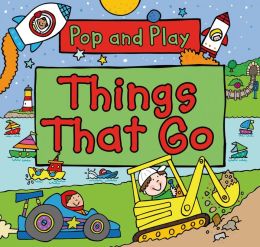
Things That go (Pop & Play) Simon Abbott. 2013. Kingfisher. 10 pages. [Source: Review copy]

The racecar whizzes past. What shape are the wheels? Vroom!
The digger scoops up dirt. Count the builders.
Chug! Chug!
The boat bobs up and down.
Where is the dolphin?
Toot! Toot!

Things That Go is another book in Kingfisher's Pop and Play board book series. The focus this time is on vehicles. Some of the movements (the pop-ups) are great. I really loved the last two, the train and the rocket. Others didn't thrill me. The text is simple. But the flow could be a bit better perhaps. Though I think questions that ask readers to interact with the illustrations are good, at least in theory. The book's main appeal may be the pop-ups. They can be fun! For little hands that can be gentle, this one may work.

© 2013 Becky Laney of Becky's Book Reviews

Sunday Salon: Reading All-of-a-Kind-Family (1951)

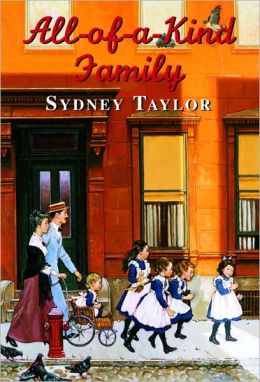
All-of-a-Kind-Family. Sydney Taylor. 1951. 190 pages. [Source: Bought]

I enjoyed rereading All-of-a-Kind Family by Sydney Taylor. This historical fiction novel is set in New York City around 1912. When the novel opens, there are five sisters: Ella, Henrietta (Henny), Sarah, Charlotte, and Gertie. They are a "steps-and-stairs" family according to the oh-so-friendly librarian Miss Allen. (Yes, the librarian plays a good role in this one!) The chapters are episodic, occurring over the course of a year. The chapters detail what life was like in a Jewish household during the early years of the new century. Some chapters are about everyday things like shopping, cleaning, going to the library, eating in bed, picky-eating at the table, etc. Other chapters are about holidays or vacations: Purim, Passover, 4th of July, visiting Coney Island, etc. My least favorite chapter remains the same: the hiding of buttons to motivate the sisters into cleaning.

I liked this one. I like it because it is old-fashioned and simple and just good. I like it because it captures a special time and place in American history.

Have you read this one? What did you think?

© 2013 Becky Laney of Becky's Book Reviews