Showing posts with label supernatural. Show all posts

Monday, February 05, 2024

16. Not Quite a Ghost


Not Quite a Ghost. Anne Ursu. 2024. [January] 288 pages. [Source: Library]

First sentence: The house stood a little apart from the rest of the block, as if it did not quite fit in. Perhaps it was wary of the other houses, or perhaps it was the other houses that wished to keep their distance from it. If only houses could talk, then one of them could tell us which it was. Of course, if houses could talk, they could also lie.

Premise/plot: Violet Hart is struggling--struggling with her health, with her friend group, with starting middle school, with getting along with her older [oh-so-moody] sister, with her new house, with her new attic bedroom. It seems the world is out to get her--no lucky breaks. But is the world truly out to get her? Or is it merely her YELLOW WALLPAPER out to get her?

My thoughts: Not my cup of tea. Oh how I WANTED this one to be my cup of tea. Definitely has Twilight Zone vibes. A blend of super-creepy and supernatural WITH your typical angsty coming of age novel. It's this back and forth between the supernatural AND the super realistic that is conflicting me. On the one hand, it doesn't embrace the haunted-ness and pure creepiness of the house. On the other hand, the slightly supernatural elements are at odds with the very real struggles of her invisible illness. At least to me. The author shares how she struggled (struggles) with her invisible diseases, and as a kid/teen it was impossible (or nearly so) for doctors to validate her symptoms, take her seriously, and diagnose her. This could have been compelling--alongside her friends not understanding why she's so tired and unable to join in on their daily activities--on its own. But the direction is an adaptation of the short story, "The Yellow Wallpaper." YET the conclusion isn't really the same if my memory is accurate. (Which to be honest it's been a LONG time since I last read it.) 

I think like the wallpaper itself this one is a little too busy/chaotic for my own personal liking. BUT I could see how this might be a good fit for another reader. 


© 2024 Becky Laney of Becky's Book Reviews

Friday, June 09, 2023

115. Captain America: The Ghost Army


Captain America: The Ghost Army. Alan Gratz. Illustrated by Brent Schoonover. 2023. [January] 176 pages. [Source: Library] [Middle Grade; Young Adult]

First sentence: TING, TING, TING, TING, PAKOW, RAT-TAT-TAT-TAT, POOM

Premise/plot: Graphic novel set during World War II starring Captain America (aka Steve Rogers) and Bucky Barnes (aka James Buchanan Barnes). There are others you'd probably recognize as well from the Marvel Universe. It is set during World War II, as I mentioned, and the pair are investigating a strange, supernatural phenomenon. The soldiers that they'd killed just hours before have come back to life and are foes once more. Their victory camaraderie broken up by GHOSTS. But ghosts that are held back (restrained) by moving water. This is a [supernatural] mystery worth investigating...and it takes them into a village.

Meanwhile, readers get panels featuring the villainy-villains. A big battle between the two is coming....

My thoughts: I have never read an actual-actual Marvel comic OR graphic novel. This is definitely a graphic novel. (I talk as if I could tell the difference with my eyes blindfolded. I couldn't.) Captain America and Bucky are two great characters that I've loved from the movies alone. I know, I know, I know that the comics can be VERY different from the movie depictions. I do think there are some differences--perhaps big differences--between these characters and the movie characters. They are not cookie cutter copies. How Gratz's and Schoonover's depiction line up against the actual [canon] collection of Marvel comics is a question for someone more well-schooled. Again, not my area of expertise. 

I definitely appreciated the story. It was a little bit over the top, but in a good way.


© 2023 Becky Laney of Becky's Book Reviews

Friday, December 18, 2020

151. A Christmas Carol


A Christmas Carol. Charles Dickens. 1843. 96 pages. [Source: Bought]

First sentence: MARLEY WAS DEAD, to begin with. There is no doubt whatever about that.

Premise/plot:  Who isn't familiar with the story of Scrooge?! Still, I suppose *something* must be said. Scrooge HATES Christmas. Hate is too soft a word really for the rage he feels when he thinks about the holiday. For Scrooge hating comes as naturally as breathing. He loves no one or no thing--nothing except money and making a profit. But what is driving his obsession with money? what is driving him to live as he does--to make the choices he does? Could there be a secret or two in his past that holds the answers to these questions? Can Scrooge be saved from his own worst enemy--himself?

If Scrooge is to be saved--can he be saved?!--it will take some supernatural intervention. For Scrooge won't be saving himself. For one thing, Scrooge does not see his own need to be saved. Saved from what exactly?!?! Saved from success?! As far as Scrooge is concerned, everything in his life is just as it should be. He in need of help? he in need of saving? Don't be ridiculous.

He will be visited by four ghosts--the first ghost being Marley, his dead business partner of old. The other three ghosts being Christmas spirits past, present, and future. Can these spirits open Scrooge's eyes? Will he start to see--will he start to judge--life differently?

My thoughts: A Christmas Carol is a familiar story--much like the gospels. Is it too familiar a story to pack a punch or two? It doesn't have to be. The truth is--like it or not--we are more like Scrooge than we want to admit. We may not hate Christmas. We may not be super-obsessed with money. We may even consider ourselves good, charitable people. But the truth is that we are all sinners; perhaps I should amend that to we are sinners one and all. At best we can say our pet sins differ from his. All of us need a ghostly encounter to reconcile us with ourselves, the world, and God. I would point out, however, that we need a Holy Ghost encounter, and not one from Marley and the three ghosts of Christmas past, present, and future.

In the first stave, readers are introduced to Scrooge's world. We see him at work and at home. We are witnesses to Scrooge's interactions. Dickens does plenty of telling, but he also does plenty of showing. At the close of Christmas Eve, Scrooge is visited by the ghost of his business partner, Marley. Scrooge is warned of his future fate and promised three spiritual visitors. In the second stave, Scrooge is visited by the first spirit, that of Christmas past. In the third stave, Scrooge is visited by the second spirit, that of Christmas present. In the fourth stave, Scrooge is visited by the third spirit, that of Christmas future. In the fifth stave, it is Christmas morning. Readers are reintroduced to Scrooge; once again, we see him going about his business. Has his outlook on life changed? Is Scrooge a new man?

When I first read A Christmas Carol, I was less than impressed with this "Christ-less" Christmas story. I still loved the Muppet Christmas Carol; I still loved the idea of loving this one. But I found grace to be missing; here was Scrooge a brand new man with a brand new outlook, but no profession or confession of belief or trust in the one true God. The message was not Jesus paid it all; all to him I owe. The emphasis was not that Christ was sufficient--that Scrooge's only hope in life or death was Christ alone. The emphasis seemed to be on outward change, on works. On reflection this time around, I see A Christmas Carol more like the letter of James than any of the four gospels. In spiritual terms, what we're dealing with is not justification--how to be made right with God, how to be saved--but sanctification--how to live life rightly.

Here are a few scriptures to keep in mind as you read A Christmas Carol:


 My tip for reading A Christmas Carol: try to read it as if for the first time.

 Favorite quotes:

  • Old Marley was as dead as a door-nail. Mind! I don’t mean to say that I know, of my own knowledge, what there is particularly dead about a door-nail. I might have been inclined, myself, to regard a coffin-nail as the deadest piece of ironmongery in the trade. But the wisdom of our ancestors is in the simile; and my unhallowed hands shall not disturb it, or the Country’s done for.
  • There is no doubt that Marley was dead. This must be distinctly understood, or nothing wonderful can come of the story I am going to relate. If we were not perfectly convinced that Hamlet’s father died before the play began, there would be nothing more remarkable in his taking a stroll at night, in an easterly wind, upon his own ramparts, than there would be in any other middle-aged gentleman rashly turning out after dark in a breezy spot—say Saint Paul’s Churchyard for instance—literally to astonish his son’s weak mind.
  • Oh! but he was a tight-fisted hand at the grindstone, Scrooge! a squeezing, wrenching, grasping, scraping, clutching, covetous old sinner! Hard and sharp as flint, from which no steel had ever struck out generous fire, secret, and self-contained, and solitary as an oyster.
  • He carried his own low temperature always about with him; he iced his office in the dog-days; and didn’t thaw it one degree at Christmas.
  • No wind that blew was bitterer than he, no falling snow was more intent upon its purpose, no pelting rain less open to entreaty. Foul weather didn’t know where to have him. The heaviest rain, and snow, and hail, and sleet, could boast of the advantage over him in only one respect. They often “came down” handsomely, and Scrooge never did.
  • Even the blind men’s dogs appeared to know him; and, when they saw him coming on, would tug their owners into doorways, and up courts, and then would wag their tails as though they said, “No eye at all is better than an evil eye, dark master!”
  • Once upon a time—of all the good days in the year, on Christmas Eve—old Scrooge sat busy in his counting-house.
  • Scrooge had a very small fire, but the clerk’s fire was so very much smaller that it looked like one coal. But he couldn’t replenish it, for Scrooge kept the coal-box in his own room; and so surely as the clerk came in with the shovel, the master predicted that it would be necessary for them to part.
  • “I do,” said Scrooge. “Merry Christmas! What right have you to be merry? What reason have you to be merry? You’re poor enough.” “Come, then,” returned the nephew gaily. “What right have you to be dismal? What reason have you to be morose? You’re rich enough.”
  • “Nephew!” returned the uncle sternly, “keep Christmas in your own way, and let me keep it in mine.” “Keep it!” repeated Scrooge’s nephew. “But you don’t keep it.” “Let me leave it alone, then,” said Scrooge. “Much good may it do you! Much good it has ever done you!”
  • “It’s enough for a man to understand his own business, and not to interfere with other people’s. Mine occupies me constantly. Good afternoon, gentlemen!”
  • Darkness is cheap, and Scrooge liked it.
  • “At this time of the rolling year,” the specter said, “I suffer most. Why did I walk through crowds of fellow-beings with my eyes turned down, and never raise them to that blessed Star which led the Wise Men to a poor abode? Were there no poor homes to which its light would have conducted me?”
  • The more he thought, the more perplexed he was; and the more he endeavored not to think, the more he thought.
  • The curtains of his bed were drawn aside, I tell you, by a hand. Not the curtains at his feet, nor the curtains at his back, but those to which his face was addressed. The curtains of his bed were drawn aside; and Scrooge, starting up into a half-recumbent attitude, found himself face to face with the unearthly visitor who drew them: as close to it as I am now to you, and I am standing in the spirit at your elbow.
  • “I am the Ghost of Christmas Past.” “Long Past?” inquired Scrooge, observant of its dwarfish stature. “No. Your past.”
  • “The school is not quite deserted,” said the Ghost. “A solitary child, neglected by his friends, is left there still.” Scrooge said he knew it. And he sobbed.
  • Now, being prepared for almost anything, he was not by any means prepared for nothing;
  • it is always the person not in the predicament who knows what ought to have been done in it, and would unquestionably have done it too.
  • “Forgive me if I am wrong. It has been done in your name, or at least in that of your family,” said Scrooge. “There are some upon this earth of yours,” returned the Spirit, “who claim to know us, and who do their deeds of passion, pride, ill will, hatred, envy, bigotry, and selfishness in our name, who are as strange to us, and all our kith and kin, as if they had never lived. Remember that, and charge their doings on themselves, not us.”
  • It is a fair, even-handed, noble adjustment of things, that, while there is infection in disease and sorrow, there is nothing in the world so irresistibly contagious as laughter and good humor.
  • “Ghost of the Future!” he exclaimed. “I fear you more than any specter I have seen. But as I know your purpose is to do me good, and as I hope to live to be another man from what I was, I am prepared to bear you company, and do it with a thankful heart. Will you not speak to me?”
  • “I will honor Christmas in my heart, and try to keep it all the year. I will live in the Past, Present, and the Future.
  • YES! AND THE bedpost was his own. The bed was his own, the room was his own. Best and happiest of all, the Time before him was his own, to make amends in! “I will live in the Past, the Present, and the Future!” Scrooge repeated, as he scrambled out of bed. “The Spirits of all Three shall strive within me. O Jacob Marley! Heaven and the Christmas-time be praised for this! I say it on my knees, old Jacob, on my knees!”
  • Scrooge was better than his word. He did it all, and infinitely more; and to Tiny Tim, who did NOT die, he was a second father. He became as good a friend, as good a master, and as good a man as the good old City knew, or any other good old city, town, or borough in the good old world. 
  • May that be truly said of us, and all of us! And so, as Tiny Tim observed, God bless Us, Every One! THE END                       


© 2020 Becky Laney of Becky's Book Reviews

Saturday, October 03, 2009

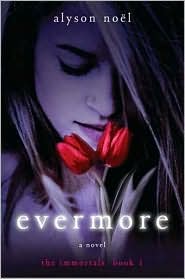
Evermore (MG, YA)

Noel, Alyson. 2009. Evermore.

Can you guess what kind of book this is based on the cover? What do those red tulips mean?

Ever Bloom, our sixteen-year-old heroine, has a gift--secret of course like most paranormal gifts are. She hasn't always had this gift--the gift of seeing people's auras, of reading their thoughts with just the simplest, barest trace of a touch--but since her near death experience, well, she's different. (Her parents, her sister, her dog--all died in a car crash.) Now, Ever is living with her aunt. And she has ever material reason to be happy. But guilt haunts her--well, guilt and her little sister. Yes, her ghost-of-a-sister still pops up ready to chat and giggle. She's got two friends to chat with as well. One, Haven, an attention-hungry twelve-step addict. The other, Miles, a gay sidekick who always knows just what to say.

What is Evermore about? Well, it's focus is on the strange new boy who comes to town. His name is Damen Auguste. And he's the only person whose thoughts (and aura) she can't read. He's her silence. He is also oh-so-dreamy. All the girls (and some of the guys) think he is ever-so-hot. But not Ever. Well, at least that's what Ever claims. She's not interested in having a boyfriend. Do you believe her? Or are you a skeptic like Haven?

Who is Damen interested in? That's a good question...since judging purely on appearances...he's an ultimate player. But there is only one girl he's giving red tulips to. And that's Ever. Is that enough for her?

Some of you may be wondering how much does Ever whines? Well, less than Bella. But she's not whine free.

First sentence: "Guess who?"

Here are a few of my favorite bits:

"Haven is what you'd call an anonymous group addict. In the short time I'd known her, she's attended twelve-step meetings for alcoholics, narcotics, codependents, debtors, gamblers, cyber addicts, nicotine junkies, social phobics, pack rats, and vulgarity lovers. Though as far as I know, today is her first one for overeaters. But then again, at five foot one with the slim, lithe body of a music box ballerina, Haven is definitely not an overeater. She's also not an alcoholic, a debtor, a gambler, or any of those other things. She's just terminally ignored by her self-involved parents, which makes her seek love and approval from just about anywhere she can get it.
Like with the whole goth thing. It's not that she's really all that into it, which is pretty obvious by the way she always skips instead of skulks, and how Joy Division posters hang on the pastel pink walls of her not-so-long ago ballerina phase (that came shortly after her J. Crew catalog preppy phase.)
Haven's just learned that the quickest way to stand out in a town full of Juicy-clad blondes is to dress like the Princess of Darkness. (31-32)


I see dead people. All the time. On the street, at the beach, in the malls, in restaurants, wandering the hallways at school, standing in line at the post office, waiting in the doctor's office, though never at the dentist. But unlike the ghosts you see on TV and in movies, they don't bother me, they don't want my help, they don't stop and chat. The most they ever do is smile and wave when they realize they've been seen. Like most people, they like being seen. (47)


"I know what it's like to lose the people you love," he whispers, reaching across the table and placing his hand over mine, infusing me with a feeling so good, so warm, so calm, and so safe--I close my eyes and allow it. Allow myself to enjoy the peace of it. Grateful to hear what he says not what he thinks. Like an average girl--with a much better than average boy. (49)


If I thought his voice was amazing with the way it envelopes me in silence, if I thought his touch was incredible with the way it awakens my skin, well, the way he kisses is otherworldly. And even though I'm no expert, having only kissed a few guys before, I'm still willing to bet that a kiss like this, a kiss this complete and transcendent, is a once-in-a-lifetime thing. (82)
What did I think of this one? I'm undecided. Part of me thinks that as light entertainment, it does the job just fine. I think if I was fourteen or fifteen, I probably would think it much more entertaining that I do now. (In some ways, it's clean enough that it could even go more towards middle school. A Twilight-esque book that serves a definite need for readers.) Is it original enough? Yes and no. I think some readers find originality overrated. They just don't care if it's all been done before. They want a book that fits a formula, a mold, that they like. In this case, it's the incredible paranormalness of it, this true-love-for-eternity theme. I think this one *may* be a book that teens love more than adults. But that isn't a bad thing. I think any book that gets people reading can be a good book.

© Becky Laney of Becky's Book Reviews

Friday, September 18, 2009

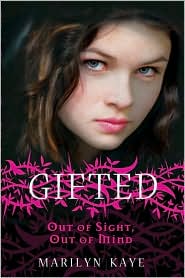
Gifted: Out of Sight, Out of Mind (MG)


Kaye, Marilyn. 2009. Gifted: Out of Sight, Out of Mind. Kingfisher. 240 pages.

I'm looking through you, where did you go
I thought I knew you, what did I know
You don't look different, but you have changed
I'm looking through you, you're not the same
-- The Beatles

Sometimes I look in a mirror and there's nobody looking back. I know I have a reflection. I just don't see it. Maybe it's all in my mind. Maybe I've got bad eyesight. Or maybe it's something else.

Tracey Devon feels invisible. The older sister in a large family--a really large family--she feels invisible at home and at school. A nobody. (Her siblings are "the Devon Seven.")

Amanda Beeson is the queen of mean. The most popular girl in eighth grade. But this mean girl is mean for a very specific reason. Do you want to know her secret?

Meadowbrook Middle School--the school that both Tracey and Amanda attend--is keeping a few secrets of its own. Secrets about a handful of their students. Nine students if you include Amanda. These are "gifted" students with unique "gifts." Of course, all these students have different ways of looking at their "gifts." Some definitely feel more like curses than blessings.

What is Tracey's gift? What is Amanda's gift? Read and see for yourself in this first book in a new series.

What did I think about this one? Well, I think it is what it is. A lighthearted, fun read right for its target audience. It's a quick read. An entertaining one. Will Gifted be the most amazing read ever for adults? Not really. But that's okay. It doesn't need to be.

© Becky Laney of Becky's Book Reviews

Thursday, September 17, 2009

Vampire A Go-Go


Gischler, Victor. 2009. Vampire A Go-Go. Simon & Schuster. 337 pages.

I'm not the hero of this story.
There are a number of important things you need to know up front. Pay attention.
I'm not the hero of this story, but I am the guy telling it. It has to be me. I'm in a unique position. I know all the players, know how they mix and match and come together to make everything happen.


Allen Cabbot is a graduate student at Gothic State University. Academically, he's not the best of students. But he's about to have an "opportunity" to change all that. A summer trip to Prague. To assist Dr. Evergreen in his research. Who is Allen Cabbot? He's a Bronte-loving English major. In fact he wants to write his dissertation "on gender coding in Wuthering Heights." How many people think this trip will go according to plan?

What is Vampire A Go-Go about? Well, it's not about go-go dancers who are vampires. It's about ancient secrets. It's about the philosopher's stone and the quest for immortality. It's about men and women (some more undead than others) who would do anything and everything to obtain what they want. It's a story that spans centuries. With a name like Vampire A Go-Go, you know to expect quirky. And quirky is part of what you get. Zombies. Vampires. Werewolves. Ghosts. Witches and Wizards. A little bit of everything really.

It's a mystery-thriller with some romance.

© Becky Laney of Becky's Book Reviews

Wednesday, July 22, 2009

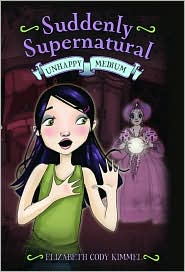
Suddenly Supernatural: Unhappy Medium (MG)


Kimmel, Elizabeth Cody. 2009. Suddenly Supernatural: Unhappy Medium. Little, Brown. 277 pages.

I daydream a lot, especially during science class. I can dream up the perfect dessert, the perfect day, the perfect slice of pizza, even the perfect boy. But I have to tell you, sleeping or awake I could never have imagined a place that looked like the Whispering Pines Mountain House.

This is the third in the Suddenly Supernatural series by Elizabeth Cody Kimmel. The first was Suddenly Supernatural: School Spirit. The second was Scaredy Kat. This book opens with Kat, Jac, and Jac's mother arriving at Whispering Pines Mountain House. Kat is tagging along on a music convention. Jac is still angsty: hating her mother with all the spirit she can muster, and being here and there again on the cello. One minute wanting to be a musician and the next wanting to never touch her instrument again. (This is an ongoing issue, it being of central focus in the previous two books as well.) This trip isn't all fun and games. Jac's mother is plagued by headaches and nightmares. And Kat's room is haunted by a Victorian medium, a Madame Serena, who is convinced that Kat is from the spirit world. Kat has to figure out how to tell her that she is the dead one, that she is the spirit. Their interactions lend some comedy to the book while her interactions with Jac are of the angsty variety. Big time drama. Part of Kat's time is spent researching spiritualism and the history of mediums.

While this one is a blend of comedy and drama, often engaging and suspenseful, I personally did not like it. Though I'm not sure like is the right word. I found it entertaining. I found myself enjoying it. But at the same time I felt this one was too heavy in spiritualism, in spirit-world-talk. I found the content objectionable on that front. Granted, this is a person-by-person thing. What one person deems objectionable or dangerous, another person will think is perfectly fine and harmless. So I'm not saying that you should find this series objectionable. (You don't have to agree with me.) I would never try to prevent readers from picking it up.

© Becky Laney of Becky's Book Reviews

Tuesday, July 21, 2009

Suddenly Supernatural: Scaredy Kat (MG)


Kimmel, Elizabeth Cody. 2009. Suddenly Supernatural: Scaredy Kat. Little, Brown. 250 pages.

The truth is, I find it very embarrassing when my mother talks to plants. There, I've said it.

This is the second in the Suddenly Supernatural series. The first was Suddenly Supernatural: School Spirit. What I like about this series--and I've read the first three so far--is the writing itself. It's engaging, light, and funny. Kat, our heroine, is a thirteen year old who has just come into her powers, her ghost-whispering spiritualist powers. It's spring break. Her best friend, Jac, is away and she's finding herself a bit bored. Sounds fairly typical right? Well, that's before she notices that the abandoned house next door is haunted by several spirits including that of a little boy named Tank. Can she use her new-found powers to help the spirits next door find some peace? It might be a little easier if she kept her mom in the loop, but that's something she's not going to do. She wants to do everything all on her own. Mostly. But is she strong enough to tackle this one all on her own? Or could she use a little help from friends new and old?

© Becky Laney of Becky's Book Reviews

Tuesday, February 24, 2009

The Dust of 100 Dogs


King, A.S. 2009. The Dust of 100 Dogs. Flux. 330 pages.

Intriguing cover. Intriguing premise. Here's whats promised,
"In the late seventeenth century, famed teenage pirate Emer Morrisey was on the cusp of escaping the pirate life with her one true love and unfathomable riches when she was slain and cursed with the dust of one hundred dogs, dooming her to one hundred lives as a dog before returning to a human body--with her memories intact. Now she's a contemporary American teenager and all she needs is a shovel and a ride to Jamaica."
Isn't that a great premise? Doesn't that make you at least a wee bit curious about this book? If that premise doesn't get you, maybe the first sentence of the first chapter will:
"Imagine my surprise when, after three centuries of fighting with siblings over a spare furry teat and licking my water from a bowl, I was given a huge human nipple, all to myself, filled with warm mother's milk. I say it was huge because Sadie Adams, my mother, has enormous breasts, something I never inherited. When I was born into a typical family in Hollow Ford, Pennsylvania, in 1972, my life was finally mine again."


Here's what you'll find in The Dust of 100 Dogs. Narrative set in the seventeenth century, narrative set in the twentieth century, and narrative revealing what she's learned during her hundred lives as a dog. These three are woven together throughout the book. Both Emer (the seventeenth century pirate) and Saffron (the contemporary reincarnation) make interesting and compelling narrators. I'm sure it's purely subjective which one you'd prefer. As a lover of historical fiction, I was a bit partial to Emer's story. I found it more interesting than the contemporary one.

But there were a few things that I didn't care for in The Dust of 100 Dogs. Things that made me unhappy. One was the introduction of a new narrator, Fred Livingstone, about 130 pages in. Fred is a despicable character. A villain if ever there was one. He's a cold-hearted man, one prone to abusing his dog, Rusty. "Fred would always get a kick or slap in somehow. Soon it would be Rusty's fifth birthday, and as far as he could remember, every day for five years Fred Livingstone had beaten him." (135) Fred's sense of reality is lacking and he's mentally, emotionally, and psychologically unstable, unbalanced. (He is always daydreaming about women, imagining conversations with them, even in his daydreams he can't get a woman the right way, so these daydreams often turn dark and violent.) He would be an interesting character to analyze because he's definitely in need of help! And in a way this all makes sense there towards the end. But the animal abuse introduced into the book by the presence of Fred in addition to the foul and abusive language (a bit stronger than I personally like) make these passages unpleasant....for me.

Not every reader will find issues with those two things. And I can see how the character of Fred adds tension and complexity to the contemporary story--along with Junior, Saffron's brother who is quite the villain himself--a drug addict, a thief, an arsonist. I would imagine that you would enjoy this one more than I did. I liked parts of it a lot. But not so much on other parts.

I do think this would make a great movie.


© Becky Laney of Becky's Book Reviews
If you're reading this post on another site, or another feed, the content has been stolen.

Wednesday, July 02, 2008

Suddenly Supernatural: School Spirit

Kimmel, Elizabeth Cody. 2008. Suddenly Supernatural: School Spirit.

Suddenly Supernatural Book 1 School Spirit"The undead are ruining my life. I blame my mother. My mother is a medium. And I don't mean the kind that fits in between small and large."

What's worse than being an uncool kid in middle school? How about being an uncool kid that sees dead people? Kat, soon after her last birthday (12? 13?), has just realized that she shares her mother's gift, her ability to see, to communicate, to help with spirits or ghosts. While Kat loves her mother dearly--most of the time--she has never wanted to share in her mother's line of work. Helping spirits communicate with the living? Not really on her to-do list. But she has little choice in the matter when the spirit that haunts the school library makes her presence known.

Suddenly Supernatural has plenty of supernatural, but it has plenty of your typical drama as well. School. Teachers. Cliques. Friends. Enemies. School dances. Jac, Kat's best friend, has problems of her own. A cello player, a talented genius sort, has lost her ability to play music. These two 'loner' types find great comfort in confiding in one another. Jac understands Kat's unique ability. And Kat understands Jac's personal struggle or turmoil. Both have gifts they don't feel comfortable with. Both feel a bit uneasy about who they are and what they want.

This is the first in a series.


Blogged with the Flock Browser

Sunday, June 29, 2008

Frozen Fire


Bowler, Tim. 2008. Frozen Fire.

"I'm dying," said the voice. Dusty clutched the phone. She had no idea who this was. A boy about her own age, by the sound of him--fifteen, sixteen, maybe a bit older. (1)

Frozen Fire is a psychological thriller that is fast-paced, tension-filled, and just unputdownable. Dusty, the girl receiving the phone call, is a great narrator. She has more questions than answers, and her choices aren't always the wisest choices--the choices we as readers would likely make--but she's so likable. She's a young teen struggling with some hard losses in her life--the mysterious disappearance of her brother, Josh, and the loss of her mother. Her mother walked out on her and her dad after Josh vanished. Living with just her dad, Dusty wants to believe the best about a mysterious young man who seems to haunt her. There's no reason to trust him, and every logical reason not to...and yet Dusty can't help feeling drawn to this stranger that is so out-of-this-world strange.

Weird. Strange. Supernatural. Whatever you want to call it, if you pick it up, you probably won't be able to put it back down...


http://www.timbowler.co.uk/frozenfire.html

http://www.timbowler.co.uk/extract-frozenfire.html

Winner of the Hull Book Award, 2007

Winner of the Highland Book Award, 2007

Winner of the Redbridge Book Award, 2007

Winner of the Stockport Schools Book Award 2007

Winner of the South Lanarkshire Book Award 2008


© Becky Laney of Becky's Book Reviews