January + February + March + April + May + June + July + August +September +October +November = Totals:
Number of Picture Books = 118 Number of board books = 29 Number of children's books (under age 8) = 74 Number of Christian books = 47 Number of adult books = 89 Number of YA books = 160 Number of verse novels: 8 Number of graphic novels = 12 Number of short story collections/anthologies/poetry = 15 Number of nonfiction = 25
I love reading A Peek At My Bookshelf. And starting tomorrow, she'll be celebrating her blog hitting over 60,000 hits by giving away 60 books in 6 weeks! (The introduction post). This looks to be a pretty amazing start to the summer! Be sure to bookmark her site (or follow) so you won't miss out on any opportunities!
Happy Sunday everyone! I am still having a hard time believing that May is over. (You can read my "May Accomplishments" post if you like.) I've gone from being overwhelmed to calm to a little whelmed to overwhelmed and back again. I've been all over the place essentially. I've joined a handful of new challenges. Take A Chance. (You can sign up here.) Beowulf on the Beach. (You can sign up here.) Book Awards 3. (You can sign up here.) Southern Reading Challenge. (You can sign up here.) And last but not least, the Summer Reading Blitz. (You can sign up here.) And I should not forget the 48 Hour Book Challenge. Hosted by MotherReader. Sign ups are still going on. It's not too late. And it's next week, by the way. Start on Friday and finish up on Sunday. Or start on Saturday and finish up on Monday. But by Monday at 7AM, your time is up. Do I know what I'm reading yet? It might be wise to read some of my library loot. I know a certain someone wants me to read Howl's Moving Castle. And there is a person (maybe two?) on twitter that highly recommended Skellig a while back. And was it Renay that wanted me to read The Body of Christopher Creed? I think it was. I know someone was pushing it :) I'm always torn between reading my review copies and reading some of these slightly older (but not really that old considering) titles that I haven't read but really, really want to like Tender Morsels. And Nation. Are you planning on participating? If you are, I'd love a hint as to what you plan to read next weekend! If you're not participating and want to chime in with what you want me to read, feel free to do that as well. I love getting recommendations!
I thought I'd take a few minutes to explain the categories by which I'm sorting and presenting what I'm doing. "What I Read In A Previous Week, But Reviewed This Week." Pretty self-explanatory. These are books that I read anywhere from eight to thirteen days ago. These are just books that I've reviewed in the past week. "What I Read This Past Week and Reviewed." These are the books that I've both read and reviewed since the last Sunday Salon post. "What I Read This Past Week And Haven't Reviewed Yet." These are books that I've read (in the past week, since the last Sunday Salon) but not reviewed yet. "What I've Read And Really Really Need To Review." This one's a deceptive pile really. Because it contains books that I've already reviewed (and not posted the review yet). OR books that I sincerely, desperately need to review. Books that I may have read two or even three weeks ago. Books that if I don't get written up soon, I might get hazy on. "What I'm Currently Reading" contains books that I'm actively reading. "What I'm Just Fooling Around That I'm Reading." This category started out as the "What I'm Semi-Reading" category. And this is probably the most dangerous category of all that I list. Because it contains books that I've NOT abandoned; (Books that I'm not planning on abandoning, by the way.) Yet at the same time, I'm not actively reading them either. These are books that are neither here nor there. They're not quite in the to be read pile--I've started them--but they're not in the currently reading pile either. What's the difference between this stack and currently reading? Well, currently reading means it sees action just about every day or every other day. These semi-reading books are books that are on my to-do list. They're on my radar. I have every intention of reading them. Just not at that precise minute. So if you're an author and you see your name on the list. Don't jump to conclusions. Don't assume the worst. The truth is, it doesn't mean that much. Because the turnaround between the two is constant. What's 'current' one week may be 'semi' the next. And vice versa. Sometimes it means I'm busy and overcommitted. Sometimes it means my focus was on the library books that were due. Sometimes it means I was anxious about completing a challenge and shifted my attention away for awhile. Sometimes it means I was simply indecisive and ambitiously curious. So don't assume your book appearing there is my final judgement of it and that it's doomed for either abandoning or a negative review.
What I read in a previous week, but reviewed this week:
Starfinder by John Marco. 2009. Daw Books. 326 pages. Sprout by Dale Peck. 2009. Bloomsbury. 277 pages. Say the Word by Jeannine Garsee. 2009. Bloomsbury. 368 pages. Fat Cat by Robin Brande. 2009. Random House. 336 pages. The Convenient Marriage. Georgette Heyer. 1934/2009. Sourcebooks. 307 pages. Frederica. Georgette Heyer. 1965/2009. Sourcebooks. 437 pages. What I read this past week and reviewed:
The Dragon of Trelian by Michelle Knudsen The House in Grosvenor Square by Linore Rose Burkard The Summoning by Kelley Armstrong When the Whistle Blows by Fran Cannon Slayton
What I've read and really really need to review: (none this week)
What I'm currently reading:
Darkwood by M.E. Breen. 2009. Bloomsbury. 273 pages. Julian Comstock: A Story of 22nd Century America by Robert Charles Wilson. 2009 (Late June?) Tor. 416 pages. The Moon Is A Harsh Mistress by Robert A. Heinlein (Adult) The Painter From Shanghai by Jennifer Cody Epstein.
What I'm just fooling around that I'm reading:
Evermore by Alyson Noel (YA) Middlemarch by George Eliot (Adult) Barchester Towers by Anthony Trollope (Adult) What I've abandoned: (none this week)
Number of Board Books:3 Bow-Wow's Colorful Life. Mark Newgarden & Megan Montague Cash. 2009. Houghton Mifflin Harcourt. Bow-Wow 12 Months Running. Mark Newgarden & Megan Montague Cash. 2009. Houghton Mifflin Harcourt. My Mother Is Mine by Marion Dane Bauer. Little Simon (Simon & Schuster) 2009.
The Fire of Ares. Michael Ford. 2008. Bloomsbury/Walker Books. 245 pages. The Birth of a Warrior. Michael Ford. 2008. Bloomsbury/Walker Books. 262 pages. Thirsty. M.T. Anderson. 1997. Candlewick. 237 pages. The Demigod Files. Rick Riordan. 2009. Disney/Hyperion. 151 pages. The Queen of Everything. Deb Caletti. 2002. Simon & Schuster. 322 pages. Forest Born by Shannon Hale. 2009. Bloomsbury. 400 pages. The Opposite of Music by Janet Ruth Young. 2007. Simon & Schuster. 346 pages. The Last Olympian by Rick Riordan. 2009. Disney/Hyperion. 381 pages. Starfinder by John Marco. 2009. Daw Books. 326 pages. The Genie Scheme by Kimberly K. Jones. 2009. Simon & Schuster. 179 pages. The Book of Time by Guillaume Prevost. 2006. Scholastic. 224 pages. The Princess Plot by Kirsten Boie. 2009. Scholastic. 378 pages. When You Reach Me by Rebecca Stead. 2009. Random House. 208 pages. Dragon Spear by Jessica Day George. 2009. Bloomsbury. 248 pages. Radiant Darkness by Emily Whitman. 2009. HarperCollins. 274 pages Morbito Guardian of the Spirit by Nahoko Uehashi. 1996/2008. Translated into English by Cathy Hirano. Scholastic Books. 248 pages. The Silenced. James DeVita. 2007. HarperCollins. 502 pages. Alcatraz Versus the Evil Librarians. Brandon Sanderson. 2007. Scholastic. 306 pages. Sprout by Dale Peck. 2009. Bloomsbury. 277 pages. Say the Word by Jeannine Garsee. 2009. Bloomsbury. 368 pages. Fat Cat by Robin Brande. 2009. Random House. 336 pages.
The Convenient Marriage. Georgette Heyer. 1934/2009. Sourcebooks. 307 pages. Frederica. Georgette Heyer. 1965/2009. Sourcebooks. 437 pages. The 19th Wife by David Ebershoff. 2008. Random House. 514 pages. Marsbound by Joe Haldeman. 2008. Ace Books. 296 pages. Lady Chatterley's Lover by D.H. Lawrence. 1928. The Talisman Ring by Georgette Heyer. 1936/2009. Sourcebooks. 303 pages.
Number of Short Story Collections, Anthologies, Poetry Books:
One of my guilty-pleasures is blog related. It all started with the wonderful Melissa. First, she taught me how to get favicons on all my blogs. Then she was kind enough how to share the magic of how to make sidebar widgets scroll. Then at some point, I can't remember if this is Melissa's fault or not, but I stumbled upon Blogbulk.com. Man, that place is evil. Evil in that after discovering it, I just couldn't leave it alone. I had to keep going back again and again and again and again. I added a comment icon to the post footer. I did the tutorial on how to make a comment link more "attractive and visible." Added a signature under posts. Added dividers between posts. Added an icon beside the post title. And Used his fix on how to get embedded comments to show up on a customized template. Discovered My Live Signature. This past week--I think it started last Sunday?--I've probably spent a good fifteen to twenty hours working on codes for my blog. (It could be pushing twenty-five, actually. If you count all the time spent working on customizing colors and such.) Speaking of which, one site that I've relied on probably for about a year at least is Big Huge Lab's Palette Generator. It is the BEST site ever. Just upload an image and wait for it to give you all the matching and complimentary colors (color codes which you can use (by cutting and pasting and hitting enter (I don't know why the enter is so important. But you hit enter and voila the color is added. If you don't hit enter, then the color stays whatever it was before.) into your "fonts and colors" layout page) I haven't had any feedback on the color changes yet. But I haven't asked for any either. Not that I'm opposed to hearing feedback, but I'm not a slave to it either. I can't promise to change colors based on polls ;)
Becky's Book Reviews Before:
Becky's Book Reviews After:
Young Readers got a complete redesign. It went from a perfectly ordinary minima +cutest blog on the block design to a customized three column design. By the time I got through with it, it's a bit different than the template I downloaded.
Template I used for Young Readers (Original, As Downloaded)
Template as Implemented on Young Readers Now
You can't tell how cute it is. But visit it. I like the greenness and polka-dottness of it all. And the sidebars are a delicious cream color. It was not easy to customize. You had to search the html code to find each little element's color. This wasn't a case where you could just use the fonts and colors layout page. The elements I wanted to change the color of were not editable. So it was a matter of perseverance and stubbornness on my part to get it to do what I wanted.
Mind-Rain: Your Favorite Authors On Scott Westerfeld's Uglies Series. Edited by Scott Westerfeld. With original introductions (to each piece) by Scott Westerfield.
Featuring the essays of: Lil Wilkinson, Robin Wasserman, Diana Peterfreund, Sarah Beth Durst, Gail Sidonie Sobat, J. Fitzgerald McCurdy, Rosemary Clement-Moore, Janette Rallison, Linda Gerber, Will Shetterly, Jennifer Lynn Barnes, Delia Sherman. And featuring two special short stories. "Beautiful People" by Charles Beaumont. "Liking What You See: A Documentary" by Ted Chiang.
How to review a collection of essays? Each piece is different. Each has a different focus. Some are Shay related, others David or Zane related, and some are all Tally, all the time. Some focus on the science and technology of the Uglies universe. Other focus on the relationships. Others focus on the society and philosophy behind it all.
I enjoyed almost all of the essays. Some more than others, of course, as is only natural. But I will say that almost all of them made me think. They engaged me and had me reevaluating how I felt about the books, the characters, etc. Some introduced new ideas to me. Ways of seeing the books in a whole new way. And so I think that is clearly an indication of success.
I will say that I just love, love, loved the inclusion of those two short stories. "The Beautiful People" is a short story by Charles Beaumont. He wrote in in 1952. And it was adapted for a Twilight Zone episode, Number Twelve Looks Just Like You, in 1964. (Condensed YouTube version below)
You can see all of the episode as well. one. two. three.
Liking What You See: A Documentary by Ted Chiang inspired Scott Westerfeld. It was the inspiration that led to the Uglies books, the Uglies universe. It is a complex, thought-provoking story. And I loved getting the chance to read it. Both short stories are really. Thought-provoking. I'd definitely recommend these two stories to everyone to read regardless of whether or not they've read the Uglies books.
"You're all good little machines," Mr Fizer told us. He sat there this afternoon in his tweed jacket and his white shirt and plaid bow tie and glared at us over the top of his half-glasses.
Cat hearts science. And she's thrilled to be in Mr. Fizer's class--Fizer's Special Topics In Research science class. A class that is legendary, "not the least because every few years someone has to run out of there on the first day and vomit because of the stress." On the first day of class, each student randomly selects a picture/photo from Mr. Fizer's hands. Your research topic for the year? A complete gamble. No matter your interest, you'll be forced to be "inspired" by the picture you select. No wonder there is stress! What does fate have in store for Cat?
It was an artist's rendering of how these early humans might have lived. There were three men and a woman out in a meadow of some sort. They were all lean and muscular and tan--and did I mention naked? They were gathered around a dead deer, guarding it from a pack of saber-toothed hyenas who were trying to move in and snatch it. One of the men was shouting. The woman had the only weapon--a rock--and she stood there poised to pitch it at the hyenas. It was a great action scene if you're into that sort of thing--the whole anthro-paleo field of studies where you care more about the dead then the living.
Can prehistoric men and women inspire Cat to greatness? Read and see for yourself in Fat Cat. A transformative story about living life to the fullest.
What did I love about this one? Practically everything. I'm not a science person. Not even a little bit. But I loved this novel. Loved that the heroine's passion for science was so strong and intellectual yet always relevant to real life, to the real world. I liked that the novel made me think. Really think. You see, it in a way goes to the science of nutrition, the science of healthy living. And I think every reader can benefit from that exposure. No, reading Fat Cat didn't make me want to become a vegan, I still love my meat. But it did make me think about what changes I would be willing to make. Encouraged me to stick with those changes I've already made. I also loved that science wasn't Cat's only interest. She was passionate about many things--including cooking and swimming. People were also important to her. Her friends. Her family. Especially her little brother. Loved the development of that relationship. Cat was a complex, very human, character that I just loved.
But this isn't just a novel about a diet or lifestyle change. How a fat girl can go from not to hot...It's so much more than that. It's a reflective and smart coming of age novel. It's a romance too. I love Matt. I do. While our heroine, Cat, was loving-to-hate and hating-to-love him, I was loving to love him and cheering this reluctant couple on. It reminded me of some of my favorite reluctant romances--like Anne and Gilbert, for example. This is one giddy-making romance...
They say your muscles have memory. Once you've trained your arms to swing a tennis racket or your legs to ride a bike, you can quit for a while--for years, even--and all it takes is picking up a racket or jumping on a bike again and your muscles remember what to do. They snap right back to performing the way you taught them. The heart is a muscle, too. And I've been training mine since I was a kid to fall in love with one particular person.... (313)
Garsee, Jeannine. 2009. Say the Word. Bloomsbury. 368 pages.
When the phone slashes a machete through my brain at six fifteen a.m. it can mean only one of two things: Dad somehow found out I was sucking face with Devon Connolly last night. Or somebody's dead.
The heroine of Say the Word is people-pleaser Shawna Gallagher. And no, her father isn't omniscient. The phone call is not good news. Her mother, her lesbian mother, the woman Shawna has been trained to hate, has had a stroke. She's dying. Remember that song in South Pacific, the one about where you have to be taught to hate? Well, Shawna's life has been like that. Her mom left her and her father when she was only six or seven. Left them for another woman. Left to have another family, a family with two little boys. Part of the anger is legitimate. I think it's only natural that that pain of being abandoned would translate into anger and bitterness. But for Shawna, the anger has been turned to hating her mother for being a lesbian. Her father, all her family really, has raised her to hate homosexuality. The words they speak, the words Shawna herself speaks are of that hate and anger. These words are ugly. These words are powerfully ugly.
Shawna has issues. Issues with her father. A man who is at times neglectful and ever-absent, and at other times controlling and manipulative. Issues with her mother. Her mother, when she visited her through the years, was equally neglectful. Out of touch with her daughter. Uncaring. She never tried to bridge the gap. It was always work, work, work. (Much like her father is all work, work, work.) Now, as a teen (16? 17?), she hasn't seen her mother in three or four years. And their last meeting, their last conversation was pure ugly. But she's dying. And she has to come to terms with that. The mother who has been so ignorable in life, becomes impossible to ignore in death. Did her mother's leaving have to do with her father? Or was she really so head-over-heels-in-love with another woman? Why didn't she try harder to have a relationship with her? What can Shawna learn about her mother from the other family? Can this other family help heal the pain? Can they help provide closure? Can she come to love and understand her mother...at last?
If the characters weren't so human, if they weren't so complexly drawn and brought to life, then this novel might be too issue-driven. A novel about all the shades of prejudice and discrimination. A novel about the inadequacies and injustices of life.
How her mother's life partner and her family are cut out of everything. No legal right to make decisions about her mother's treatment. No legal right to make the funeral arrangements. How her ex-husband, whom she hated, ruled and bullied and gloried in this horrible situation. Took advantage. True, some of this--most of this--could have been prevented if Shawna's mother had drawn up a a will and other legal papers. But she didn't foresee her own death--it was too unexpected, it was too sudden. And now it's too late.
What's right? What's wrong? Shawna has a sinking feeling that her father is wrong. Not just a little wrong, but unforgivably, undeniably wrong. Shawna sees how ugly her father can be, how horribly selfish and controlling he is. And seeing his ugliness makes her reflect on her own life.
Say the Word is about Shawna's coming of age. Her growing up and growing wise. In a way, to borrow from the Grinch, it is about Shawna's heart growing three sizes.
Heyer, Georgette. 1936/2009. The Talisman Ring. Sourcebooks. 303 pages.
How to introduce this one? Think, think, think. I could mention that it has a heroine that reminds me of Catherine Morland of Northanger Abbey, Jane Austen fame. Because it does. Eustacie de Vauban is silly and impulsive and much too much into romantic novels with daring adventures and dashing, swoon-worthy heroes. She, like Catherine, has an over-active imagination. But, this book isn't her story alone. So maybe that wouldn't quite be fair.
The book opens with a dying old man, the family patriarch, Sylvester, calling his family together. He wants his granddaughter, Eustacie, whom he rescued from France before the revolution got started with all the guillotining, to be safely married. He wants his great-nephew (Sylvester is Tristam's great-uncle), Tristam Shield, to marry her. He decidedly does not want Basil "The Beau" Lavenham to be the man for the job. Though since Ludovic Lavenham's "death" there is really no one closer in the line to inherit his title and his lands. But is Ludovic really dead?
The more time Eustacie spends with Tristam, the more she knows that he is not the one for her. He is not adventurous. He is not romantic. He is not impressed with her storytelling and imagining. He is much too grounded in reality to ever be dashing and heroic. He's simply put not hero material. So Eustacie makes up her mind to run away. In the middle of the night. On horseback. What could be wrong with that?
Well, maybe just maybe as she's running away...she runs right into the middle of a pack of smugglers. Instead of being scared silly. She's in love with the notion. An adventure worthy of any real heroine! Fortunately for her, her kidnapper is none-other than her cousin Ludovic. He's a man already on the outs with the law--charged with a murder several years previous. But is he guilty of that crime?
Can Eustacie (and company) prove Ludovic's innocent of murder? Can they redeem his name, enable him to come out of hiding, and claim what is rightfully his?
This one is silly and fun. A pure delight. It's just comical.
For May 28, 2009: Is there a book that you wish you could “unread”? One that you disliked so thoroughly you wish you could just forget that you ever read it? For May 21, 2009: What book would you love to be able to read again for the first time?
"Unread"
Definitely a trilogy by Phillipa Gregory. I believe the order of the books is Wideacre, The Favored Child, and Meridon. These books aren't only deviantly disturbing--imagine the worst and then multiply it a couple of times, and just when you think you've sunk as low as you can go, go some more.) There's not any redeeming qualities in these books. These books are masquerading as historical fiction, but they're trash plain and simple. (And I'm not alone, the book has 66 one star ratings on Amazon, 26 two stars, 24 three stars, 26 4 stars, and 57 five stars.)
"Reread"
It would be awesome if I could read Gone With The Wind with fresh eyes. I almost wish that there was a 'refresh' button that you could push before starting the novel that would erase the movie from your memory. Completely. It's not that I hate the movie. I wouldn't go that far. But it's not the book. It gets so many things wrong. And I think people often mistake the two. Think they're more similar than they actually are. I think people assume that the book is like the movie, and it isn't. If you've only seen the movie, then you don't know the half of it. Not that I'm cranky. I'm not. Well, maybe a little.
I'm happy to be a part of John Marco's blog tour for Starfinder. While Starfinder is his first YA novel--fantasy, by the way--he has written many books. For a full listing, visit his website. (He also blogs.)
Can you tell us a little bit about your background and your journey towards becoming a published author?
My background is rather average, to be honest. I wasn't a great student and I didn't get serious about college until I was in my thirties. But I always knew I wanted to be a writer. Even the term "writer" seemed glamorous to me when I was a kid. I personally believe that writers are born rather than made, and all I mean by that is almost all people who become writers had the desire to do so from an early age. It kind of starts off with a compulsion to tell stories, or at least it did for me. I used to bang away at my sister's portable typewriter (typewriter? What the heck is that?), churning out atrociously written adventure tales. I say atrocious because they were, but that's perfectly okay--that's how writers learn.
As I got older my life took a detour into having to make a living. I was lucky enough to become a technical writer, which at least had the word "writer" in the title, and I did that for years, kind of drifting between jobs, always wanting to return to the dream of fiction writing but never really doing so until I was closing in on turning 30. At that point something just clicked and I got serious about it, and started writing my first novel, "The Jackal of Nar." Luck intervened here as well, because I found an agent online on Compuserve who was actively looking for new clients. I sent her what I had written so far on my book, and she really loved it. She waited another two years almost for me to finish it, then sold it to Bantam Spectra. And that's basically how I got started.
What inspired you to write Starfinder?
Oh, so many things. Having a child for one thing. Having a kid is such an eye-opening experience. All of the books I wrote before Starfinder were kind of dark and grim. They were fantasy books, certainly, but they lacked that sense of wonder that I see in my son. It awakened that in me. I really don't think I could have written the book without him, odd as that might sound. Plus, I had always wanted to write a YA book, because for a while now YA books have been the bulk of the novels that I've been reading. Not all of them have been great, but some of them have been amazing, so memorable and poignant that it was just something I needed to tackle. I hope I can keep on writing in the YA genre because I truly love and admire it.
What do you love about writing? What do you find the easiest? What do you find the hardest? The first part of your question is probably the easiest for me to answer--what I love most about writing is the solitude. Everyone who knows me knows that I like quiet and being alone, especially when I'm working. And for me there's just nothing like getting into a story all by myself. Sometimes I talk to myself as I'm writing, or stand up and act things out. It gets pretty weird, and I wouldn't want to do that with people watching.
I can't honestly say that any part of the writing process comes easily to me. On the other hand, I don't want to say it's extremely difficult either. Writing can be a lot of fun and I try not to lose sight of them. Perhaps the easiest thing for me is getting inside the heads of the characters. I seem to do this instinctually. There's the old question of which comes first, character or story, and for me it's always the characters. I enjoy creating them and getting to know them, and I always ask myself what he/she is after.
The hardest part of writing for me is probably the time it takes. Everything in publishing is slow. It takes a long time to write a book, naturally, but then it takes another long stretch of time to have it edited, and the whole back and forth of the production process. It's tedious and I don't enjoy it at all, because I don't have a lot of patience.
Can you describe what a typical day is like as a writer?
Sure. Just imagine your own day at work, and that's pretty much what it's like to be a writer. I get my son off to pre-school, come home and have something to eat, and then I sit down to work. I might be outlining or researching or actually writing, but basically it's me sitting at a computer until lunch time, then back at it until it's time to pick up my son. I used to write at night a lot, but not so much nowadays. Night time for me now is spent with my wife and son, or maybe catching up on emails and such. It's a routine, but it's need to be a if I'm going to make headway. Writing, like anything, takes discipline.
How do you find the time--do you find the time--to keep reading? Do you have any recent favorites?
When people say they don't have the time to read I say that's nonsense. There's an old expression that I learned many years ago from some self-help guy--people give time to the things that are important to them. That immediately struck me as so obviously true. Everyone has some time to read. Some folks just choose not to do so. Maybe they prefer TV or sports or the internet, and I have no problem with that. I just don't think they should blame reading as though it's some kind of all-consuming actively that they couldn't possibly find the time for. If you want to read, you will.
Besides YA novels I also read a lot of memoirs. Good ones, though, and not the celebrity kind which are almost always pointless. I also read the occasional book about psychology. It's hard to pick a favorite, though. My all time favorite books are books I read a long time ago, which I like to reread from time to time.
If you had twenty-four hours, a time machine, and a limitless supply of money, what would you want to do?
Okay, so I've given this some thought, and I realized that money doesn't have much to do with what I'd want to do with a time machine. I wouldn't choose to do something grand, like install myself as emperor for a day or build my own space ship. I'd probably want to go back in time, not forward, and if I could see anything at all then I'd want to go back to Independence Hall and watch all those founding fathers thrash out the Declaration of Independence. That would be amazing, to be there with Adams and Jefferson and everyone else. I'd also love to meet George Washington--a personal hero of mine--but I'm not sure he ever made it to Independence Hall, since he was out fighting the British at the time. Or as we history buffs like to call them, the "lobsterbacks!"
Moth was flying his kite near the aerodrome when he heard the dragonfly crash.
Starfinder is a fantasy novel for young adults. It's a typical fantasy in many ways. It stars a young boy--an orphan of course--who is thrust into a mysterious quest which ends up changing his destiny. Full of adventure and fantastical creatures--centaurs, dragons, mermaids, etc., the novel picks up pace after Moth, our narrator, loses his caregiver (grandfather-figure) Leroux. Soon Moth and his best friend, a young girl named Fiona, are off on a quest to fulfill an old man's dying wish. A wish that they can't quite wrap their minds around, but a promise is a promise is a promise. So off they go into the unknown and along the way they may just discover the unknown about themselves.
I'll be honest, the first few chapters dragged for me. I wasn't particularly inspired to keep reading. But once the quest had begun, once the adventure started, once they met the dragon, it began to pick up for me. I actually became connected with the story. (Or at least better connected with the story.) Though it got off to a rough start--for me--it did improve enough for me to be thankful that I stuck with it. And I think that now the world and characters have been created--have been set up--it will only get better from here.
Because I just couldn't wait until next Wednesday:
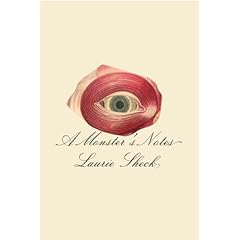
A Monster's Notes by Laurie Sheck.
The description as found on Amazon:
What if Mary Shelley had not invented Frankenstein’s monster but had met him when she was a girl of eight, sitting by her mother’s grave, and he came to her unbidden? What if their secret bond left her forever changed, obsessed with the strange being whom she had discovered at a time of need? What if he were still alive in the twenty-first century?
This bold, genre-defying book brings us the “monster” in his own words. He recalls how he was “made” and how Victor Frankenstein abandoned him. He ponders the tragic tale of the Shelleys and the intertwining of his life with that of Mary (whose fictionalized letters salt the narrative, along with those of her nineteenth-century intimates) in this riveting mix of fact and poetic license. He takes notes on all aspects of human striving—from the music of John Cage to robotics to the Northern explorers whose lonely quest mirrors his own—as he tries to understand the strange race that made yet shuns him, and to find his own freedom of mind.
In the course of the monster’s musings, we also see Mary Shelley’s life from her childhood through her elopement with Percy Bysshe Shelley, her writing of Frankenstein, the births and deaths of her children, Shelley’s famous drowning, her widowhood, her subsequent travels and life’s work, and finally her death from a brain tumor at age fifty-four. The monster’s fierce bond with Mary and the tale of how he ended up in her fiction is a haunted, intense love story, a story of two beings who can never forget each other.
A Monster’s Notes is Sheck’s most thrilling work to date, a luminous meditation on creativity and technology, on alienation and otherness, on ugliness and beauty, and on our need to be understood.
I really, really want to get my hands on this one. I wonder if the publishers know how very very much I love me some monster. I mean, Frankenstein is only one of my favorite, favorite books of all times.
I have a secret. And everyone knows it. But no one talks about it, at least not out in the open. That makes it a very modern secret, like knowing your favorite celebrity has some weird eccentricity or other, or professional athletes do it for the money, or politicians don't actually have your best interests at heart.
Meet Sprout. The green-haired wonder of a boy who doesn't have it all figured out. He's got some things figured out: he knows he's gay; he knows his father is an alcoholic. But he doesn't have his life all figured out. (Does anybody? If they say they do, are they are lying?) Since his mom died, Sprout's life has been, well, weird. It starts with a sudden move across the country.
"My dad and I moved here four years ago, when I was twelve. Long Island to Kansas. Fifteen hundred miles, most of it on I-70. We drove it in twenty-three hours, pausing only for food--McDonald's, Cracker Barrel, more McDonald's--and gas. There was no reason we didn't stop. It's not like there was anything waiting for us in Kansas. It was more like we were trying to get away--or he was trying to get away, and I was his hostage. I'm not even sure Kansas was our destination, or if it's just where my dad ran out of steam. Maybe it's just where he realized he couldn't run away from his memories."
Sprout is an eccentric teen, no doubt. And it's more than just his green hair. One teacher, Mrs. Miller, notices his genius, his gift for writing, his gift with words. She sees in him a chance to win big. The essay-writing contest. He just needs some polishing, something that she's more than willing to do day after summer day. And since Sprout isn't that popular a kid, he's got the time to spare. Will a summer spent in private with the teacher change a boy's life forever? Maybe, maybe not.
The narrative is practically perfect. Wit. Humor. Heart. This book has everything that I needed and wanted. Loved the writing of this one.
There were a lot of lies in our life, and if I end up telling a few, it's only because I'm repeating what I heard (13)
Mrs. Miller's detentions were famous: thousand-word essays on the history of the wheat; dramatic monologues on the Homestead Act of 1846; or just copying the complete definition of the verb to be from the dictionary--by hand, in crayon, using a different color for each letter. (16)
Sometimes my dad liked to drive. Sometimes my dad liked to take me with him when he drove. Sometimes I didn't manage to sneak into the forest before he found me. This must've been one of those times. So... (22)
I have to admit, though, in the two weeks since Mrs. Miller had put the idea in my head, it had grown on me. The truth is, I do enjoy playing around with words (if you're still reading, you might've noticed that). And I was also beginning to think maybe I had something to say. Like, you know: I'm a creep, I'm a loser, I smell like Teen Spirit but I'm beautiful no matter what they say, and I'm bringing sexy back, yeah! Does that make me crazy? Probably. But now it seemed Mrs. M. was telling me I couldn't write what I wanted. That I had to discuss a topic someone else picked out. This was starting to sound less like an extracurricular activity, more like, well, school. (45)
Should Sprout be allowed to write what he wants? To have the freedom to be himself? The freedom to just be. It's a charming novel about a boy's coming of age...and his first real relationship. This relationship is tastefully portrayed--much more tasteful than what I was expecting. (After reading The Screwed Up Life of Charlie the Second, that is). The emotions are there, but we're not privy to every single detail about Sprout's intimate life. The relationship just is, it doesn't feel like it's there for shock value or anything.
I so want this book! Listen to the description (found at Amazon):
The return of one of children's literature's most memorable characters is a gift indeed.
The eccentric, forceful, big-hearted Grandma Dowdel is the star of the Newbery Medal–winning A Year Down Yonder and Newbery Honor–winning A Long Way from Chicago. And it turns out that her story isn’t over—not even close.
It is now 1958, and a new family has moved in next door to Mrs. Dowdel: a Methodist minister and his wife and kids. Soon Mrs. Dowdel will work her particular brand of charm—or medicine, depending on who you’re asking—on all of them: ten-year old Bob, who is shy on courage in a town full of bullies; his two fascinating sisters; and even Bob’s two parents, who are amazed to discover that the last house in town might also be the most vital.
As Christmas rolls around, the Barnhart family realizes that they’ve found a true home—and a neighbor who gives gifts that will last a lifetime.
I so loved A Long Way From Chicago and A Year Down Yonder. Loved, loved, loved them. I'm so excited that another one is coming soon :)
How patient are you as a reader? Does a book have to hook you from the start? If you're not 'into' the story by the end of the first or second chapter, do you abandon? Do you stick with it--if it's a slow starter--if it's been recommended to you by a friend? What if it's an award winner? Do you stick with it then? What--in your opinion--makes for a slow start? What are your reasons for staying....or going? How often does it pay off? I mean, if you stick with a slow-book, how often do you end up loving it...and how often do you wish you had your time back? Do you like to be warned ahead of time?
Middlemarch by George Eliot Barchester Towers by Anthony Trollope A Talisman Ring by Georgette Heyer The Moon is A Harsh Mistress by Robert A. Heinlein The Dragon of Trelian by Michelle Knudsen The Circle of Friends: Book 1: Lori by L. Diane Wolfe Mind-Rain: Your Favorite Authors on Scott Westerfeld's Uglies Series When The Whistle Blows by Fran Cannon Slayton* The House in Grosvenor Square by Linore Rose Burkard Alcatraz Versus the Scrivener's Bones by Brandon Sanderson* The City in the Lake by Rachel Neumeier* Pretty Monsters by Kelly Link* Tyndale New Testament (only 8 more books to go!)
* = By my bed. Have been by my bed for two or three weeks. Need to be reading. But haven't actually started quite yet.
Not more than five days after she had despatched an urgent missive to her brother, the Most Honorable the Marquis of Alverstoke, requesting him to visit her at his earliest convenience, the widowed Lady Buxted was relieved to learn from her youngest daughter that Uncle Vernon had just driven up to the house, wearing a coat with dozens of capes, and looking as fine as fivepence.
I love Georgette Heyer. I know not every reader will find her writing a traditional, delightful treat to savor slowly but surely. But for me, it's just as much about the experience as the end result. I won't lie. Georgette Heyer never offers an easy read, a fluffy read. If the modern day romance novel is the wonder bread of the literary world, Georgette Heyer would offer readers the fiber-heavy complexity of whole grains.
It's romance. Never doubt that. Her books are all about (often unlikely) heroes and heroines finding love. And her books almost always have more than one couple finding love and deciding for marriage. But her books are never just about romance. They're about society and family and life itself. Her characters are human: in other words, she's smart enough to make her characters--all her characters--flawed. I think the fact that they're so complex makes the comparisons to Austen so natural and so right.
And her books are satisfying. But instead of the quick-and-easiness of modern romance novels, her books offer a lingering satisfaction. (I'm not knocking modern romance novels. Not really. I'm as guilty as can be of enjoying a nice smutty book now and then. But you've got to admit that at least some modern romance novels are mindless and forgettable often starring mix and match heroes and heroines.
Frederica Merriville is a charming heroine who doesn't want to be the heroine. As an older sister, and as a woman in her mid-twenties, she feels the spotlight should always ever be on her younger and oh-so-beautiful younger sister, still in her teens, Charis. She has come to London in hopes that she can launch her sister into society, into the ton. She wants her sister to have a chance to find love and happiness and marriage and family. You know, all the things she thinks she'll never have for herself. And Charis isn't her only consideration. She's got three brothers: Harry, Jessamy, and Felix.
Lord Alverstoke is frustrated and amused. In the past few days, he's had both of his sisters beg him to give a ball in honor of their daughters coming-of-age. He's said no, not once but twice. But the third time may just be the charm. When Frederica--the daughter of a slight acquaintance--shows up unexpectedly, asking him for his help, he's surprised to hear himself say yes. In part because he knows that launching the oh-so-beautiful Charis into society will annoy his sisters because their daughters are oh-so-plain. Yes, his nieces will get the ball. But he'll expect Lady Buxted to introduce the Merriville sisters. To welcome them both into her fold and take them along with her own daughter into society. It's blackmail of the amusing sort: his money will pay for her daughter's chance--the clothes, the shoes, the hats and bonnets, the gloves, etc.--but he will get to see her squirm at having to 'help' these strangers.
Soon Lord Alverstoke is acting as guardian of the Merriville family. He proclaims them distant cousins, and society opens their arms...true, Charis, is quite beautiful, and true, Frederica knows how to hold her own in conversation. But it is his wealth and his prestige that get the ball rolling so to speak.
What did I love about Frederica? How fully-fleshed the characters are. We don't just see Lord Alverstoke falling in love with Frederica. We see him come to love the whole family. We see Frederica's brothers up, close, and personal. We see the lovable but troublesome Felix have one adventure after another. We see the lovable eagerness of Jessamy. Both brothers became favorites of mine.
I loved the characters. I loved the slow-and-easy (in no hurry to get there) pace of the romance. The book is not boring--far from it--but it's comfortable not excitable.
I want to give embedded comments another try. If I hear back from you (via email or comment) that you are unhappy with the switch and that you're not able to leave a comment, then I'll change back. I know that there had been a few glitches last fall with it, but I've been reading up on how to 'fix' said glitches and I want to see if this will work :)
Heyer, Georgette. 1934. The Convenient Marriage. Reprinted by Sourcebooks, 2009.
"Lady Winwood being denied, the morning caller inquired with some anxiety for Miss Winwood, or, in fact, for any of the young ladies. In face of the rumour which had come to her ears it would be too provoking if all the Winwood ladies were to withhold themselves."
We meet the Winwood family early on in The Convenient Marriage. We spy on them (in a way) as Mrs. Maulfrey comes to call--or should I say get the juicy gossip on the latest news in the family. Elizabeth, the oldest sister is upset and rightfully so. Her mother, Lady Winwood, has just agreed to an engagement between her and the rich Earl Rule. The problem? Elizabeth is in love with a poor (at least relatively speaking) soldier, a Mr. Edward Heron. Charlotte, the middle sister, doesn't see what the big deal is. After all, in her way of thinking marriage doesn't amount to much. She has no interest--so she claims--in becoming someone's wife. But the youngest sister, Horatia feels her sister's pain. And she's determined--though she stutters or stammer and has thick eyebrows--to do something to solve this dilemma. She gives Mr. Heron her word that she will not let their hearts be broken. Her plan is quite bold and quite wonderful. By that I mean it is deliciously entertaining. The first few chapters of this one are so full of promise. Especially the second and third chapters. If there was an award for the best-ever-second-chapter-in-a-book, I'd nominate The Convenient Marriage.
However, the book soon settles down. As you can probably guess from the title, it is about a marriage--a husband and wife. Marcus Drelincourt (a.k.a. The Earl, or Marcus, or simply 'Rule') and his wife, Horatia (or Horry). And since the marriage occurs early in the book--by page sixty--the reader knows that there must be some drama in the works. And indeed there is. There's the former (and somewhat still current) mistress who's jealous and spiteful, Lady Massey. There's the cousin-who-would-inherit-it-all-if-only-Rule-would-hurry-up-and-die, Mr. Crosby Drelincourt, a cousin. And the villainous and cold-hearted Lord Lethbridge. All three of these people add to the drama--each in their own little way. All want to get revenge on Rule. All want to see the happy little couple become miserable. And oh the plotting that goes on that tries to break up this pair!
Horatia's closest friend is her brother, Pelham. Though he's a bit of a gambler--and often an unlucky one at that--he's got a good heart. I don't know if it was Heyer's intent to make him so likable, so enjoyable, but I just really liked him in spite of his flaws. He truly had his sister's best interests at heart. And she does need someone to look out for her with all the villains roaming about the town (or should that be ton) out for revenge.
None of the characters in The Convenient Marriage are perfect. All are flawed in one way or another. But the relationships are genuinely enjoyable, and are quite well done. The atmosphere of The Convenient Marriage--much like Heyer's other novels--is so rich, so detailed, so luxuriously drawn. The society. The fashion. The wit. The charm. The dangers of being unique in a world where conformity reigns. The delicate balance between being respectable, being boring, and being the Talk or Toast of the ton.
Happy Sunday everyone! I am having a hard time believing that May is almost over. I've been in denial, I guess. You see, I've definitely over committed myself for the month of June. Gulp. I don't know how I'm going to manage actually. I've got nine blog tours--not all at Becky's Book Reviews--but still. In addition to the blog tours, I've got several book challenges ending in June or on July 1. So I've got commitments there as well. (5 L.M. Montgomery books, for example, for the Second Canadian challenge). Do you prefer to live in denial or do you like having a plan and getting a handle on the chaos?
I am excited for the summer to start, however. My book club will be reading Gone With The Wind. I'd love to have you join me. Just email me at blaney1129ATgmail.com if you want an invite.
Are you planning on reading something special for the summer? I have a long list of books I hope to read. Like, I'd *love* to get to The Stand this summer so I can read it for the It's The End of the World challenge.
What I read in a previous week, but reviewed this week:
When You Reach Me by Rebecca Stead. 2009. Random House. 208 pages. (MG) Dragon Spear by Jessica Day George. 2009. Bloomsbury. 248 pages. (MG, YA) Radiant Darkness by Emily Whitman. 2009. HarperCollins. 274 pages (MG, YA) Morbito Guardian of the Spirit by Nahoko Uehashi. 1996/2008. Translated into English by Cathy Hirano. Scholastic Books. 248 pages. (MG, YA) The Silenced. James DeVita. 2007. HarperCollins. 502 pages. (YA) The 19th Wife by David Ebershoff. 2008. Random House. 514 pages. (Adult)
What I read this past week and reviewed:
Do You Want A Friend? by Noel Piper. 2009. Crossway. (Picture Book) Princess Pig. Eileen Spinelli. Illustrated by Tim Bowers. 2009. Knopf (Random House) (Picture Book) Bow-Wow's Colorful Life. Mark Newgarden & Megan Montague Cash. 2009. Houghton Mifflin Harcourt. (Board book) Bow-Wow 12 Months Running. Mark Newgarden & Megan Montague Cash. 2009. Houghton Mifflin Harcourt. (Board book) My Mother Is Mine by Marion Dane Bauer. Little Simon (Simon & Schuster) 2009. (Board Book) Alcatraz Versus the Evil Librarians. Brandon Sanderson. 2007. Scholastic. 306 pages. (MG) Lady Chatterley's Lover by D.H. Lawrence. 1928. (Adult)
What I read this past week and haven't reviewed yet:
Sprout by Dale Peck. 2009. Bloomsbury. 277 pages. Say the Word by Jeannine Garsee. 2009. Bloomsbury. 368 pages. Fat Cat by Robin Brande. 2009. Random House. 336 pages.
What I've read and really really need to review:
Starfinder by John Marco. 2009. Daw Books. 326 pages. (Middle Grade) The Convenient Marriage. Georgette Heyer. 1934/2009. Sourcebooks. 307 pages. (Adult) Frederica. Georgette Heyer. 1965/2009. Sourcebooks. 437 pages. (Adult)
What I'm currently reading:
Middlemarch by George Eliot (Adult) The Talisman Ring by Georgette Heyer (Adult) The Moon Is A Harsh Mistress by Robert A. Heinlein (Adult) Evermore by Alyson Noel (YA)
What I'm just fooling around that I'm reading:
The Dragon of Trelian by Michelle Knudsen (*Hangs head in shame* I've got this one on for a blog tour in the first week of June. I'm barely into it. And it's just not grabbing me. At least not yet. Bother, bother.) The House in Grosvenor Square by Linore Rose Burkard (Adult) (Haven't touched it this week) Circle of Friends Book #1: Lori by L. Diane Wolfe (Young Adult/ Adult) (I read two more chapters in this one the past week. But I'm only getting to it once or twice a week.) Barchester Tower by Anthony Trollope (Adult) (I really wanted to get to this one. But it's been a week, and I think I've only read one chapter in that time.) Leonardo's Shadow by Christopher Grey (Middle Grade) (Only read one chapter--and that was last Saturday. I just haven't gotten back to it.) Mind-Rain: Your Favorite Authors On Scott Westerfeld's Uglies Series. Edited by Scott Westerfeld. (Young Adult) (Still have two or three essays left. So I'm almost done with it. But not quite.)
What I've abandoned:
Heroes of the Valley by Jonathan Stroud (It was a library book. It wasn't grabbing me. I was about a hundred pages in. And the characters just weren't care-worthy.)
Come June, I'll be going to Tara. Again. Want to come with? Gone With The Wind by Margaret Mitchell is the book selection for June/July in my google reading group, Reading With Becky. If you want to join in, just send me an email. (use the address found in the profile).
All are welcome to join in...whether you're a newbie, a skeptic, or a life-long fan. If you've only seen the movie, then the book just might surprise you!
Anyway, here's the schedule:
Part One: Chapters 1 through 7; Due June 12th Part Two: Chapters 8 through 16; Due June 19th Part Three: Chapters 17 through 30; Due July 10th Part Four: Chapters 31 through 47; Due July 24th Part Five: Chapters 48 through 63; Due August 7th
Ours is essentially a tragic age, so we refuse to take it tragically. The cataclysm has happened, we are among the ruins, we start to build up new little habitats, to have new little hopes. It is rather hard work: there is now no smooth road into the future: but we go round, or scramble over the obstacles. We've got to live, no matter how many skies have fallen.
According to what I've read on the internet, though it was written in 1928, this was one was deemed 'too smutty' to be published (at least widely published) until the 1960s. And even then, it took some trials to do it. Is it obscene? Is it literature? Is it both? Can a book legitimately be both? No doubt, it was shocking then. But is it still 'shocking' now?
I didn't know quite what to expect from this one. It doesn't start off horribly shocking. It starts off rather beautifully. Smooth and beautiful. Poetic. It feels like truth. Even if you disagree with the philosophy in general, it still feels true. Words have a way of doing that. That's why words are often considered dangerous. The reader is introduced to Constance "Connie" Chatterley, the wife of a paralyzed war veteran, Clifford Chatterley. The two are married. The two are seemingly wealthy. Better off than most in any event. He is a nobleman, a "lord" and by marriage that makes Connie a "lady." But she doesn't feel comfortable with that title and the responsibilities of being 'above' everyone else. Her wealth and position are a burden, little else, to her.
In a way, Lady Chatterley's Lover asks the question, can "modern" men and women be happy? What does it mean to be happy? What does it mean to be successful? What does it mean to really live? Is life really truly about the earning and spending of money? Is the quality of life really and truly measured by how much stuff you have? Is money itself evil? Is industry and technology evil?
In regards to happiness, the novel addresses the issue of love and sex and successful careers in terms of 'making' people 'happy.' Clifford, since the accident, throws himself into trying to be "successful." At first this success is all about fame and acclaim. He wants to write. He wants to be heard. He wants to be known. He wants people to see him as a success. When this proves unsatisfying, he turns to industry. He turns to being a business man. For Clifford, this means getting involved in the coaling industry. The pits and mines and dealing with the working class. Connie, on the other hand, throws herself into several things. At first thinking that if she can find love on an intellectual level she'll be happy...then thinking if she can find satisfaction on the physical level...then thinking if she could only have a child to love and nurture...and so forth. Connie is always changing the definitions of what it takes for her to be happy and satisfied with her life. Early in the book, she thinks that if she can intellectually love her husband but find some relief with another man (she does have needs after all) then all will be well. But as Clifford changes as well, she realizes she doesn't want anything at all from him. The less she has to do with her husband, the less her life is connected with his the better.
Oliver Mellors, the lover of Lady Chatterley and the game-keeper of Lord Chatterley, is an interesting character. (Probably the most interesting character in the entire novel.) His dialect makes him a bit hard to understand, for one thing, and his personality is more abrasive than the others in a way. He's more tell-it-like-it-is than the rest. In a way, he's tender, but in other ways he's very rough around the edges. Very gruff. And he's definitely got a grudge against the world, though in all honesty all the characters seem to have a grudge against the world. Mellors is definitely cynical about love and marriage and committing to one woman. And he's not really a family man either. It's not that he's a heart-breaker necessarily. He's not a player in that way. It's more he's a guy who's up front that he wants sex, needs sex, loves sex. And he's not going to put up with a woman who doesn't share that. That is one reason why his marriage didn't work out right.
The novel isn't just about this adulterous affair. A novel that stretches the limits in what you can talk about in that regards. Far from it. It's about social class, economics, philosophy, gender differences, society, you know, meaning of life type stuff. Here are two quotes about money which I think just scream relevance:
"Anyhow, nobody knows what should be done in spite of all the talk, the young ones get mad because they've no money to spend. Their whole life depends on spending money, and now they've got none to spend. That's our civilization and our education: bring up the masses to depend entirely on spending money, and then the money gives out." (268)
"If you could only tell them that living and spending isn't the same thing! But it's no good. If only they were educated to LIVE instead of earn and spend, they could manage very happily on twenty-five shillings." (268)
The novel has its sections where it lays out an argument against this 'modern' life. This philosophy of spend, spend, spend. A philosophy of I want it, I deserve it, I need it...NOW! So it was refreshing to see the novel in that light. It was also weird, in a way, to see the juxtaposition of reason and intellect versus animal instinct (if it feels good do it--and keep doing it) battle it out to see which way makes a person happiest.
Have you read this one? What did you think? Do you think it too pornographic to be literature? Do you think it is just as shocking today as when it was first written? What did you think about that ending?
Sanderson, Brandon. 2007. Alcatraz versus the Evil Librarians. Scholastic. 307 pages.
So, there I was, tied to an altar made from outdated encyclopedias, about to get sacrificed to the dark powers by a cult of Evil Librarians. As you might imagine, that sort of situation can be quite disturbing. It does funny things to the brain to be in such danger -- in fact, it often makes a person pause and reflect upon his life. If you've never faced such a situation, then you'll simply have to take my word. If, on the other hand, you have faced such a situation, then you are probably dead and aren't likely to be reading this.
Alcatraz versus the Evil Librarians is one of those rare gems of a book where you could open it to practically any page and find treasure. It's funny. It's fun. It's exciting. It's clever. Take for instance, this little treasure found at the beginning of chapter four:
Hushlanders, I'd like to take this opportunity to commend you for reading this book. I realize the difficulty you must have gone through to obtain it -- after all, no Librarian is likely to recommend it, considering the secrets it exposes about their kind.
Actually, my experience has been that people generally don't recommend this kind of book at all. It is far too interesting. Perhaps you have had other kinds of books recommended to you. Perhaps, even, you have been given books by friends, parents, or teachers, then told that these books are the type you "have to read." Those books are invariably described as "important" -- which in my experience, pretty much means that they're boring. (Words like meaningful and thoughtful are other good clues.)
If there is a boy in these kinds of books, he will not go on an adventure to fight against Librarians, paper monsters, and one-eyed Dark Oculators. In fact, the lad will not go on an adventure or fight against anything at all. Instead, his dog will die. Or, in some cases, his mother will die. If it's a really meaningful book, both his dog and his mother will die. (Apparently most writers have something against dogs and mothers.)
Neither my mother nor my dog dies in this book. I'm rather tired of those types of stories. In my opinion, such fantastical, unrealistic books -- books in which boys live on mountains, families work on farms, or anyone has anything to do with the Great Depression -- have a tendency to rot the brain. To combat such silliness, I've written the volume you now hold -- a solid, true account. Hopefully, it will help anchor you in reality.
So, when people try to give you some book with a shiny round award on the cover, be kind and gracious, but tell them that you don't read "fantasy," because you prefer stories that are real. Then come back here and continue your research on the cult of evil Librarians who secretly rule the world.
I think everyone should read this book. Seriously. It's the story of a boy--Alcatraz Smedry--who receives his inheritance--a bag of sand--on his thirteenth birthday. His parents are dead, and he's been in the foster care system for years. He has difficulties in settling down with families--he's been moved from foster home to foster home--because he has a way of breaking things just by touching them. When we first meet Alcatraz, he accidentally has broken a stove and set the kitchen on fire. Most would say this 'gift' makes Alcatraz extremely unlucky. But, it may just be his saving grace. When a mysterious old man claiming to be his Grandpa Smedry appears the day after his birthday, the boy is in for a shock or two. Fortunately for us readers, we're along for the ride! What follows is one exciting adventure. Grandpa Smedry claims this world is controlled by a cult: a cult of evil Librarians. Evil librarians that have stolen Alcatraz's inheritance: the bag of sand is missing! Can these two team up and reclaim what is rightfully theirs?
I checked out six books this time. Let's hope I have better luck this go round. I didn't finish most of what I checked out last time. In fact, I think I only finished one book.
Skellig by David Almond The Body of Christopher Creed by Carol Plum-Ucci Bound by Donna Jo Napoli Howl's Moving Castle by Diana Wynne Jones The Moon is A Harsh Mistress by Robert A. Heinlein. Mars Life by Ben Bova
Stead, Rebecca. 2009. When You Reach Me. Random House. 208 pages.
So Mom got the postcard today. It says Congratulations in big curly letters, and at the very top is the address of Studio TV-15 on West 58th Street. After three years of trying, she has actually made it. She's going to be a contestant on The 20,000 Pyramid, which is hosted by Dick Clark.
I really, really loved Rebecca Stead's first novel, First Light. So I was excited to get the opportunity to read her second novel, When You Reach Me. It has a completely different feel to it than her first one.
The novel is historical fiction--set in 1978/1979 in New York City. It's not strictly historical fiction. There's some mystery involved, a twist here and there that makes it unique. If I were trying to sell this book--book talk it if you will--I'd say that it was a loving tribute to the children's classic, A Wrinkle In Time. Our heroine, Miranda, just loves A Wrinkle In Time. Loves it to pieces. She probably feels about it the same way I feel about Ender's Game. That's love and devotion folks!
Part mystery. Part historical fiction. Part coming-of age. The plot focuses in on Miranda and her friends and classmates, her family and neighborhood. What's the mystery? Miranda receives a series of mysterious letters through the course of a few months. Letters that are personal and prophetic. Here's the first letter she receives:
M,
This is hard. Harder than I expected, even with your help. But I have been practicing, and my preparations go well. I am coming to save your friend's life, and my own. I ask two favors. First, that you write me a letter. Second, that you remember to mention the location of your house key in the letter. The trip is a difficult one. I will not be myself when I reach you.
The letters are always slightly weird and found in unexpected places. As the novel unfolds, Miranda accepts these strange offerings as a weird but cool part of her life. Who else receives notes predicting the future in an all-too-personal-and-meaningful way?
While I enjoyed First Light more, I still enjoyed this one. It was just so completely different than any other book I've read.
The winner of Crocodaddy is WindyCindy. I've sent you an email letting you know. If you haven't received it, please email me with your mailing address so I can pass it along to the author!
Is anyone having trouble viewing the blog? It's loading on my end--and faster than usual. I'm really loving the scrolling sidebars! I've heard from a loyal reader that there was some difficulty in having the blog open and/or load properly. And just yesterday my friend was saying she was having trouble viewing all blogspot blogs. Anyway, I was just curious if this was a widespread problem or it it is a temporary glitch.
Edited to add: I *think* it may be an Internet Explorer issue. So if you usually use IE and are having trouble reading this blog and other blogger blogs... Using another browser and/or using a feed reader may solve your issues. I *hope* this isn't a long-term problem because I know a lot of people use IE.
Since the initial publication of The 19th Wife last August, I have received hundreds of emails from readers eager to share with me an interesting and often poignant story about their own connection to American polygamy. Typically these stories are about Pioneer ancestors who, in the 19th century, embraced the practice of plural marriage as part of their belief. I have heard the story of the great-great-great grandmother who was a 12th wife and I have heard the story of the great-great aunt who was a 6th wife and I have heard from many, many direct descendants of Brigham Young, which is not wholly surprising given that he had 57 children. I’m always happy to receive these emails because with each story told our understanding of American polygamy grows more complex and rich.
But the most unsettling emails, and the ones I both dread and appreciate the most, are those from people who know about polygamy today. While writing The 19th Wife I spoke with a number of people who told me about their experiences as either a plural wife or as a child of a polygamous household. (It’s worth pointing out that not a single man with plural wives was willing to speak to me.) Their stories inform the contemporary portion of the novel, Jordan’s story. It is from these generous people that I learned how a polygamous household works, how the dynamics among the sister wives play out, and how children go about their day, from rising early to get in line for breakfast to begging their fathers for a minute of affection.
But since the book has appeared, I have met via the Internet even more people from polygamous families – plural wives and children of polygamy. Their emails often begin by telling me that The 19th Wife more or less reflects their lives and the world they come from. Although this is artistically gratifying it also upsets me because there is a part of me that wishes I had gotten it all wrong and that in fact such abuse, deprivation, and degradation do not exist. Alas, fiction can be true.
About two months ago I received an email from a woman who grew up in a polygamous community similar to Mesadale, the fictional community Jordan is from in the book. She said that she had read the novel and that the world I described is an accurate depiction of the community she was born into and had lived in as plural wife until 2003. But the real reason she was writing me was more harrowing: One day her younger brother, a boy in his late teens, was found dead under mysterious circumstances. The woman felt certain that her brother had been murdered although she did not know by whom or why. Fearing for her own life, she fled, leaving behind her family and friends – everyone she knew and loved. Now, six years later she was writing me because she knew I had been back to this world and that I had some contacts within. As an apostate, she no longer had any communication with her loved ones and she was writing to me to ask if I could tell her about the people she missed and feared for. She concluded by telling me that she knew some day soon she would have to return to this world to find out the truth about her brother’s death and to seek justice.
Being a writer in 2009 means I can communicate instantly and directly with readers. I never know what will be in my inbox in the morning: a salutation from Salt Lake, a greeting from Galveston, or a cry for help from a woman who has just read about herself in my novel. Writing a book is a lonely act: for a few years I was at my desk writing The 19th Wife, alone except for my dog, Elektra, who is always at my feet. I often wondered who might read the book and how it would be perceived. With each email, I have a sense of how the book sits in someone’s lap and someone’s life. I’m grateful to everyone who has sought me out to share something of themselves with me, whether the story is sad or happy or, as often is the case, something in between.
I hope to hear from many more readers. Don’t be shy! You can reach me at www.19thwife.com
Ebershoff, David. 2008. The 19th Wife. Random House. 514 pages.
In the one year since I renounced my Mormon faith, and set out to tell the nation the truth about American polygamy, many people have wondered why I ever agreed to become a plural wife.
The 19th Wife is a complex novel. It's an adult novel, for sure, though more mature teens could probably handle the content. (I'm thinking of the language. This one is far from clean.) What I loved about this one was its intensity and depth. The novel could have easily gone astray. After all, it is a novel that splits its focus in two.
One story is modern day. A man--grown son--coming back to his childhood town to see his mother who has been arrested and charged with murdering his dad (or stepdad, I think it is). He's an adult who's seen and done a bit too much. Having been kicked out of his home by his father for getting caught holding hands with one of his sisters (half-sister? step-sister?), he got along the best he could. Living on the streets. Selling his body. (Though it's been years since he was reduced to that lifestyle, he's doing "better off" now and living in California.) He's angry. He's bitter. He's confused. He's rejected the faith of his parents. And he's gay. Not going to exactly make him popular back in his hometown. But when he gets the news that his mom has been arrested--though he hasn't heard from her since he was kicked out--he packs up what he can and travels with his dog--he loves his dog!--and makes for home not knowing just what to expect. This side of the story is all mystery and drama. Can he make peace with his mom? Can he figure out who really murdered his dad?
The second story is historical. It's set in the early days of the LDS church. We see Joseph Smith and Brigham Young up, close, and personal. We get a novelized accounting of the early days of the church. It's semi-gradual shift to adopt pologamy. Our narrator through these portions shifts chapter to chapter. One of our main characters is Ann Eliza Young, a young woman who grew up in a polygamous family. A young woman who saw how hard it was on her mother for her father to keep bringing in wives. A young woman who wanted to be the one and only wife. But a woman who ultimately had bad luck in love and ended up marrying a complete jerk, having two kids, divorcing, and remarrying. She remarried the church leader actually. Became one of many of Brigham Young's wives. But that marriage didn't go smoothly. And their divorce wasn't only ugly, it was scandalous.
What these two halves have in common is polygamy. Specifically, the books present different viewpoints on how polygamy effects women and children...and ultimately even how it can be destructive and dangerous to men as well.
The novel shifts back and forth between centuries. This could have been tricky as far as pacing goes. Just when momentum is building up for one side of the story, the reader is flipped to the other one. Time and time again we're built up to a very intense point only to have the narrative shift. The good news is that I, as a reader, found both stories interesting. There were places I loved one more than the other. But even that changed throughout the novel. I didn't just love one over the other. I genuinely came to care for both stories. So, yes, it probably through me a little to have to go back and forth and back and forth. But both stories added so much to the novel as a whole, that I ended up happy with it overall.
If you'd like to win a paperback copy of The 19th Wife, please leave a comment between now and June 3rd. Please leave your email address or link to your email in your profile.
Uehashi, Nahoko. 1996/2008. Moribito: Guardian of the Spirit. Translated into English by Cathy Hirano. Illustrated by Yuko Shimizu. Scholastic.
High quality. You'll notice it from the start. This book is very pleasing--to the eyes, yes, but also to the touch. But I'm reviewing the book, not the book jacket, so I need to get back on task.
At the moment the royal procession reached the Yamakage Bridge, Balsa's destiny took an unexpected turn.
Who is Balsa? Why should you care? Well, Balsa is the star of Nahoko Uehashi's Moribito: Guardian of the Spirit. She is a body guard, a female warrior. She is paid to protect. Paid to fight. As to why you should care? This book is a fun fantasy novel with lots of action and adventure. Originally published in Japan in 1996, the book has at last been translated into English and published in America.
When Balsa saves the Prince's life (second prince, not the crown prince), the second queen (second wife, mother of the second prince) shows her gratitude by inviting Balsa to her home, her palace. An offer Balsa cannot ignore. Though she knows that this invitation comes with a hidden cost. The Queen wants something from her. Wants it badly. The Queen feels her son is in danger. She wants Balsa to take the prince, Chagum, and run. Why is he in danger? Well, I could go there. But I'd likely confuse you. Or else you wouldn't believe me. If I told you the prince had a magical/spiritual egg inside him waiting to hatch? And that the whole book resolves around protecting this Prince/egg? You might think it a rather odd plot twist. But it works. And well. It's exciting. It's well written.
This is the first book in a long and seemingly well-beloved fantasy series in Japan. (Beloved enough to inspire anime and manga adaptations. According to Wikipedia, the series will air in the United States in the summer of 09.)
The brainchild of the ever-fabulous, Renay, Nerds Heart YA brings together twenty bloggers and sixteen YA books--all from 2008, I might add--in a book tournament like no other*. (She promises cake!) You can follow all the action by keeping up with our official twitter account, Nerds Heart YA. Reviews and co-reviews (not to mention the BIG decisions!) will be coming all summer long. Here, revealed for the first time, are the sixteen shortlisted books:
Stop Me If You've Heard This One Before by David Yoo The Latent Powers of Dylan Fontaine by April Lurie My Most Excellent Year by Steve Kluger Alive and Well in Prague, New York by Daphne Grab I Know It's Over by C.K. Kelly Martin The Last Exit to Normal by Michael Harmon Pretty Monsters by Kelly Link The Screwed Up Life of Charlie the Second by Drew Ferguson The Shape of Water by Anne Spollen What They Always Tell Us by Martin Wilson The City in the Lake by Rachel Neumeier Cracked Up To Be by Courtney Summers Debbie Harry Sings In French by Meagan Brothers Feathered by Laura Kasischke Leftovers by Laura Wiess The Opposite of Invisible by Liz Gallagher
Who are the judges? Only some of the best book bloggers out there! But don't take my word for it, see for yourself!
*True there was that little-old-tournament SLJ's Battle of the Books...but....these sixteen books are lesser known titles, the 'underdogs' of the year if you will.
Marena hurried down the street, past the long stretch of identical home units, the winter air needling her awake.
Marena can barely remember 'the before.' But when she does, she breaks the rules. She writes down her memories. She fights to remember each little detail--as painful as those memories may be--because they are what keep her her. The Zero Tolerance Party wants people to forget their individuality, to forget their uniqueness, their differences. To embrace the group collective. Marena and her friends attend YTF, which I *think* stands for Youth Training Facility. Marena is suspect because her mother was a "traitor" to the party. She was active in the resistance. Marena lives with her father, whom she hates, and her little brother, whom she tolerates just barely. In Marena's world, sadly, it is illegal to write and read and draw (at least the old-fashioned way). Even illegal to own paper and pen (or pencil). There are exceptions, of course, people can read the sanctioned propaganda of the ZT party to their heart's content. They're required to recite it daily. Required to worship the words of this book which tells them what to think and how to act. Required to make their pledge of loyalty daily before lessons can begin.
Marena's life isn't easy. And by resisting, she's only complicating things. But does she have a choice? The Silenced is a novel about choices. Difficult choices. It's a novel about finding one's voice as well. Does Marena have the right to remain silent in the face of such injustice? When everything is so wrong with the world? Do you?
The Silenced has everything I love in a dystopian fiction. There were so many things I loved about it. Details that if I were to include might spoil it for you. So I'll leave off just why I loved it. But it worked for me.
"I want you to ask yourselves something and really think about it. If I were to take away everything about you that you think is you, who would you be?" He let the question sit. "Because that's what I'm going to do. I'm going to kill whatever you think is you. There's no room for you anymore. There's only room for us." (166)
"Persephone, Daughter of Demeter, the harvest goddess. Kidnapped and forced to--" Wrong! In every book of myths, the same; in every book, wrong! Oh, I know it all got complicated because of the choices I made. I'm not trying to pretend I'm blameless. Still, after thousands of years, I wish people knew what really happened when I walked in my mother's flowering vale and the black horses landed, crushing flowers and filling the air with heady perfume. Just once I'd like to set the record straight.
Persephone narrates Radiant Darkness telling her version of how events went down. How she came to be the Queen of the Underworld. What can I say about this one? If you like Greek mythology--novelizations and retellings of mythology--then I think you'll enjoy this one. It's a tell of rebellion and frustration. Perspephone is the daughter of a goddess. And she's tired of it. Tired of her mother alternating between being domineering and controlling and being neglectful. Her mother is always off being worshipped. Off to this or that festival. Persephone feels the time has come. She's ready to be a woman. Ready to be accepted as one. The problem? Her mother treats her like she's six.
So when Persephone meets a tall, dark, handsome stranger, she's all for love. True, she doesn't know his name. True, he's mysterious. But he represents everything that is missing in her life. So she continues meeting him. Again and again. Until one day she learns the truth. He's a god. (Not a big surprise there, after all, her mother is a goddess.) But he's the god of the underworld. If she chooses him, she'll be leaving everything behind. Is she ready to make that choice? To live with her consequences?
Liv is hosting "A Shakespearean Summer" reading challenge. Here are her rules for the challenge:
So onto the rules.1. You must read three plays by Shakespeare between June 1st and August 31st. There's a list of all of his stuff toward the bottom of this page.2. After you've finished reading one, do a post about it on your blog. Link back to this original post in your own post so people can see what it's all a part of.3. If you don't have a blog, leave your thoughts in the comments of this post so there's some sort of documentation.4. The Sparknote versions of the plays can count. Because yes, Shakespeare is hard to understand and sometimes we might need a little help along the way. I know that I'll be reading some Sparknotes.5. Have fun.
Lisa Mantchev--one of my favorite, favorite, favorite people. (And no, she didn't give me a cupcake to say that!) is the sponsor for the challenge. And successful participants who complete the challenge are entered to win some prizes. And since one of those prizes is an autographed hardback copy of Eyes Like Stars, I am so there!
Okay, so you might have noticed a few changes around here at Becky's Book Reviews. Probably subtle changes. I won't subtract points if you can't find them all or anything. But I wanted to clean up the sidebars a little without actually getting rid of anything. Let me know if the scrolling helps the load time any. I'm hoping it will. I notice it is faster on my end. But it's your end that matters. Let me know if I need to keep at it.
I got a request via email asking me to clearly label my posts so that folks can match them with the right age group. While I had been doing this in the 'labels' or 'tags' section of the post (the bottom of each post), I have decided that I should make a note in the title itself. That way you know what you're getting right from the get go. MG will be for Middle Grade. YA for Young Adult. I haven't decided if 'A' will be for Adult (since people might think it's a grade/rating) or if I'll just leave that off. Also, since 'adult' can be considered to have two meanings--depending on whether you're in the gutter or not. I don't want there to be any confusion since I don't mean adult adult.
I will keep using labels as well. I'm not always consistent in application though. You would think I could always remember to be both general and specific. (Every YA book being labeled "YA Fiction" regardless of genre.) So using the tag "YA Fiction" (notice on the right sidebar) won't bring you every book ever reviewed. So you might have to try "YA Fantasy" or "YA Historical Fiction" etc. to get every one. If you're looking to see if I've reviewed a specific title or a specific author, your best bet might be to try a search. And I encourage you to use the archives as well. Browsing can be fun. And I hope it would yield some unexpected surprises to add to your TBR pile.
I have a little bit of mixed feelings on labeling in general. In that some books can be equally enjoyed by a sixth grader, a tenth grader, and an adult. After all, it isn't about ability so much as interest and appeal. And a few folks feel shy about reading 'below' their supposed age range. As if reading a book labeled Middle Grade or Juvenile makes them look dumb. So I haven't decided if I'll cross-label (MG, YA) or (YA/Adult) or what. What do you think?
"It's a bucket of sand," I said. "Yes, yes, it is!" Luka was still grinning at me with delight. "Black sand. And we got six bucketfuls!"
Dragon Slippers. Dragon Flight. And now Dragon Spear. This novel continues the adventures of Creel and her friends both human and dragon. If you haven't read the first two books, then this review may reveal spoilers for the first two books. If you've read the first two books, then you'll probably want to read the third one regardless of what I have to say about it! But I will try my best to not have any spoilers about the third one.
Creel is engaged! She's marrying Prince Luka! The date has been set. The plans are underway. Including elaborate plans for her wedding gown--but will the plans go off without a hitch? What do YOU think? Can any wedding really truly go according to plan down to the last little detail? Luka wants the marriage, not the wedding, so he'd be more than thrilled if she'd consent to elope with him. Or if she'd settle for a very small, very private wedding. But Creel--dressmaker that she is--wants to make the PERFECT dress. And a perfect dress needs to be admired, right? If only she could uninvite some of her guests. If only her true friends could be there for her big day. Why oh why did the dragons have to be banished? Why oh why did her family have to come. Her bossy mean old aunt! Her scheming aunt that thinks this is the perfect opportunity for her daughters to marry well. The only person she's happy to meet again is her brother, Hagen.
When the novel opens, Creel and Luka are preparing to go on an extended vacation together to go visit the dragons in their new home, their very beautiful and exotic island home. (Complete with fainting goats). How are the dragons settling into their new home? Are her dragon friends doing well since 'peace' has come into the land?
The heart and soul of this one--like the others--is found in the dragons. Creel has a special bond with the dragons. And her destiny seems to be tied in with hers. The book presents a new danger complete with life-threatening adventures and challenges.
Did I like it? Yes! I don't know that it was as magically thrillingly wonderful as the first in the series. But I love these characters and want to read about them. I'm always happy to get reacquainted with Luka and Creel.
Can it stand alone? Yes and no. I think it's best read as part of the whole. But the book does include little asides--especially in the beginning--that stand as explanations about this world George has created. These catcher-uppers help with characters and setting. So everything you *need* to know for the book to make sense is there within this one volume. Not all fantasy books are that helpful. And some fantasy books that do are too helpful. This information can bog down and be too obvious. But not in this case. Not at all. So if it's been a while since you read the others, or if you're just jumping in now, then I think you'll do fine.
Happy Sunday everyone! And I'll add in a happy anniversary to Cynda and Michael too!
Have you read any good 'first' lines lately? I've come across two this week that I think are great. They are as different as can be from one another. But both stood out to me. Aren't you glad that there so many different kinds of books out there? A book for each mood and season. I don't have just one flavor, just one 'favorite' sort of book. Not that I have a problem with folks that do. Folks that just read in a narrow category of books.
Ours is essentially a tragic age, so we refuse to take it tragically. The cataclysm has happened, we are among the ruins, we start to build up new little habitats, to have new little hopes. It is rather hard work: there is now no smooth road into the future: but we go round, or scramble over the obstacles. We've got to live, no matter how many skies have fallen.
and
So, there I was, tied to an altar made from outdated encyclopedias, about to get sacrificed to the dark powers by a cult of Evil Librarians. As you might imagine, that sort of situation can be quite disturbing. It does funny things to the brain to be in such danger -- in fact, it often makes a person pause and reflect upon his life. If you've never faced such a situation, then you'll simply have to take my word. If, on the other hand, you have faced such a situation, then you are probably dead aren't likely to be reading this.
If you have stumbled across a great book, do let me know! I love to hear from you. It makes my day quite honestly to hear what you're reading.
What I read in a previous week, but reviewed this week:
The Genie Scheme by Kimberly K. Jones. 2009. Simon & Schuster. 179 pages. (Middle Grade) The Book of Time by Guillaume Prevost. 2006. Scholastic. 224 pages. (Middle Grade) The Secret Holocaust Diaries by Nonna Bannister. 2009. Tyndale. 300 pages. (Older Teens/Adult)
What I read this past week and haven't reviewed yet:
When You Reach Me by Rebecca Stead. 2009. Random House. 208 pages. (Middle Grade) Dragon Spear by Jessica Day George. 2009. Bloomsbury. 248 pages. (Middle Grade/ Young Adult) Radiant Darkness by Emily Whitman. 2009. HarperCollins. 274 pages (Middle Grade/ Young Adult) Morbito Guardian of the Spirit by Nahoko Uehashi. 1996/2008. Translated into English by Cathy Hirano. Scholastic Books. 248 pages. (Middle Grade/ Young Adult) The Silenced. James DeVita. HarperCollins. 2007. 504 pages. (Young Adult) Frederica. Georgette Heyer. 1965/2009. Sourcebooks. 437 pages. (Adult)
What I've read and really really need to review:
Starfinder by John Marco. 2009. Daw Books. 326 pages. (Middle Grade) The Convenient Marriage. Georgette Heyer. 1934/2009. Sourcebooks. 307 pages. (Adult) The 19th Wife by David Ebershoff. 2008. Random House. 514 pages. (Adult)
What I'm currently reading:
Mind-Rain: Your Favorite Authors On Scott Westerfeld's Uglies Series. Edited by Scott Westerfeld. (Young Adult) Alcatraz versus the Evil Librarians by Brandon Sanderson. (Middle Grade) Leonardo's Shadow by Christopher Grey (Middle Grade) Middlemarch by George Eliot (Adult) Barchester Tower by Anthony Trollope (Adult) Lady Chatterley's Lover by D.H. Lawrence (Adult)
What I'm just fooling around that I'm reading:
The House in Grosvenor Square by Linore Rose Burkard (Adult) Circle of Friends Book #1: Lori by L. Diane Wolfe (Young Adult/ Adult)
Weekly Geeks: Share your fun literary facts about the town or area where you live. You can talk about famous (or not so famous) authors who live there, novels that have been set in your area, or any other literary facts that you know about where you live. Feel free to embellish with pictures of places and/or authors, maps of the area, and fun facts about the authors.
All of the authors I'm highlighting spent some time in my home town. But they do not currently live here. And they may not have been born here. But spend a few years here, yes.
Author of The True Adventures of Charley Darwin; In Mozart's Shadow: His Sister's Story; Duchessina: A Novel of Catherine de Medici; Loving Will Shakespeare; Marie, Dancing; Patience, Princess Catherine; Kristina, The Girl King; Doomed Queen Anne; Beware, Princess Elizabeth; Anastasia, the Last Grand Duchess; Isabel, Jewel of Castilla; Mary, Bloody Mary; White Lilacs; Jubilee Journey; Gideon's People; Drummers of Jericho; Rio Grande Stories; Where The Broken Heart Still Beats.
A few of these are set in Texas, I know. And White Lilacs specifically is set in my hometown. Though she does change the name slightly. She was inspired during her time here to write on something in the town's past.
She lives now--according to her site at least--in New Mexico.
Author of Going Bovine, A Great and Terrible Beauty, Rebel Angels, Sweet Far Thing. Contributing author in these short story collections: Up All Night; The Restless Dead; 21 Proms; Vacations from Hell;
Jones, Kimberly K. 2009. The Genie Scheme. Simon & Schuster. 179 pages.
Janna, our heroine, has the fortune to get her own genie. Janna who is always ever complaining about her life. How awful it is that she doesn't have every little thing she wants. How awful it is to be her. Always focusing on what she doesn't have and dreaming--in big, big ways--of all the hundreds of millions of things she wants, no she needs to be happy. She wants all of column A and B. How does this girl get her own genie? Well, she sees a homeless woman in a thrift store trying to buy a winter hat. She doesn't quite have enough money for it--though the hat is in far from perfect condition--so she leaves the store without it. Janna spends her own money--the money she'd saved up for several weeks to buy the new book in her favorite series--to buy the hat and gives it away to this old woman. Later that day--or perhaps the next day?--the old woman suddenly appears in Janna's bedroom proclaiming herself to be Janna's very-own-genie. But is Janna responsible enough to have a genie? Is anyone ever really responsible enough to have a genie?
I have mixed feelings on The Genie Scheme. On the one hand, it is easy to read. It's far from boring. There really aren't any pacing problems. It wasn't hard to fall into. (There was no 'adjustment' period where you flirted with the idea of abandoning, etc.) But on the other hand, the tone of this one was a bit moralistic. A bit message-y. A bit let's-teach-this-spoiled-brat-a-lesson. Were the lessons being imparted good ones? Yes. No doubt about it. Compassion and generosity and thinking of others before oneself. Of thinking about the world around them. The environment around them. All good messages. And no doubt the main character, the heroine, is a better person for all the moralizing done within its pages.
Yolen, Jane. 2009. My Uncle Emily. Illustrated by Nancy Carpenter. Penguin.
It's always refreshing to see unique picture books. In the case of My Uncle Emily, we have a picture book about Emily Dickinson in her role as an aunt and a poet. Here's how the book starts off, "One day when we were in the garden, choosing flowers for the table, my Uncle Emily gave me a dead bee and a poem for my teacher. Sometimes Uncle Emily is like that, as if she wants me to see the world one small bee and one small poem at a time."
Our young hero is a young boy (school-age) Gilbert. He's a bit nervous about taking a bee and a poem to school the next day. But since "Uncle Emily" wrote the poem just for that reason: just to share with him and his classmates. Go he must. But will they understand? Will they think he's weird?
The Bumble Bee's Religion
His little Hearse-like Figure Unto itself a Dirge To a delusive Lilac...
So he does share his aunt's gifts with others. And all seems to go well. Until. Until recess. When a boy teases him about his "reckless" aunt. (He meant 'recluse'). Now Gilbert is a boy with a limp going home, proud that he defended his aunt, but wishing and hoping that no one notices his limp, hoping that he doesn't have to tell the truth about what happened that day in school.
Should he tell the truth? Did he do the right thing?
I liked this one. I liked it better without reading the author's note. But that's because I like to block out reality at times. I think this is a lovely book. I enjoyed the illustrations by Nancy Carpenter.
If you love books--and who doesn't if you're reading this blog?!--head on over to Jenn's Bookshelf. She's having a HUGE contest to celebrate her 200th post. She's giving away tons of books. Some of these books have been on my wishlist for years.
A few months ago, I read and adored Carrie Ryan's Forest of Hands and Teeth. (Read my review of Forest of Hands and Teeth here.) It was a thrilling read. Simply put it was unputdownable. So I am very pleased to bring you my interview with Carrie Ryan. You may visit her on the web. She blogs at Carrie's Procrastinatory Outlet. Can you tell us a bit about your background and your journey towards becoming a published author?
I started writing my first novel right before graduating from college (I’d thought I was too young before then – little did I know!). My first year out of school I taught and ended up writing two novels, neither of which I tried really hard to sell. Then I stopped writing for about four years while I applied to and went to law school. It was after I’d been practicing law for a few months that I decided I really wanted to try writing again. I realized I wished I hadn’t stopped writing all those years before and I didn’t want to wake up in ten years wondering why I still hadn’t tried to go after my dream.
So in early 2006 I decided that I’d give it a go! I started and stopped a few different novel ideas and even subbed one partial. I started writing The Forest of Hands and Teeth in late 2006 and ended up selling it about a year later. A year after that, in the fall of 2008, I quit my law job to write full time! It’s been a pretty crazy experience so far!!
What inspired you to write The Forest of Hands and Teeth?
I started writing The Forest of Hands and Teeth for NaNoWriMo in 2006 and finished it in April 2007, so it took me about 5-6 months to write the first draft. Then I revised it for about 3-4 months before I started querying agents.
What came first, the premise or the characters? How important was it for you to have resonating characters that readers care about?
It’s hard for me to remember what came first. I had a vague idea for the world but hadn’t really planned to do anything with it. Then I was walking home from work one night when the first line came to me and that’s when I first thought about Mary. I wrote about a third of the book in two weeks so I guess I already had the world but it took the character for me to really start writing.
Do you have a favorite scene or a favorite quote from the novel? What is your favorite bit that you’re extra-proud to have written?
Some of my favorite scenes are spoilers – lol. I still really love the first line – the opening never changed during the entire revision process. I think part of what I love about it is that it really seemed to come out of nowhere – was totally unexpected and it’s what really started it all.
Do you share Mary’s love of the ocean?
I really do – I love everything about it (except jellyfish).
What was your first impression of the cover art for The Forest of Hands and Teeth?
It wasn’t at all what I was expecting but I love it. My editor told me she was going for something lush and romantic. At that time most YA covers didn’t have people’s faces on it and a lot were iconic (think Stephenie Meyer’s books). So to have a girl and see her face was a shock. But they TOTALLY nailed everything!
What do you love about writing? What do you find the easiest? What do you find the hardest?
I love it when I lose myself in the writing – when the words just flow. That’s usually when it’s easiest to write. At the same time, there are days when it’s just hard to get lost in the story – that’s always the hardest!
Can you describe what a typical day is like as a writer?
I joked the other day on twitter that my day was basically: “typitty type type type. Pause. Ponder. Delete delete. Take sip of diet coke. Ponder. Type type type. Pause. Delete.” And that’s pretty much it. I think everyone had a different process. For me, when I’m writing I try to reach a certain number of words a day and when I’m revising I pretty much dedicate all my time to it.
Can you tell us anything about your current work in progress? Do you have any upcoming releases?
Right now I’m revising The Dead-Tossed Waves which is the companion/sequel to The Forest of Hands and Teeth and is coming out in Spring 2010. There will also be a third book in the series out in Spring 2011. Right now pretty much all I can share about the companion is that it’s written in a different point of view and starts after the end of the first book.
How do you find the time—do you find the time—to keep reading? Do you have any recent favorites?
I LOVE to read and I make time for it! I read every night before bed and if I finish work early for